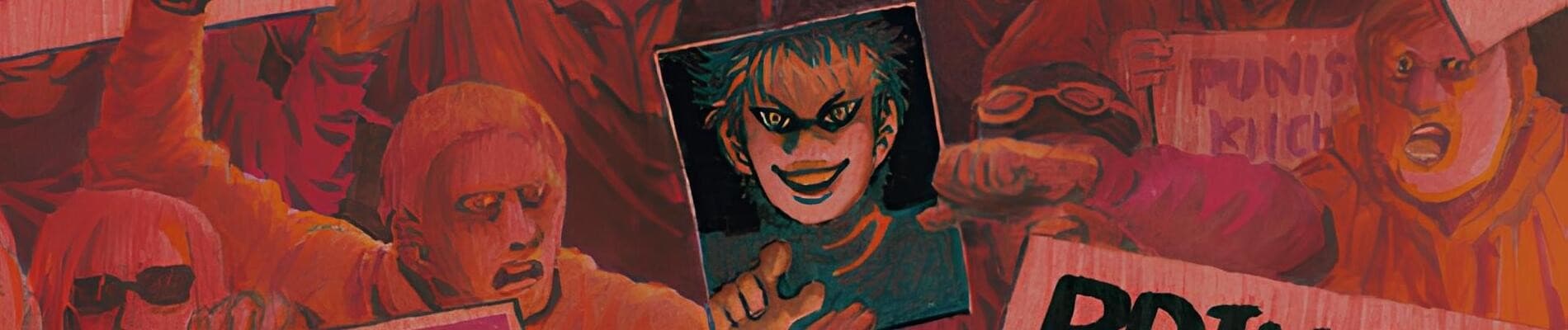
PREFACE: "There's Daddy, Mommy, and Kiichi. Daddy was born in the mountains, Mommy grew up by the sea, and in the city, we held hands before we even met. But in the end, it led to your birth, Kiichi." My experience with Kiichi was a journey of ebb and flow, its story often teetering between highs and moments of lag during its buildup arcs. While these preludes occasionally dragged, once the narrative took flight, it became a dopamine ride. The charm lies not only in Kiichi's growth but in how the political rhetorics has been presented in an unadulterated manner from the lenses of the Japanese side of things.
--- PROTAGONIST: "Kiichi, born on the day of prediction, would turn out to be a man of unparalleled virility." Initially, Kiichi appeared unremarkable, almost a cliché of the "cool, edgy protagonist" often seen in seinen works. Yet, a significant shift occurs during the time skip to his adolescence. While early story arcs faltered due to their weak buildup, Kiichi's evolution shone as a highlight, breaking free from these narrative shortcomings. My perception of him transformed as he began to break out of his shell, connecting with characters like Kai and facing his past traumas. These experiences shaped his erratic behavior — vulnerable, and prone to adopting others' beliefs. But fast forward to Kiichi VS, and he has matured, adopting a logical, more socially conscious demeanor. This transformation not only marked a shift in Kiichi’s character but also in how I saw him. Juxtaposing the naive child he once was with the man he became underlines a factor in play: the weight of responsibility and duty often demarcates childhood from adulthood. Having endured more than most could fathom, Kiichi’s young mind grappled with the harshness of mortality. In response, he shouldered burdens far too heavy, attempting to mimic adulthood’s facade while subconsciously yearning for security and simplicity. By the close of the first book, traces of change begins to appear.
Kiichi VS presents a matured Kiichi whose sparks of rebellion flares more into flames of life upon meeting his soulmate. This love reawakens a long-lost innocence, softening his hardened resolve and drawing out a new tenderness. The battle within him shifted, from a life driven by rage against death to one focused on cherishing life. Through love, Kiichi's understanding of life and death matured — not as opposites but as intertwined facets of living fully. During the Mt.Fuji spreads we see Kiichi was nothing more than a normal human, shouldered by weights of responsibilities, weights of his parents death, which he sub-consciously blamed himself, breaking away from those shackles of duties, he broke free. Where he lowered himself to the normality of the typical, he wanted love the final piece which defined him. All he ever wanted was Love, a forgotten chunk.
--- POLITICAL VIEWS: It wouldn't be a big surprise if Kiichi never received an official english translation or high recognition especially in the west, considering how Arai unveiled the truth of “Americanization” in the Japanese society. Much like Billy Bat, Kiichi stood firmly when it came to showing the dark side of America and it's actions without sugar coating or pulling the punches. The prequel book dives into the corrupt facets of Japanese Government, shedding light to the ignorance of the upper echelons on the societal issues like Homelessness, Homicide, Corruption, Political Exploitations etc, while giving more emphasize on Child Prostitution. My views about the manga took a big turn from this moment on, presenting the true nature of the government and society to such a depraved activity while the society is being ignorant to it and not batting an eye while the government is taking no measures about it but also unsurprisingly having an active participation in the very act of child prostitution itself. This isn't fiction this is reality in Japan; Child prostitution or CP isn't a big deal in Japan, By the gradual molding of the laws and judiciaries this case is now being overlooked and being turned into the new normal. An example to jog your memory is the Controversy of the Rurouni Kenshin Mangaka, who held a surprising amount of CP in his custody but got off the leash with a $1000 fine. On the Sequel Story, Kiichi VS the story takes a turn more towards the international stage, by bringing in the “American” aspect to the play. American government holding a special treatment in Japan where any crime done by the US Army officials wouldn't be an issue as America is the scaffold for Japan. Arai didn't go softly when expressing this issue into his manga, boldly showcasing what the Americans have done to the Japanese society. The Mad Cow disease is another example in the manga on how an American Capitalism driven more importance to business than human lives.
Even after Japan became republic and democratic the direct influence of another country (America) meddles with their decision making, a dog in the leash scenario. Arai tries to put the limelight into this problem which most Japanese people are ignorant about or just didn't know about. The story is more political than you think it is. The political problem's being overlapped with each other into fooling the people with the facade of “it’s for the betterment of the nation and people” is more than natural and this doesn't apply to any one nation but many. While most of the people reading this would be not understanding what this all means especially the American influence on Japan watch this video.
The manga comprises of two parts: Kiichi & Kiichi VS. It always boggled my mind as to why the sequel manga's title was named Kiichi VS? VS in usual terms means versus, but who is Kiichi fighting against? Could it be with himself, or could it be the invisible figure without a singular identity, The Social Construct a.k.a The Society. The invisible figure which manipulates the masses?
--- FINAL VERDICT: Lke i previously said, my experience with Kiichi as a whole is filled with ebb and flow. The story seriously lacked in an interesting build-ups which made the whole journey a rough one, not necessarily a bad one... or atleast “Kiichi” picked the drowning ship up. Also let me set this straight, Politics in a story is always a good thing, Politics or Governance is one of the best form for the depiction of Human vices and Human virtues in tantamount scale. It's one of those spices which elevates the narrative exponentially. The story is more grotesque and realistic than I initially thought it to be. Arai did a great job working with the expression of his Political and Social views of Japan while trying the best to be unbiased. The vileness of the human society and the corrupt mechanisms inbuilt into this system which sub-consciously made the people weak in the spine, lacking the push to criticize against, there was a need for revolution, a need for the VOICE, This made Kiichi. The story was really well put, bringing real life references to put up a sliver of realism to the already grotesque setting. The manga was phenomenal. Kiichi as a protagonist was exceptionally crafted, growth from a rebellious uncontained fire to a polished diamond, Kiichi's growth is something to be witnessed. Became one of my favourite protagonist all over the animanga genre. A great manga but definitely not the pinnacle nor the greatest piece of literature, the strength's were often overshadowed by the flaws present, but it wholly presented what the story meant surmounting those obstacles.