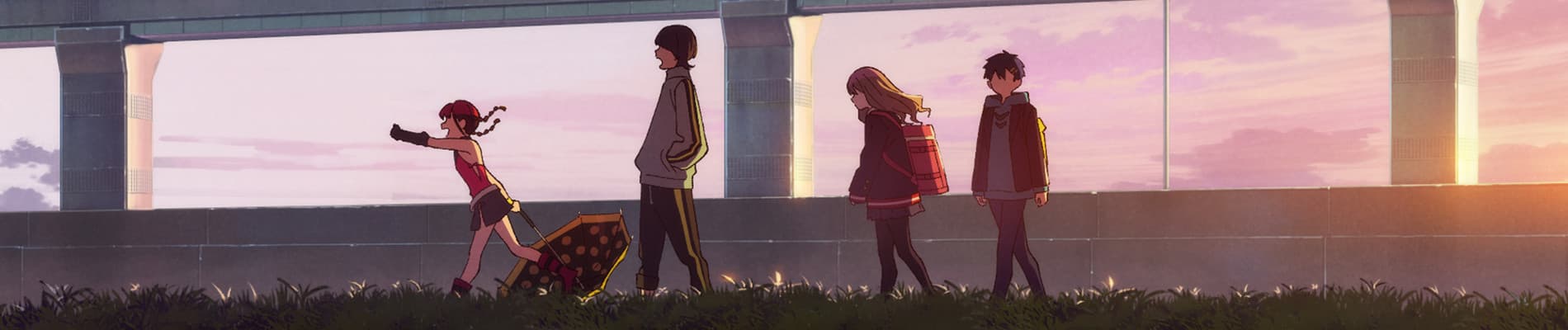
Not long ago, I had watched the previous season, SSSS.Gridman, so I remembered that I didn’t like the sequel much, mainly because of how different they are from each other. However, rewatching it made me realize that this installment also has a lot to offer, although I still like SSSS.Gridman much more.
Repeating what I mentioned about SSSS.Gridman, the "SSSS" in the name comes from "Superhuman Samurai Syber Squad", a nod to the American adaptation of "Gridman the Hyper Agent." However, there’s also another meaning addressed in Gridman’s respective review. In Dynazenon, the "SSSS" stands for "Scarred Souls Shine like Stars," which makes sense when you consider the main cast.
From the beginning, we can see that our protagonist, Yomogi Asanaka, is someone who rarely spends time with his group of friends because he’s constantly working. However, it’s not that Yomogi’s family has financial problems; it’s simply that he feels uncomfortable with the idea of his mother dating someone who could potentially become his new father.
Yomogi becomes interested in a girl, Yume Minami, a girl who frequently invites boys to meet her at a certain place, though she never shows up. Minami eventually invites Yomogi, and he accepts, even waiting for her for 40 minutes in the rain.
Gauma, a starving homeless man to whom Yomogi had given bread, confronts Minami during this situation. Amid their conflict, a Kaiju appears. Gauma summons a giant robot that traps the three of them, along with a hikikomori named Koyomi Yamanaka, who happens to be nearby. At first, they are hesitant about fighting, but by the second episode, they are determined to prevent deaths caused by the Kaiju, who are led by a group of Gauma’s former friends. Throughout the story, the protagonists open their hearts, seek answers, fight Kaiju, and battle their own inner struggles, each with their respective challenges.
IF YOU’RE INTERESTED IN THE STORY, I RECOMMEND SKIPPING THE FOLLOWING SPOILERS
In Gridman, there were two characters who caught my attention: Yuuta and Akane. This time, there was only one character in particular: Minami. I understand that at the beginning of the story, you might think she’s a bad person, and I get that, but I also understand her.
Minami expresses her pain by doing the same thing her sister did to her—breaking promises. However, once she becomes part of the Dynazenon group, she decides to change. She stops ignoring her sister’s death and chooses to seek answers instead of suffering internally. There’s a point where Minami is unsure if her sister died accidentally or by suicide. Like in the previous installment, there’s an episode where everyone is in a dream.
In this dream, they relive their pasts. Here, each character confronts their respective struggles or what haunts them the most. While some, like Gauma, decide to repeat their past decisions, others, like Minami or Koyomi, choose differently. Koyomi decides to act opposite to how he did before, while Minami decides to ask questions. She’s not there to change the past; she knows there’s no turning back and that no matter what she does, it’s a false world. Instead, she chooses to ask her sister why... but the answer Minami arrives at herself is far more interesting.
The truth is, it doesn’t matter why her sister died—whether it was an accident or suicide. The fact is, her sister is gone, and Minami wishes she could’ve spent more time with her. By accepting this reality, Minami is finally able to move forward. Symbolically, the knot between the two ankhs is untied, representing her letting go. This is reflected in how she stops taking out her pain on others and begins to decide the direction of her own life while cherishing who her sister was. I’m sure anyone who has experienced something similar understands Minami’s behavior. The death or near-death of a family member can affect you much more than you might imagine, even if you didn’t interact with them often.
It’s curious how the character I liked the least the first time I watched ended up becoming one of my favorites, and how Gauma, who I initially liked the most, ended up being the one I liked the least. I didn’t talk about all the characters because I think Minami carries the best parts of the anime, though Gauma and Yamanaka are also characters with plenty to discuss.
I thought it was cool that the remaining group members each had an "S" somewhere on their bodies. As the title suggests, "Scarred Souls Shine like Stars." Although only Yomogi and Minami’s marks are shown, I’m sure Asukawa and Yamanaka also have theirs.
The worst aspect, I believe, is that the protagonist is relatively simple compared to the other characters. However, because he isn’t given too much focus, characters like Minami, Yomogi, and Gauma are allowed to shine, which I greatly appreciate since Minami became one of my favorite anime characters. I also believe that the fights in Gridman are better since this series places more emphasis on character development than on the mecha battles themselves.
I recommend SSSS.Dynazenon. I think it’s a work that, like its predecessor, discusses important themes. The characters are much deeper than they might initially appear. It’s a series where you might even find yourself identifying with a character’s situation—and who knows? Maybe it could help you move forward, no matter how difficult it seems.
29 out of 29 users liked this review