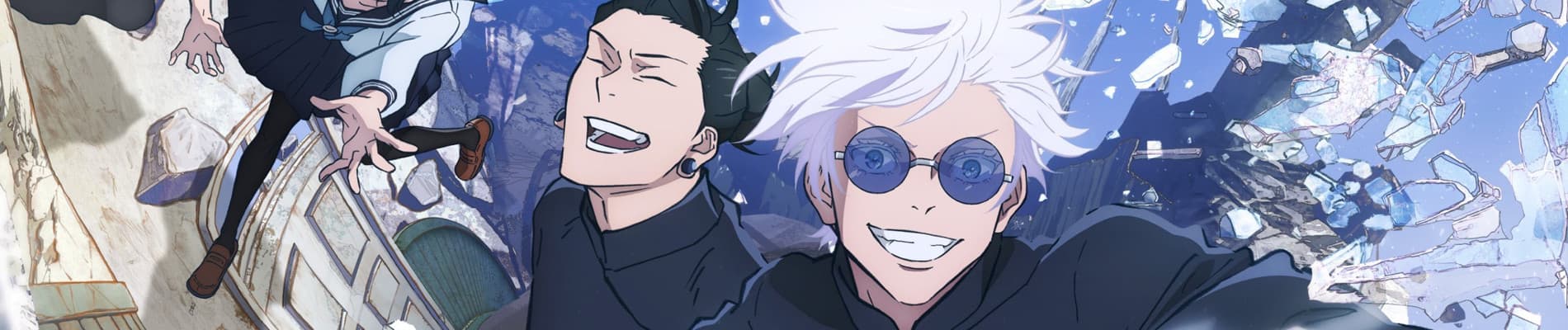
Jujutsu Kaisen Season 2 boasts stunning animation throughout. However, it falls short in terms of character development and thematic depth. The season begins with a promising flashback arc, though its conclusion feels rushed. I will warn one, final time. This is a SPOILER review, do not read further if you do not wish to have the show spoiled.
Geto's rapid descent from seeing people as individuals to viewing most of the population as a different species feels abrupt and unconvincing. This shift in his character needed more time to flesh out, but it is still a well written arc.
Before the Shibuya Arc, we get a small story about Mechamaru. His revelation as the traitor was set up well in Season 1 and his motivations are both compelling and understandable.
However, this doesn't get the focus it deserves because Mechamaru is abruptly killed off. This is emblematic of a broader issue found throughout the season. Compelling characters with unique abilities and potential for growth and thematic exploration are often killed off for a cheap tug at the heart strings or shock value.
Mechamaru's character had so much more potential, as did his fascinating power set, yet he's killed off before any of that can be explored and any viewer can get significantly invested.
The Shibuya Arc starts off strong, particularly with the tension built around Gojo's fight. The animation and direction are excellent, and the battle is well-executed. Gojo's defeat is believable, especially given his reluctance to harm civilians, which is consistent with his character and contrasts well with Geto—or at least, who we thought was Geto.
The series later reveals that Geto had actually died and his body was possessed by an evil spirit. This twist does make logical sense, and I had actually predicted it, but it does pose a significant issue: our main antagonist is now a complete nobody with no personal connection to any our cast. The new antagonist lacks the depth and personal connections that made Geto so compelling, especially his relationship with Gojo and his background as an ex-sorcerer. The antagonist remains underdeveloped throughout most of the season and only gets fleshed out in the finale, and I would argue he still fails to become a truly engaging character.
From this point on, the series starts to decline significantly. The show proceeds to kill off numerous characters, including newly introduced ones with intriguing powers like Naobito Zenin, as well as returning characters like Nanami and Nobara. I have issues with both of these choices.
Eliminating newly introduced characters feels lazy and doesn't contribute much to the story. We haven't had the chance to become invested in them, which makes it disappointing after seeing their unique powers and personalities.
The decision to kill off established characters is even more problematic. Like with Mechamaru, Jujutsu Kaisen prematurely ends the stories of characters who haven't completed their arcs. In the case of Nobara, her entire backstory is hastily crammed in just before her death, which feels forced and poorly executed.
Nanami lacks meaningful character development and seems to have been killed off primarily to advance Itadori's character, which is a weak justification for such a decision. Itadori did not need additional motivation to despise Mahito or seek revenge, with Junpei's death already serving that purpose effectively. Nanami's death has almost no discernible impact on Itadori's character growth. However, the scene itself is well-directed, with the juxtaposition between Nanami's dream vacation and the brutal reality he faces creating a powerful and memorable visual contrast. The use of jump cuts between these two starkly different scenarios is a standout choice, and it's a fantastically executed scene.
The deaths of Nanami and Nobara function as a shallow repetition of Junpei's demise, which feels like a missed opportunity considering how compelling these characters are.
The series later attempts to draw a connection between Itadori and Mahito, suggesting they are "the same" because Mahito kills people without reason while Itadori saves them without reason. While it's understandable for a villain like Mahito to view things this way, what's truly surprising—and somewhat nonsensical—is that Itadori agrees with this comparison. This basic notion feels more suited to a middle schooler's idea of depth than a complex narrative.
It's worth pointing out that killing and saving are fundamentally different actions. Killing is proactive and permanent, particularly in Mahito's case, while saving is reactive and temporary. This basic distinction should be apparent.
The fundamental difference between killing and saving extends beyond mere action and reaction; it encompasses moral implications and intent. Killing involves taking a life intentionally, causing harm and ending someone's existence. Saving, on the other hand, involves preserving life and preventing harm, reflecting at least some degree of innate compassion and desire to protect others. Killing and saving are outright opposites; considering them 'the same' is not just oversimplifying but also fundamentally absurd. While there's undoubtedly a connection between the two, it's a nuanced relationship that goes beyond simple similarity. Viewing opposites as the same is a childish notion that overlooks the clear distinctions between the contrasting concepts.
The animation and direction really steal the show here. I have nothing but respect for the hardworking staff who pulled off such amazing visuals, especially considering the awful conditions they worked under. You can tell they poured their hearts into making every fight stunning.
The animation is smooth, the camera work is dynamic, the colors are vibrant, and overall it is beautiful. It's clear the team knew what they were doing and wanted to make every episode visually captivating.
However, while the visuals are undeniably impressive and contribute significantly to the show's appeal, they can't fully compensate for the shortcomings in writing. Despite spanning two seasons with over 20 episodes each, the series falls short in exploring its themes deeply and developing its characters beyond surface-level traits. For a show with this much runtime, its superficiality is disappointing.
If you're here for the eye-candy, you're in for a treat. But if you want a story that's as strong as the visuals, you might be left wanting more.
32 out of 37 users liked this review