Kingdom
a review by AlexSonicfun2012
a review by AlexSonicfun2012
A manga that aspires to be a Chinese seinen masterpiece but ends up as a shōnen version of Dynasty Warriors — and not even a great one at that. I’ve managed to read all 839 chapters of Kingdom, along with its short chapters outside the main series. Before delving deeper into this review, let me clarify: if you’re one of those who truly love Kingdom, that’s perfectly fine. But this review may not resonate with you. That said, I hope you’ll hear me out before dismissing my perspective.
________________________________________
Initial Expectations
When I first heard of Kingdom, it was through the relentless praise it received in videos and top manga lists. Many called it one of the best seinen manga of all time, lauding its "intelligence" and "thought-provoking" qualities. Unfortunately, after reading the series, I found that it falls short of those claims. Yasuhisa Hara, the mangaka, was once an assistant to Takehiko Inoue, the genius behind Slam Dunk, Vagabond, and REAL. Yet Hara seems to have learned little from Inoue’s mastery of storytelling, producing a work that barely deserves the seinen tag.
________________________________________
The Premise and Simplification of History
The story is a fictional adaptation of China’s Warring States period, culminating in the unification of China under Ying Zheng, the King of Qin. The tale begins with Xin, a war orphan who dreams of becoming a "Great General of the Heavens," and follows his rise as he aids Ying Zheng in reclaiming his throne and conquering rival states.
On paper, this premise has enormous potential. Ancient China’s rich history is a treasure trove of intrigue, betrayal, and philosophical depth. A seinen manga could have explored the intricate politics, societal structures, and existential dilemmas of this era. Instead, Kingdom simplifies everything, turning complex historical events into a repetitive, formulaic shōnen power fantasy. It’s like taking the nuanced philosophy of The Art of War (學者不識其範、完範者可以命世)—and reducing it to "swing your sword harder."
________________________________________
Art: Spectacular but Occasionally Silly
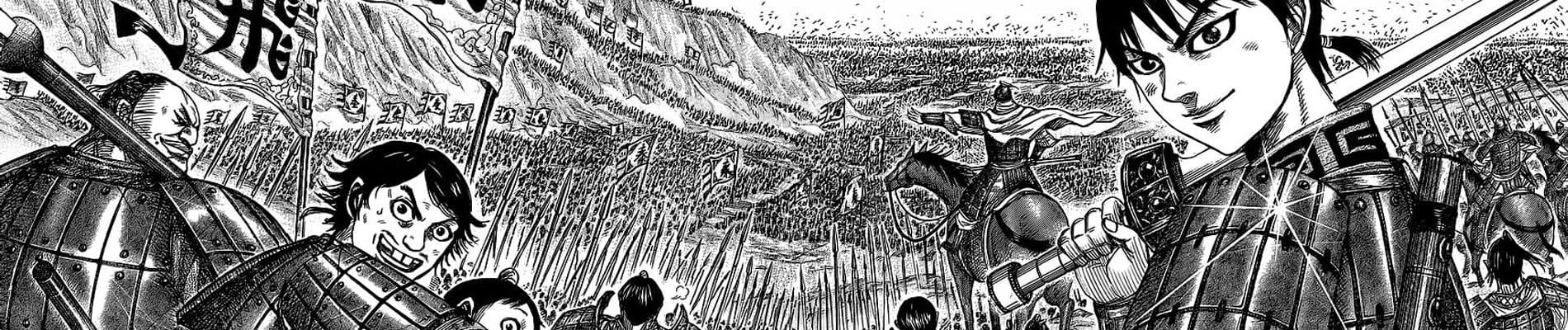
I’ll give credit where it’s due: Yasuhisa Hara’s art shines in depicting large-scale battles. Panels showcasing thousands of soldiers, intricate costumes, and dramatic battle sequences are breathtaking. Few mangaka can rival Hara’s ability to illustrate the sheer scale of war.
However, the art often undermines the intended seriousness. Some character designs border on parody, resembling Dynasty Warriors caricatures more than historical figures. I couldn’t help but hear the Dynasty Warriors OST in my head while reading—and it fit a bit too well.
In trying to emulate traditional Chinese art styles, the manga occasionally devolves into visual absurdity. It’s like an awkward middle ground between The Romance of the Three Kingdoms (三國演義) and a flashy JRPG.
________________________________________
Pacing and Repetition
One of the manga’s biggest flaws is its pacing. The story falls into a repetitive cycle:
This rinse-and-repeat formula dominates all 839 chapters. The "Coalition Arc," often touted as the series’ best, epitomizes these issues. On paper, it’s an ambitious narrative with multiple factions and grand stakes. In execution, it’s just another oversized war arc with little strategic substance. The battles rely on brute force and plot armor, with characters surviving due to their flashy designs rather than any tactical brilliance.
As Confucius once said: “有幾念學也,不早不慢;有幾念武也,無語無道。” (“There is thought in learning, there is timing in warfare; yet without balance, there is neither wisdom nor success.”) Kingdom misses that balance entirely.
________________________________________
Character Development: A Shōnen Protagonist in Seinen Clothing
Xin, the protagonist, is the quintessential shōnen hero: brash, simplistic, and driven by dreams of becoming "the strongest." Over 839 chapters, he undergoes almost no meaningful growth. He solves problems with brute force, rarely reflecting on his actions or evolving as a person.
Side characters fare little better. Most exist to serve Xin’s journey, their personalities reduced to single traits or gimmicks. The only standout is Qi Wang, whose charisma and complexity make him a rare bright spot. Unfortunately, his early death robs the series of one of its few genuinely compelling characters.
By contrast, Vagabond excels at character development. Takehiko Inoue’s portrayal of Musashi Miyamoto humanizes the legendary swordsman, exploring his inner struggles and growth. Musashi’s journey is deeply philosophical, reflecting on themes of identity, purpose, and mortality. As Musashi himself says, “我要越過江海,則需踏实地上。” (“To cross the great seas, one must first walk firmly upon the earth.”)
Kingdom offers no such introspection. It’s all flash and no substance, with characters spouting clichéd lines about "greatness" while showing little depth.
________________________________________
Themes and Philosophy: Shallow Waters
Seinen manga like Berserk and Vagabond excel because they tackle profound themes with maturity. Berserk’s Golden Age arc uses war to explore trauma, ambition, and human fragility. Guts fighting 100 soldiers is harrowing, highlighting the brutality of war. In contrast, Kingdom glamorizes its battles, treating war as a stage for flashy moves and heroic posturing.
Even Chinese philosophy, which could have enriched the narrative, is sorely underused. The Warring States period is a goldmine for exploring Confucianism, Taoism, and Legalism. Instead, Kingdom opts for simplistic morality and superficial politics. It’s as if Hara read The Analects (訓“不知生,許語死”) and thought, "Too complicated. Let’s just have Xin punch someone."
________________________________________
Conclusion
Kingdom aspires to be an epic retelling of China’s Warring States period but ends up as a generic shōnen story wrapped in a seinen disguise. While Hara’s art captures the grandeur of war, the repetitive storytelling, shallow characters, and lack of thematic depth hold the series back.
For those seeking a truly profound exploration of history, philosophy, and human nature, I’d recommend Vagabond or Berserk. Kingdom is best enjoyed with low expectations, perhaps with the Dynasty Warriors OST playing in the background. As a wise man once said: “奇能者,過者究乎空。” (“What strives for greatness but stumbles, ultimately falls into the void.”)
Kingdom Live-Action Movies
On Discord, I had the pleasure of watching all three Kingdom live-action movies with my cultured friends. While many claim that the One Piece Netflix adaptation broke the "curse" of anime and manga adaptations, I respectfully disagree. In my view, the adaptations that truly shattered this so-called curse include Riki-Oh, Oldboy, and, of course, the Kingdom movies.
These films are a marvel. They took what many consider a mediocre seinen manga and refined it into something greater. Like a skilled artisan following the Confucian principle of 工匠精神 (gongjiang jingshen – “the spirit of craftsmanship”), the filmmakers trimmed the excess fat of the manga, amplified its best scenes, and delivered a distilled version of the story that shines brighter in live action.
The cast is uniformly solid, with every actor embodying their role with conviction. The directing is competent, and the production values are exceptional, especially by Japanese standards. Perhaps the greatest triumph lies in the fight scenes. These manage to strike a harmonious balance between realism and the dramatic flair of shounen. They create a spectacle that knows not to take itself too seriously while remaining captivating. As the ancient Japanese saying goes, “術は意に通じ、意は気に通ず” (jutsu wa i ni tsūji, i wa ki ni tsūzu – “Skill connects to intention, and intention connects to spirit”), and these fight scenes embody that spirit of purpose and energy.
The writing is another standout aspect. With Kingdom's original creator Yasuhisa Hara co-writing the scripts alongside Shinsuke Sato and Tsutomu Kuroiwa, the story feels both authentic and streamlined. However, the movies are not without flaws. Some characters feel one-dimensional, and certain scenes from the manga had to be sacrificed to fit the constraints of a film runtime. Yet, these are minor quibbles when weighed against the overall experience.
In my opinion, these movies are the definitive way to experience the story of Kingdom. They elevate the material into an epic live-action saga that deserves more recognition and respect than the One Piece live-action adaptation. As Laozi reminds us in the Tao Te Ching, “合抱之木,生于毫末;九层之台,起于累土” (A tree as great as a man's embrace springs from a small shoot; a terrace nine stories high begins with a pile of earth). The Kingdom movies honor their humble manga origins while building something grand and enduring.
That said, Kingdom IV: Return of the General is the weakest of the three—the pacing suffers, and while it gives Wang Qi plenty of screentime, it sidelines too many others, undermining the ensemble dynamic.
If you’re looking for a cinematic epic that blends action, drama, and spectacle with a touch of grounded realism, these films are an absolute must-watch.
47 out of 77 users liked this review
