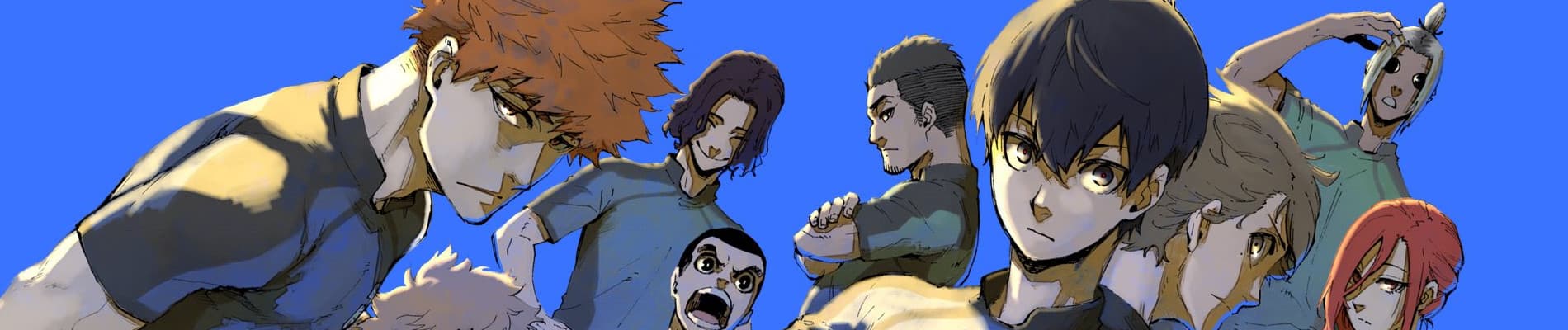
Blue Lock
a review by AlexSonicfun2012
a review by AlexSonicfun2012
I am up to date with both Blue Lock and its side story, Episode Nagi. Written by Muneyuki Kaneshiro, known for works like As the Gods Will, Bokutachi ga Yarimashita, and Jagaaaaaan (some of the best yet underrated manga I’ve ever read), and illustrated by Yusuke Nomura, a former assistant to Hajime Isayama (Attack on Titan), this series promised something revolutionary for the sports genre. However, despite the initial praise for its unique premise, Blue Lock feels like a derivative work, mishandling ideas borrowed from superior narratives and presenting them in a tasteless way.
________________________________________
The Premise: A Flawed Foundation
Blue Lock starts with an intriguing premise: following Japan’s disastrous defeat at the 2018 World Cup, the Japan Football Union launches a radical project to create an "absolute ace striker." By isolating 300 of the country’s most promising youth players in a facility and pitting them against each other, they aim to forge the ultimate goal-scorer who embodies pure egoism and can single-handedly carry Japan to victory.
At first glance, this might seem exciting, especially with the tagline, "The best offense is a good offense." But when you examine the premise closely, it’s riddled with issues:
Parental Consent and Mental Health Neglect: How were the parents okay with sending their kids to an isolated facility, stripped of phones and freedom, potentially shattering their mental health? While higher-ranked players eventually gain privileges, the setup’s disregard for basic well-being undermines realism.
Premise Contradictions: The project claims to focus on creating the ultimate striker, eliminating 299 players in the process. Yet, as the story progresses—notably before the U-20 World Cup arc—players are suddenly forming teams, playing as midfielders or defenders, and even returning after elimination. This undermines the core "winner-takes-all" premise.
Misinterpretation of Football: Egoism may work in individual sports like boxing, where "It’s not the size of the dog in the fight but the size of the fight in the dog" applies. But football is inherently a team sport. Even the greatest players like Messi or Ronaldo rely on their teammates to succeed. The story’s attempt to blend individualism with teamwork feels forced and contrived, diminishing its psychological appeal.
________________________________________
Lack of Stakes: Where’s the Drama?
Sports narratives thrive on stakes. In classics like Ashita no Joe, the threat of physical and emotional ruin gives the story weight. Blue Lock tries to introduce stakes by claiming that losing players will be barred from representing Japan professionally. Yet, disqualified characters often return, erasing any tension.
If the goal was to create an ultimate team rather than a striker, this should have been established from the start. Clear rules and a structured progression system—laid out by Jinpachi Ego or via documents given to players—could have added intrigue and legitimacy to the narrative.
________________________________________
Characterization: Flat and One-Dimensional
The characters in Blue Lock fail to stand out:
Yoichi Isagi (the protagonist): Bland and forgettable, Isagi has no depth. He’s unremarkable.
Jinpachi Ego: Reduced to a caricature of a "mad genius," Ego’s over-the-top monologues lack substance.
Supporting Cast: Nearly all characters share the same goal—to be the best striker. This uniformity strips them of individuality. Their backstories add little to the narrative, making it hard to care about their journeys.
Anri Teieri, the sole prominent female character, exists primarily to be objectified, further highlighting the series’ lack of meaningful character development.
_______________________________________
The Art: Generic and Edgy
While Yusuke Nomura’s art shows technical competence, it’s overshadowed by poor design choices:
The "monsters" that supposedly symbolize players’ inner egos come off as laughable rather than intimidating.
The glowing eyes and exaggerated expressions make the story feel more like a parody than a psychological thriller.
Character designs are so indistinct that names are frequently displayed to avoid confusion, reflecting a failure in visual storytelling.
Even the facilities and match settings lack variety, further diminishing the immersive quality of the manga.
_______________________________________
A Game of Missed Opportunities
Football is called the beautiful game for a reason. Legends like Pelé said, "Success is no accident; it’s hard work, perseverance, learning, and teamwork." Blue Lock tries to reinvent the genre but forgets the fundamentals of football—cooperation, strategy, and heart.
In contrast, series like Haikyuu!! excel by celebrating teamwork and building friendships, making the sport itself appealing. Even One Outs (a psychological baseball manga) creates tension and stakes through its protagonist’s cunning tactics.
________________________________________
Final Verdict
Blue Lock had the potential to revolutionize sports manga but squanders it with shallow characters, a flawed premise, and lackluster stakes. It’s neither a compelling psychological thriller nor a tribute to the beauty of football.
My Recommendations for Quality Sports Manga:
Ashita no Joe: A gripping boxing tale with real stakes.
One Outs: A psychological masterpiece set in baseball.
Slam Dunk: A heartfelt basketball story.
REAL: A poignant exploration of wheelchair basketball.
In football, the first rule is to "play as a team."Unfortunately, Blue Lock ignores this, making it one of the worst sports manga I’ve ever read. Save your time and pick something that respects the spirit of the game.
34 out of 51 users liked this review
