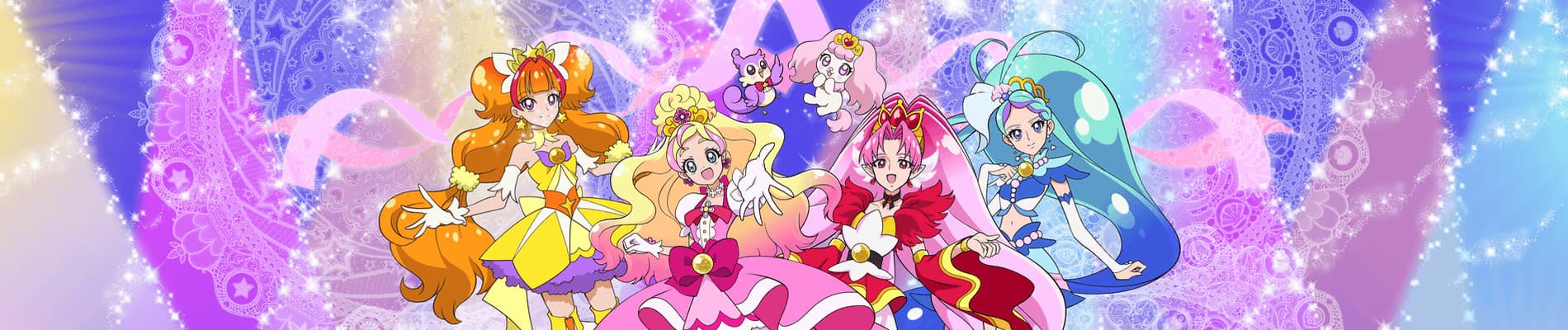
My journey of discovering Precure is almost coming to an end, as I recently finished Go! Princess Precure, which is the twelfth series in release order. It’s generally acknowledged as at least one of the best series in the franchise, and I absolutely agree. It doesn’t invent much that’s new but revisits several series tropes and brings them to their maximum brilliance, with some exceptions.
From a technical standpoint, Go! Princess Precure features some of the best action scenes in the franchise. There are many truly exhilarating fights, including those in the first two episodes, the ones where Close acts as the boss, the final battle with Lock, the battles against Dyspear, and many more. The atmosphere is also incredible during moments like episodes 38-39, Kirara’s proclamations, Towa’s imprisonment in the cocoon, Dyspear and Twilight’s intimidating moments, and so on. With 50 episodes, there are some weaker ones, but the overall quality remains high.
Musically, the OSTs excel at making the strong, intense scenes even more alive and emotional. I really like the opening in terms of both visuals and music. It has the significant merit of changing visually as many as nine times throughout the series to best reflect the ongoing story events. In particular, it manages to portray the relationship between Haruka and Kanata. Regarding the two endings, I appreciate the continuous evolution of the 3D models compared to previous years; musically, I like them, though they’re not extraordinary to me.
The henshins (transformations) are all truly spectacular, accurately reflecting the characters’ personalities. Cure Flora’s highlights her love for flowers; Mermaid’s her majesty and connection to the ocean; Twinkle’s her desire to shine and her modeling skills; and Scarlet’s her fiery passion. My favorite is Twinkle’s because I love her too much and how what I’ve mentioned is emphasized. An important strength of Go! Princess Precure is that in various episodes, especially those with major events, the transformations are shortened, or only the protagonist’s henshin is shown. In other series, this is much rarer, and I’m glad it was handled differently here, as, while I enjoy these moments, watching them repeatedly can feel tiresome. Go! Princess Precure strikes an excellent balance.
As for the plot, as often happens, a kingdom falls under the control of a group of villains, and fairies escape to Earth to seek the Precures, who must save everyone. I liked how, from the start, it’s made clear that the ultimate goal is to become Grand Princesses. One of the elements that sets this series apart is the setting: the protagonists live at the Noble Academy, a school with dormitories where they reside. It’s a prestigious institution, difficult to enter due to the challenging admission tests and high standards of elegance it requires. This choice leads to two main consequences: the characters are only at home under specific circumstances, and the other students and their dreams are explored more deeply. Yes, because the main theme of this season is dreams and how they help individuals grow despite difficulties. Among the most important secondary characters is Yuki Aihara, an old acquaintance of Haruka’s who used to tease her about her goal but now aims to become a Grand Slam-winning tennis player. His relationship with Haruka isn’t great even now—they often bicker—but gradually, they come to see more positive traits in each other. Haruka deeply respects his dedication and scolds him harshly, calling him weak, when he gets discouraged after not being chosen as a regular player.
The series, as mentioned, allows for better understanding of other characters, such as Riko Furuya (who wants to be a director and is particularly strict with Haruka), Ranko Ichijo (who seems to want to be a top idol and is a failed rival of Kirara), Reiko Kisaragi (originally a strict supervisor of the female dormitory, afraid of dogs, who forms a strong bond with Pafu), Hanae Komori (initially without particular ambitions, later aims to create floral compositions), Kimiraro Ijuin (Minami’s arrogant childhood friend who wants to become her fiancé and seeks to become a man worthy of her), and many others. Given these examples, I feel the other members of the student council were underutilized. At school, there’s also Principal Yume Mochizuki, a key character. She’s the author of The Princess of Flowers, the book that inspired Haruka’s dream. Her development is crucial, as she explains that her story doesn’t have a true ending because she wants each person to choose what kind of princess they want to be. Another figure at the top is Shirogane, who’s essentially the school’s jack-of-all-trades and protects the dreams of those completing their journey there.
Outside the school, notable characters include Stella Amanogawa, Karin Akehoshi, and Bauanne Baurollo, pivotal to Kirara’s development, as well as the Kaido family, Tina and Kyoko Tachi, who help her find her own dream, and the Haruno family. However, the queen of the supporting cast is Yui Nanase, Haruka’s first friend at the new school, the first Earthling victim of Dys Dark, and the first non-Precure to discover their identities. Throughout the series, despite being unable to assist in battles, she stands by her friends, supporting them in difficult times and building meaningful relationships with everyone, especially Towa and Haruka. She’s grateful for being allowed to stay with them and admires them closely as they protect everyone’s dreams. Her goal is to become a children’s book illustrator, a path she momentarily loses sight of, forgetting the most important things, but she finds her way back through children drawing together. One day, she hopes to narrate the Precures’ exploits, which she ultimately achieves, as seen in the finale. She plays a crucial role in the final arc by telling all the Noble Academy residents about how the Precures fought for their future. She even manages to free herself from despair on her own and saves everyone. The hope generated by the freed people then allows the protagonists to win the final battle.
From the Hope Kingdom, there are the mascots Aroma and Pafu. Aroma has moments where he is overly disrespectful toward Haruka, but aside from that, he’s helpful and strives to improve as a butler. Pafu is adorable, always does her best, and forms lovely bonds even outside the main group of protagonists. It’s a shame we didn’t see their human forms more often. Overall, they’re a very successful mascot duo. Also worth mentioning is Miss Shamour, a competent teacher who helps the Princess Precures when they need support. She also teaches Towa and Kanata skills like playing the violin and plays an active role in Shut’s redemption, helping him improve his makeup skills.
Finally, there’s Kanata, the prince of the kingdom. He contributes directly multiple times, even fighting the antagonists and sacrificing himself in one instance. His existence is pivotal because he’s the one who encouraged Haruka as a child, when she was demoralized by Yuki’s bullying, to continue pursuing her dream. This is why I find the choice to make him lose his memory and become an ordinary person brilliant: he denies his former self, who valued dreams and hope so deeply, and even asks Haruka to stop wanting to be a princess, not wanting to see her suffer anymore. Later, he regrets this decision, as it emotionally crushed her, but seeing her recover helps him finally regain his memories. It’s unfortunate that the romance between him and Haruka never fully developed, but given the message of the finale, it makes sense. His search for his missing sister is also well done, as he ultimately helps her break free from Dyspear’s mind control by playing the same melody they used to play together as children on the violin.
As for the antagonists, I think they were well-executed, although there are better examples in the franchise. The leader of Dys Dark is Dyspear, whom I easily consider one of the best Precure bosses, mainly for two reasons. First, I appreciate that she is the embodiment of despair itself, which logically ties her proximity to the Hope Kingdom, as hope and despair are closely linked—two sides of the same coin. Second, she is very intimidating, such as when she arrives on Earth and imprisons Towa or during her battles against the Precures; in general, she often conveys a sense of unease. She is also highly manipulative, using Towa’s dream of becoming a Grand Princess to lure her into the Forest of Despair.
Then there’s Close, who surprised me. At first, he seemed like the typical early-series villain who’s mocked by everyone and then eliminated after a desperate attempt to defeat the Precures. However, despite his strained relationship with Dyspear, she unexpectedly resurrects him after Lock’s defeat, and he becomes a truly formidable opponent. Not only does he grow much stronger, but he also devises intelligent plans that put the protagonists in serious trouble. Despite allowing himself to be absorbed by Dyspear, after her defeat, she entrusts him with the task of plunging the world into despair. He becomes the series’ final enemy, facing Cure Flora, his true rival from the very beginning. She was the one who started his string of defeats and foiled all his plans. He despises her because, despite all adversities, she never gave up and kept pursuing her dream. In the end, Haruka decides not to fight him but to talk to him. She realizes that defeating him is pointless because even if she does, he will return. Instead, she chooses to acknowledge his existence—that of despair itself—and accept it as part of life.
Life isn’t a fairy tale; people will inevitably face unhappiness in one way or another. Haruka knows this because she has experienced it multiple times. What matters is not being overwhelmed by it. This is the most beautiful message the series conveys and marks the end of hostilities between these two characters. It’s a highly metaphorical and profound conclusion. Close leaves, understanding with disgust that he will never be able to plunge her into despair entirely, but he casually promises that he will return. At this moment, I see despair personified, content no longer to be demonized but accepted as an inevitable part of life.
The third antagonist is Lock, revealed to be a vest that took possession of a fairy’s body. He has a rather violent personality and harbors resentment toward Dyspear, who sees him as a mere pawn. Taking advantage of her weakening after the battle with the Precures on Earth, he retreats to the Forest and decides to become the king. He undergoes physical growth and displays the ability to split into clones, a technique that allows him to steal the Dress Up Keys. The Precures, now unable to transform, must strive to recover the items that were taken from them, and they succeed. This sets off a grand battle against Lock in his final form, at the end of which he is defeated. He is resurrected and manipulated by Dyspear, but thanks to the fairy he possessed and the protagonists, he frees himself and sides against Dys Dark.
The fourth antagonist is Shut, who serves as the comic relief for much of the series. After Twilight's appearance, he becomes her lackey; then Lock looks down on him, and later, even Close does the same. This causes a decrease in the frequency of his attacks, and he devotes himself more to his hobby—makeup. He even takes lessons from Miss Shamour. Because of this, Dyspear also gives him one last chance. The constant devaluation he has suffered since meeting Twilight takes a toll on him. He can no longer bear the pain and decides to unleash his hatred toward the world. However, as he loses control, it is pointed out to him that the thing he values most—beauty—has vanished. He is defeated and begins to reflect, thanks to Miss Shamour as well. During the final battle, he stays on the sidelines for a while until his desire for revenge takes over. He lands a powerful punch on Close and, along with Lock, fights alongside the Precures.
Finally, there are Stop and Freeze, who are clearly the weak links. They have no real personalities; all they do is seal people's dreams, and the fights against their monsters are the least qualitative part of the series. To conclude on the antagonists, the animations where each of them sees people's dreams and seals them are very beautiful and convey their intent well.
Now, on to the protagonists. I’d like to start with Minami Kaido, who, in terms of her base personality, doesn’t show much originality. She is presented as the daughter of a wealthy family, is quite serious, has no apparent flaws, and has a clear future path as the heir to her parents' company. And indeed, although she has worked hard to become who she is now, she has no problems with anything; the only thing that scares her is ghosts. Because of this, it’s as if she has built a wall between herself and others due to her grandeur. Haruka will be the first to try to break through and get close to her. Their friendship makes her much less rigid and intimidating in the eyes of others, to the point where even Kimiraro, who has known her since she was a child, notices that she is now different. Minami herself acknowledges this, saying that she likes her new self and thanks Haruka for changing her. She expressed the same gratitude when dancing with her, calling Haruka her knight for saving her from a ghost. This development is fairly standard but well done; the important part about her comes later.
Minami, as mentioned, has wanted to become the future head of her family’s company since childhood and has worked hard for it. However, she has always had a special interest in the sea and its creatures. As a child, she didn’t know how to swim and nearly drowned but was saved by a dolphin with whom she formed a strong bond and named Tina. She maintained this connection over the years. Later, she is invited by her parents to a high-society party where she is presented as the heir to their company. However, here she meets Asuka Kitakaze, a marine veterinarian who is in contact with the Kaido family but has chosen not to enter a working relationship with them, fearing she wouldn’t be able to conduct her research freely under someone else’s authority. Spending time with Asuka, Minami becomes intrigued by her profession. Nonetheless, she doesn’t feel ready to give up her first dream and tries to set aside this doubt. However, she continues to show signs of unease and is revealed to have spent a lot of time researching Kitakaze’s website. This makes her feel terrible because she doesn’t dislike the work of a CEO and fears betraying her family, to whom she has always promised to do her best in that role in the future. After speaking to her mother on the phone, she cries because she doesn’t have the courage to tell her family about her new dream, even though they treat her so lovingly. In the end, with the help of Kirara and the others, she realizes that what she truly wants is to become a marine veterinarian and reveals the truth to her parents. Despite her fears, she receives their full support because that is her true dream. Clearly, in reality, not everyone has parents who would support such a decision, especially given the important role Minami had been assigned. However, I believe the message is what matters: the first dream you have doesn’t have to be your final one; it can change over time. One last thing I’d like to highlight is her bond with Tina. Seeing Minami terrified at the thought of losing Tina was impactful.
The next protagonist I’d like to discuss is Towa, who has her ups and downs. First of all, she is initially introduced as Twilight, Dyspear’s daughter, who doesn’t acknowledge any princesses other than those like her—showing only “refinement, grandeur, and elegance” without any trace of anything else. She aims to eliminate the impostors, meaning the Princess Precures, and their dreams. Her design is beautiful, as is the theme of the blue flames. When she directly engages in battle, she proves to be a formidable opponent with a strong aura and charisma. However, as Twilight, she doesn’t present any other characteristics. In her role as an antagonist, she doesn’t have any development or moral doubts; when she returns to her true self, she instantly switches from villain to hero. There isn’t the same degree of engagement present with characters like Eas, Ruru, Michiru, Kaoru, and others. Certainly, they are different types of characters, as Towa is inherently good, but my connection to Twilight is weaker. It is later revealed that she is the young princess of the Hope Kingdom and Kanata’s sister, who aspired to become a Grand Princess. However, she struggled to reach such a high level of skill, often becoming discouraged despite the support of her brother and parents, who encouraged her to smile and spent time playing the violin with her. Dyspear exploited this fragility by deceiving her and luring her into the Forest of Despair, where she was stripped of her identity and memory, becoming her "daughter."
After being freed following an important battle, she encounters her “mother” again and falls victim to despair once more, believing she has no future due to the harm she caused as Twilight. Haruka offers her support and frees her from her mental prison. I appreciated how her determination is symbolized as a passionate and vital flame, an element reflected in her transformation into Cure Scarlet and her attack. She no longer wishes to run away from her crimes; instead, she accepts them, resolves to atone, and commits to becoming a Grand Princess. This leads her to suppress herself out of a sense of duty, feeling that she does not deserve to have fun. The writer Yume and Haruka reach out to her, and Towa eventually accepts the friendship of the Precures, enrolling as a student at Noble Academy. She has various adorable traits; for instance, she shows total ignorance regarding common earthly conventions, struggles to follow school rules since she is used to being served by butlers, and slides down stair rails, admitting she always wanted to do so (peak cuteness).
She develops a lovely friendship with Kirara, who becomes her classmate and roommate. In one episode, Kirara tries her best to help her in school, to the point of becoming frustrated and exhausted due to her modeling job. Meanwhile, Towa struggles to fit in and tries to manage everything on her own so as not to trouble her friend further. In the end, they come to an understanding after a heartfelt conversation in nature. I would have liked to see even more of their school friendship explored. She also has a meaningful relationship with Minami, to whom she reveals her fear of the night and darkness, which reminds her of the times when she was Twilight. A particularly touching episode shows her trying to hide the fact that she cannot swim, and she admires Yui for her honesty. She also feels deeply saddened when Kanata loses his memory, but Haruka supports her, encouraging her to give him time and trust. Eventually, they reunite and play the violin together, just like they used to in the past.
I appreciate how, despite her ignorance of many earthly matters, Towa is not naive and is often the first to be suspicious of Close in disguise. Another important moment comes when, after seeing Shut lose everything, she recognizes that Twilight was a lonely woman who disregarded others, whereas Towa herself now wants to help him. However, I wish she had played a more central role in the final battle against Dyspear, given their shared history. That said, her combat scenes are always impressive. Despite the connections she builds, I sometimes find her a bit detached when she isn’t the focus of an episode, almost like a supporting character.
Now, let's move on to Kirara, who is absolutely my favorite character. From the moment I saw her in the first episode, I adored her design and hoped she would become a Precure—and luckily, she did! Her two introductory episodes were wonderful; I loved her personality right from the start. She comes across as aloof and uninterested, not only towards Haruka—whom she remembers for being late on the first day of school—but also toward an authoritative figure like Minami. As soon as she discovers that the Dress-Up Key might bring her trouble, she immediately returns it and refuses to become a Precure, calling them and the Zetsuborg "weirdos" when she first encounters them. I love how bold and straightforward she is. However, she isn’t unapproachable; for example, she gives Haruka a nickname and is pleased when a classmate watches one of her performances. From the outset, she exudes incredible charisma and ambition, aspiring to become the brightest star.
When Dys Dark's monster creates problems for her, she decides to handle the issue herself and transforms into Cure Twinkle. While Haruka and Minami assume this means she has officially decided to become a Precure, she clarifies after the fight that she only did it to teach her enemies a lesson and still has no intention of joining the team. She later explains to Haruka the reason behind her initial refusal and her distant attitude toward her classmates: she is determined to give 100% to her modeling career to become a world-class top model like her mother, Stella, and fears being distracted by becoming a Precure. However, as she spends more time with Haruka, Kirara begins to realize that she has been missing out on something important: friendship. She comes to understand the joy of having someone who genuinely celebrates her successes, even after initially refusing to collaborate.
Kirara decides to continue striving for her dream of becoming a top model while also embracing her role as a Precure. Her joy in achieving milestones becomes mutual when Haruka accomplishes her goal of designing her own dress. Kirara’s concern for her friend’s well-being during this process is touching.
I appreciate how her modeling career is taken seriously in the story. There are several small moments that showcase her ability to manage her dual life effectively. One notable subplot involves her rivalry with Ranko, a fellow student and aspiring model who aggressively challenges Kirara on a TV program. Initially uninterested in competing, Kirara changes her mind when she learns that the winner will receive Marble Donuts—a treat she adores.In the final test, the two have to run while wearing embarrassing mascot costumes, but what I appreciate is that Ranko falls just before the finish line, and although Kirara congratulates her on her determination, she does not stop and crosses the finish line, showing her great resolve. Unbothered Queen—in children's cartoons, it’s rare to see this kind of behavior from a positive character, as they often opt for moralizing routes.
Regarding family, this is important to her, and you can see it in how she approaches Haruka's younger sister, who feels lonely after Haruka enters the Noble Academy. She explains how she herself experiences her relationship with her mother, who is almost always away for work reasons. Their relationship is explored further in a later episode, where it is shown that Kirara has admired her mother since she was a child and, because of this, tried to imitate her. However, her mother, somewhat tactless, did not particularly praise her efforts, which annoyed her. Unlike her mother, Kirara is not a natural talent but had to work very hard, and now she is extremely tense because she has to share the stage with her mother for the first time.
Because of this, the day before, she tries to practice a lot, unaware that this is hurting her and preventing her true smile from shining. Her mother, then, deliberately tries to irritate her to relieve her tension and free her from her negative thoughts. She succeeds, and Kirara, seeing that her mother's dream was to perform with her, becomes incredibly happy. Later, as already mentioned, her initial interactions with Towa are not easy, given that Towa does not know many customs and does not communicate her difficulties, which also irritates Kirara. However, the two eventually clarify things. Later, Haruka wants to perform on stage, and Kirara helps her. Just as she was supported in the past, this time it’s her turn to offer help. She gives Haruka plenty of advice, telling her that a smile is what matters most. However, at the time of the performance, Kirara cannot be there because she is fighting a Zetsuborg. She deeply regrets this until she discovers that everything went well and acknowledges her friend's abilities.
Additionally, Kirara's agent tells her that she has become sweeter since making friends, and her classmates find her much more approachable compared to before, as she used to leave school immediately after classes ended. Gradually, she also becomes less averse to the attention of her fans. Then, thanks to her various achievements, she receives an invitation to a fashion show in America, which could make her a world-renowned top model. At the same time, she is assigned an assistant who aspires to enter the field in the future: Karin. The two have a heartfelt conversation about their dreams, with Karin confessing that, not excelling at anything, she began dreaming of becoming a model and became interested in the profession after seeing someone in a magazine, though she does not reveal that person’s identity. Because of the Zetsuborg, Kirara discovers that it was she herself who inspired Karin, thanks to her immense brilliance. However, the plane to America is departing soon. All her companions show up to help her, urging her to board quickly. After that conversation and seeing how important she has been to Karin, Kirara decides to give up her dream to protect Karin’s dream with her own hands. Usually, in Precure, the consequences of such actions are not addressed, and they simply say, “There will be another chance” (which irritates me a lot). This time, that doesn’t happen. Kirara must deeply apologize to her staff and suffers a significant blow to her image for missing such an important event. She realizes she cannot offer mere excuses, as this also affects the reputation of those working with her, and she decides to pause all activities related to fashion until Dys Dark is defeated. She no longer considers compromise acceptable, and this development is beautiful.
The students and those close to her, however, understand that depriving Kirara of her brilliance and aspirations is like hollowing her out. They organize a fashion show in which anyone who wishes participates. She notices how disorganized everything is but understands how much everyone is encouraging her to keep going, and she enjoys watching it. She steps onto the stage and speaks with Baurollo, who gives her the opportunity to move to Paris in a few months to repair the damage to her image. She accepts, even though she will have to say goodbye to her friends in a few months for the sake of her dream. With renewed determination, seeing how everyone has encouraged her to follow the path she truly desires, she decides to help Minami, who is having doubts about her future. Kirara knows she can’t do much for her and isn’t an expert in such matters, but she reminds Minami that she is not alone. Kirara has gone from being someone focused solely on her dream, at the cost of ignoring everything else, to becoming a much more well-rounded person.
Finally, there is the protagonist of this story, Haruka. As a child, she read the book The Princess of Flowers and became so passionate about the main character that she wanted to become just like her one day. However, although her parents were happy to see her so lively, her classmates began to mock her for genuinely believing she could achieve such a dream. While reflecting alone in a garden, a young nobleman, Kanata, approaches her and tells her she can do it, having realized she is the rightful owner of one of the Dress Up Keys.
Even years later, Haruka shows she hasn’t changed at all; her goal is still to become a princess. To get closer to her goal, she decides it would be appropriate to become a student at Noble Academy. I won’t recount every single moment of Haruka’s development, or I’d practically have to rewrite the plot of every episode, and I’ve already touched on many things while discussing other characters. Upon arriving at the academy, she is thrilled because she considers it the place she has always sought due to its radiant atmosphere. She wants to learn a lot and engage in various activities: dancing, tennis, tailoring, playing the violin, having tea, creating floral arrangements, assisting Kirara, and more.
Her original vision of a princess revolves around the typically feminine qualities expected of royalty; it is still a naive and fairy-tale-like view. Immediately, she faces significant initial difficulties, as Minami and Kirara display vastly superior abilities. It is through hard work that she manages to improve in various areas, achieving unexpected results. The confrontation with Twilight becomes a crucial moment. Twilight tries to deny Haruka’s dream, asserting that only elegance, majesty, and refinement matter, and that one must completely lose themselves to express this—whether playing the violin or otherwise. Haruka, however, decides to play a melody from her heart, which is appreciated by a seasoned professional, more so than rigid perfection.
Later, she has the opportunity to speak with the author of her beloved book, who confides that within every person, there is a unique Princess of Flowers, and it is up to each individual to decide what theirs should be. Haruka takes these words to heart, rejecting Twilight’s opinion, which excludes anyone unlike herself. She suffers a severe psychological blow when Kanata, now without his memory, tells her to stop wanting to be a princess. However, reflecting on the past, she realizes she cannot give up, even without the support of the man who once enabled her to continue dreaming and led her to meet the other Precures. Her desire was not born from Kanata but from herself and her reading; her dream defines her—she could never live without it. Then, Dyspear traps her in a fairy-tale world where her life up to that point is erased from her memory. There, she spends her time as the ideal princess: elegant, always helped, and capable of doing anything. In such a situation, what makes her fully realize the strangeness of that reality is the fact that, after watering a small flower just once, it quickly grows, and soon after, countless others bloom from nothing. At that moment, Haruka, still doubtful up to that point, decides to completely reject that world: a reality where everything is obtained without effort is not worthy of being dreamed of. This is not the kind of princess she wants to become; she aspires to be like a flower that grows with strength, grace, and beauty. It is a dream that is endless. One of her most beautiful scenes is the transformation during episode 39, when she approaches Towa, accepting her as a friend, or when she performs excellently as Juliet. She is a fun, inspiring protagonist with great dedication and is not academically foolish either. Like the other characters in Go! Princess, she is not a walking catchphrase but reacts sensibly to the events around her.
It can be said that the finale of this series paved the way for other sad/emotional endings that would be created in subsequent Precure series. In fact, the protagonists completely lose their Precure powers, and at the end of the school year, the group must separate, also because Earth and the Hope Kingdom must remain apart. Despite their promise to always remain united in their hearts, they will be physically separated. Finally, there is a flash-forward in which a little girl reads Yui's picture book, which narrates the adventures of the Princess Precures. She wonders if the protagonists will meet again. A definitive answer is not given, but the concept already expressed during the series is reiterated: it is up to the viewers to decide because, within each of us, there is a different princess. Kirara, Towa, and Minami are seen continuing their careers, and Haruka is shown well-dressed in a garden, but nothing else is revealed. It is an excellent ending that creates a beautiful parallel between those who followed the series and its protagonist.
In conclusion, I consider Go! Princess one of the best Precure series, featuring an excellent cast of characters (both main and secondary), a compelling story that knows where it’s headed, important themes treated with relative maturity, visually impactful battles, and much more.
14.5 out of 15 users liked this review