
This review is spoiler free, however has occasional marked spoilers, some of which are safe for anime onlys
My history with this series is a bit weird. I heard whispers of it online a few years ago, notably seeing people call it a masterpiece, but in my head all I thought was ‘how could a comedy cooking manga be THAT good?’ When the anime got announced I took note that I could watch it, but only if nothing else comes out. The season before it released, ‘Campfire Cooking in Another World with my Absurd Skill’ aired, and made me completely sick of cooking due to its mediocrity. I planned not to watch the Delicious in Dungeon anime due to burnout, but my friend who I watch things with insisted we saw it. After that, I watched the show weekly and halfway though I started buying the manga.
It's safe to say I agree that Delicious in Dungeon is a masterpiece.
#Art
The artwork is extremely strong and memorable. Characters have interesting designs, the backgrounds are well drawn and full of small details that show a deep care from the author (Ryouko Kui), and the overall designs can be quite malleable if needed to show comedy or a change in atmosphere. The full page and double page spreads are undoubtedly impressive and rich with detail, but even the smaller panels that just show the characters and their small worlds are impressive.
It’s impossible to discuss the artwork in this series without going into the monster designs, which are absolutely top of its class. Ryouko Kui has a clear love and obsession with animals and monsters that goes back years (check her website and previous works for that fact). Every single monster and idea has been crafted to suit this world, putting thought into its habitat, how it is made to survive in it, what it eats, what it looks like, what its behaviour is, which can all be seen in its art. Laios is clearly her outlet for this stuff, not only is his constant lore rants about monsters indicative, but also the way he designs monsters is completely absurd. Where the other monsters were crafted with everything in mind, Laios’ designs are completely done with the ‘rule of cool’. Take an example from the end of the manga (not safe for anime onlys).
Spoiler, click to viewclick to hide
The creature he turns into during the final battle makes absolutely no sense. It has a rhino, wolf, and eagle head, It has a mix of animals legs, a snake's tail plus another random tail, two different types of wings and so on. All of it just feels like the author's last chance to put something really cool into the story and letting all of her parameters go just to nerd out over a monster, even giving a whole page just to show off her magnificent creation. It’s always a blast seeing a person draw what they love and knowing they adored the whole process.
There is also a noticeable increase in art quality throughout the manga, with every aspect improving. Most notably, the way the characters are drawn drastically improves, with more detail and care put into their designs.


#Comedy
It’s hard to understate just how much of a joy the series is to read. While the comedy does rely on similar jokes from time to time, like Marcille not wanting to eat monsters and then really enjoying it, it’s the way these jokes grow over time which make them not feel repetitive. To take that example, over time Marcille does get more and more willing to eat the monsters, eventually not putting up a fight anymore. When Izutsumi joins the party and she doesn’t want to eat monsters, we see the character that wanted to eat them the least have to convince someone else to do it, which is a very funny idea and also great character growth. It’s hard to segment this review into different categories as every aspect perfectly intersects with each other, where it is impossible to talk about just one thing, but while we are on the topic of larger ideas…

There is a trend for adult orientated media to not be fun to consume. While I like gritty, depressing stories like Monster or Goodnight Punpun, I also enjoy having fun, and Delicious in Dungeon strikes this balance perfectly. While it does have some real gut-wrenching moments I would not feel comfortable showing a child, for most of the manga, it’s incredibly fun seeing the group get into wacky shenanigans, and throughout them, it doesn't feel like the series lost it’s core demographic of adults. I consistently had a smile on my face throughout reading. We need more adult media that goes for this tone.
#World Building
This is an area that I believe truly shines. I have not read a manga with world building as in depth as this. While the vast majority of the story takes place in a singular dungeon, Ryouko Kui goes out of her way to make every aspect of it make sense, from the dungeon itself to how the many adventurers interact with it.
Take for example, resurrection. Your soul is linked while in the dungeon, meaning if you die, you can be resurrected. Since this is, as you can imagine, quite a vital service, there are professional retrievers so your body can be brought back to safety and you can be resurrected. Since this is a paid service, and you are willing to pay whatever to not die, there are scam artists who will deliberately kill or let a party die so they can retrieve the corpses and make a profit. If you adventure too low down or die in a way where the body cannot be found, you can't be resurrected as the risk is too high. Because of this, a lot of adventurers will remain near the top floors where their corpses can be retrieved easily and it would be harder for scammers to get away with their grift. This leads into the problem of the dungeons' ecosystem, where there is overhunting of the top floor monsters, meaning the ecosystem suffers greatly and risks the dungeon being out of order. All this is explored in text and is an attention to detail you don't see much anywhere else. While this is just one example, there are countless other ideas to explore like this, that intersect and have the same amount of depth. It is a testament to the true care and thought that went into creating this world.
In the physical editions of the manga, which is how I read it, there are bonus chapters at the end of each volume which dedicate a page to elaborating on monsters or oddities in the dungeon. Despite none of these being vital to the story and were not adapted in the anime, they were a highlight to me and I was always looking forward to reading them. To use another example, the section on Harpies goes into the vile way they hunt, mainly relying on stealing other monsters prey when they are killed and shitting everywhere so the hunter leaves. While this could have just been an exposition dump, it also involves a cute interaction between the newly met Laios and Kabru, where Laios is rambling about monster lore to Kabru who finds it so repellent and disgusting that he is thinking about beating Laios up.

The way all the aspects of the manga intertwine is amazing and leads well into…
#Characters
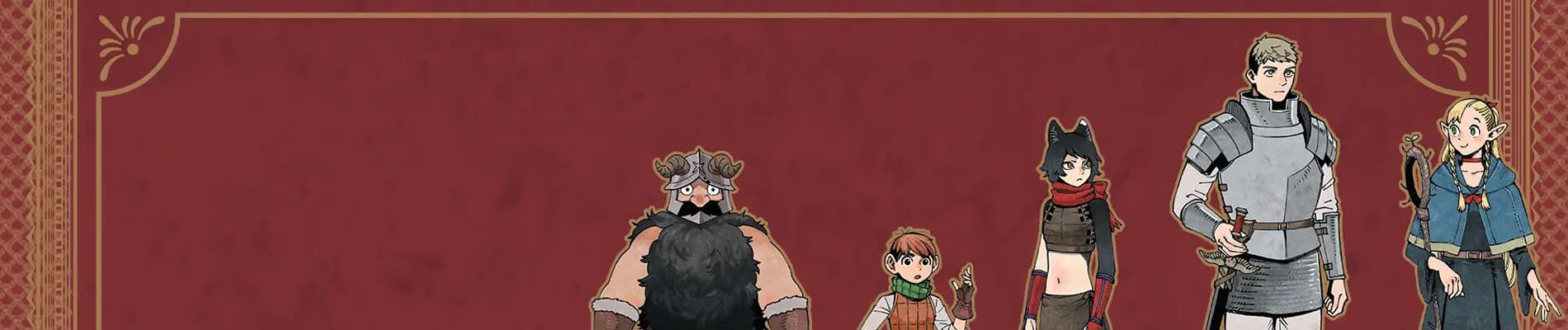
For a series which largely markets itself as a comedy cooking manga, the characters have become some of my all time favourites. As with everything else in this series, they have an extreme amount of depth to them, with all of them all having their own lives and motivations outside of the story. They feel like characters who decided to go on an adventure, rather than characters who were made to go on an adventure. While I could talk about all of the characters, I would like to specifically talk about two of my favourites, starting with Marcille.
Originally given the role of the comic relief of the party, who exists to be somewhat incompetent and mainly there to be disgusted by the meals the group end up making, she grows and is revealed to have her own motivations, which while I can't get into to avoid spoilers, are beffiting of her and are an interesting addition to the story. Furthermore, while I said she was incompetent, it is only due to her inexperience as an adventurer, who originally joined the party upon the request of Falin, the main motivation of the story, due to extreme competency in offensive magic. She didn’t just join because of Falin, but the dungeon gave her a chance to research a way to her goal. There is a lot more to get into, but, again, in the interest of keeping this section of the review as spoiler free as possible, I will leave it here.
The second character I wanted to talk about was Laios. I could very easily go into his character like I did for Marcille, I’d like to focus on his not too subtle autism. Laios is probably the best autistic representation I have ever seen. Despite it never being explicitly stated, he is clearly autistic, but it is never used as a punching bag by the story and characters. The comedy from him comes from a place of sincerity and is not exaggerated in order to make fun of him. The manga never looks down on him for the way he rambles about monsters, is oblivious to others feelings, struggles to communicate in a way that doesn't upset others, but rather makes jokes of how those aspects impact others. We never doubt that Laios cares about his companions, and neither do they, his autism is a part of his character and not his whole personality. The narrative impact these aspects have make sense. Look at the scene between Laios and Shurou (spoilers ahead, safe if you've seen the anime)
Spoiler, click to viewclick to hide
After the fight with a newly resurrected Falin, Shurou gets mad at Laios for his lack of awareness. He shouts at him about how annoying he found him, how he would always interrupt moments between Shurou and Falin when he was trying to get close to her, how his constant good nature would make him feel like an asshole for wanting to leave. Laios responds by saying he never realised that Shurou felt that way and that if he did, he should have told him that (a feeling many autistic people can relate to). Neither party is explicitly labelled as right or wrong for how they feel. Shurou’s frustrations are completely understandable, and Laios’ shock at this knowledge is also fine, as he was never explicitly told to leave and he had good intentions with how he acted.That to me is what makes Delicious in Dungeons representation work so well. It presents autistic people's actions and habits as natural and fine, acknowledging that most of them never mean any harm, but at the same time it doesn’t patronise them by acting as if they are saints and giving a realistic look at how these traits affect others.
 ___
___#Narrative and Cooking
The story revolves around a groups journey, consisting of Laios, Marcille, Chilchuck and Senshi to rescue Falin, Laios’ sister who was eaten by the red dragon. The premise is simple enough and seems to just give a basic reason for the group to find monsters and cook them. However, it doesn’t take long for the series to show its real hand. We feel constantly throughout the manga how big of a loss Falin was to the group, both to the people who are looking for her and the people who knew her. From the little conversations of the group where Falin isn’t there to cover for Laios, how a lack of a healer puts the group in danger and stresses Marcille, Chilchuck’s clash of priorities, only wanting to do things for coin and take the safe route, but deciding to go on a rescue mission anyway. We are drip fed knowledge of her masterfully throughout the story, and despite her having very little page time, we as the audience begin to value her just as much as the members of the core group.
Cooking is not just an aspect of the story, it is involved in everything. Rather than something like Campfire Cooking, which is a boring fantasy show interspersed with moments of cooking, it seems like the world revolves around it here. Cooking is used for comedy, it is used to get closer to characters, it is used to solve puzzles in the dungeon, it is used as solutions to fights. It's not just the core group as well, a very important character later on’s core ability revolves around consuming, the solution the party comes up with at the mid point involves cooking, several side characters have issues around cooking and food with some really interesting perspectives into it, like a town of immortal people who, since they have no need to eat, have ended up dulling their sense of taste to nothing. The manga doesn’t just look at cooking as a fun thing to do, but as a vital part of the universe of Delicious in Dungeon, it’s by far the best use of cooking I’ve ever seen.
The show uses setups and foreshadowing amazingly. Things you would not expect to be relevant later show up, making the seemingly unimportant and filler chapters near the start matter well into the later parts. The living armour chapters introduce Kensuke, Laios’ new sword, that isnt just used as a one off bit but becomes a recurring aspect to deal with. Senshi’s golems lead into a fight later on, the characters we meet throughout the journey all end up impacting later events. There is plenty of foreshadowing as well, leaving aside the monster encounters, the constant winged lion statues and general motifs left around the dungeon are a great hint to what's to come.

Despite all the silly shenanigans that end up happening, the narrative has a real heart to it and is not scared to go into more sincere, vulnerable territory. I’d like to use an example from later on in the series, so spoilers for chapters 64 and 65, well past the anime.
Spoiler, click to viewclick to hide
As the crew enter Sissels hideout, and decide to lure Falin out with a meal made of the local rabbits, which are one of the most deadly monsters in the dungeon, a wacky sequence emerges where everyone ends up dying and Marcille uses necromancy to use the corpses of the party to win the encounter. While this is an absolutely hilarious and tense fight, the aftermath leaves Marcille alone, where she breaks down from the stress of it all, and says this absolutely bone chilling line:
The series always reminds you that at the centre of all the silliness, these are people with lives, hopes and feelings, and the events that are played off as jokes do affect the cast throughout the story.
#The Ending
Spoilers ahead… obviously.
Spoiler, click to viewclick to hide
I truthfully have not seen a more fitting and well done ending for a series in my life. The escalation to potential global collapse was not something I was expecting, but it worked and was explained perfectly. The change from Lunatic Magician to The Winged Lion as the major villain and his reveal as a demon was a very nice choice. The final fights and set pieces are spectacular, with some jaw-dropping and disturbing art.
 The curse put on Laios and his ability to feel fully satiated being consumed are both incredibly funny, especialy after becoming king and inadvertently having an extremely safe kingdom due to the lack of monster attacks, and deeply tragic as we know that both of those things were core to Laios during his adventure. However, even with that tragedy, I'm really happy that they went for a positive ending. There is a tendency for stories to avoid having happy endings as for some reason it can be seen as childish or dumbing down the story instead of just being an often very satisfying and rewarding conclusion. Being able to see the group and Falin all be together again was really hear warming, and I'm not ashamed to admit that the final panel made me cry. Truly a beautiful ending.

#Conclusion
I don't often rate things a perfect score. Out of the almost 300 collective anime and manga that I have seen, I have given 4 perfect scores. Even series I adore, series that I have tattoos of, I don’t give perfect scores to, so when I do give a perfect score to something, it means it is something truly special and unique. I cannot imagine a single way that delicious in dungeon can be improved, the art is great, it is consistently funny, the world building is outstanding, the characters are rich witch depth, and the narrative is one of a kind. It is one of the best fantasy stories of all time and something every person with an interest in manga, fantasy, or stories in general should read.
 ___
___