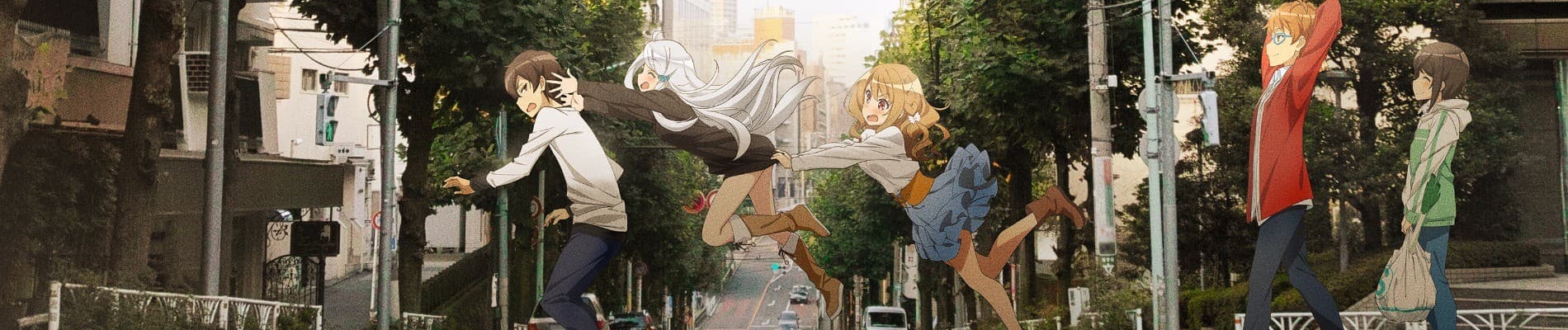
This anime is actually an allegory for Otaku culture in Japan.
Although our MC (in this case analogous to Japanese male youth) is surrounded by peers and women who would be willing to be with him, he instead focuses on an unobtainable fantasy (a little sister). In the same way that it is literally impossible for our "hero" to get an imouto, it is literally impossible for the average Otaku to have his fantasy fulfilled. However, women in his life do not represent women, they represent the idea of opportunity. Nayu represents the simple-to-obtain release of hedonistic desires (the present). Myaa represents the long-term goals of every person (the future). However, our knight-in-shining-armor instead continues to seek to obtain the unobtainable.
Furthermore, we see MC's friend acting as a representation of the crushed dreams of youth. The best part of having a goal is the buildup to it. Once a dream is reached it becomes the status-quo and thus becomes uninteresting and typically disappointing. Another idea explored in his character is the flawed personal hero. MC looks up to his friend as being a success, someone who he should look up to. However, internally the friend looks at MC as the truly successful one. The friend's character holds this duality from about the midway point onwards. The friend is in love with a woman who loves MC, he (through his own denseness) doesn't see that he is the more successful of the two. MC has independence, the women, the money, and the loyal fanbase.
The anime that MC and his friend strive to achieve narratively represents success. When the friend obtains his anime adaptation, it's nothing like he'd hoped. Things (seemingly) out of his control lead to it being a complete flop. This is meant to act as a cautionary tale to MC, but despite this, he charges head-first into a premature success that has doomed so many around him.
The anime chooses to end on a hopeful note for the group's (representing Japan's youth) future. MC admits his romantic feelings for Nayu (a woman who has been throwing herself at him for the entire show, usually literally), and he gets his anime greenlit (one of the ultimatums he set for himself to confess his romantic feelings). It presents a dreary view of today's youth, but it presents a world where things got better. That is a message which should really resonate with the audience.
10.5 out of 14 users liked this review