Log Horizon
a review by TheRealKyuubey
a review by TheRealKyuubey
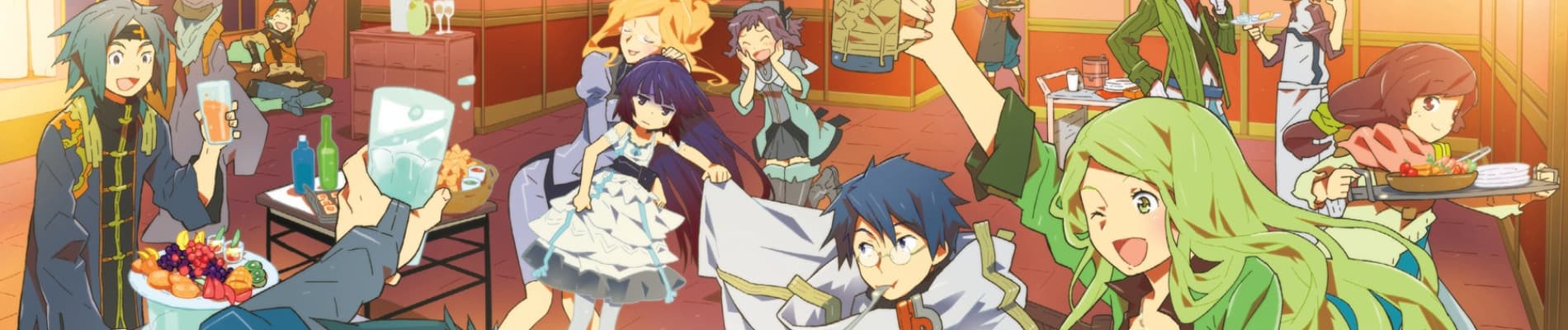
For countless people across the planet, online gaming is an invaluable escape from the horrors of reality. To log onto your favorite MMORPG after a long, demanding day of work and/or school is the ultimate form of stress relief, and one of the most popular games of all time is the fantasy MMORPG called Elder Tales. One seemingly normal day, however, the escapism it had offered for so long was turned on its head. Upon the release of its twelfth expansion pack, Cultivate the Noosphere, players worldwide suddenly find themselves trapped inside the game, in the bodies of their characters, inside of a fictional world made real. Among them is Shiroe, a socially awkward grad student, and a certified veteran of the game. Trapped in a world full of danger and monsters, he’ll enlist a handful of colorful allies and employ a series of devious ploys to transform the world of their favorite game into a society worth living in.
I usually begin this portion of a review by talking about the pedigree of an anime, but I don’t really have a lot to say about the origins of Log Horizon, mainly because I don’t have a ton of experience with its primary studio or director. I’ve seen a couple of titles that both have worked on, but I haven’t seen any of them recently enough to draw any worthwhile comparisons between them and this series. The strongest comparison I should be able to make is to Fairy Tail, because studio Satelight Inc. and director Shinji Ishihara also worked together on that, but I only watched 26 episodes of Fairy Tail over ten years ago. I guess a far better comparison would be AKB0048, which I also haven’t seen in years, but which I do vaguely remember having some of the same production quirks I noticed in Log horizon... Namely, a disparity between 2D and 3D animation. Not the same disparity, just a disparity.
Log Horizon, overall, is not a bad looking show. The visuals are a mixed bag, which is not the last time I’ll be using that phrase in this review. Most of the time, the aesthetic of this series is kind of dated, and since I don’t usually say that about anime from 2013, you can kind of guess that the issues it had were outdated even at the time. There are a lot of really obvious budget cutting tricks on display, like extreme close-ups, extended key frames, bouncing character images up and down to create the illusion of walking, the works. The background artwork, at least in the daytime, can be a bit on the bland side, just huge flood-fill color dumps like a kids’ coloring book. Characters who aren’t in close-up, yet even as close as middle depth, are often portrayed off-model, and the 3D animation can sometimes be jarringly noticeable, such as when an army of fish men are swarming a beach during a huge battle scene. Having said that, there are positive counterpoints to all of this.
As generic as the backgrounds can look during the day, things can get absolutely beautiful at night, with the sky featuring a sea of stars swimming through a blend of dark blues that you can so easily get lost in, and CG enemies look far better under these circumstances. The 2D and 3D animation blend together seamlessly when characters are using magic attacks, and speaking of attacks, the actual action scenes are exciting, well choreographed, and thoughtfully planned out. A lot of money clearly went into these scenes, and I would say the cheaper scenes between each battle compensate for their budget dips JUST well enough to not take you out of the story. Character designs are anything but generic, with every adventurer from the main cast to nameless background extras looking convincingly like the creation of some human player. The people of the land are a tad more generic, but the important ones are designed in just the right way to stand out while still remaining subtle in comparison.
The English dub is frankly outstanding, which must have been a challenge considering the massive size of the cast. Sentai Filmworks pulled out all the stops, casting their own stable of veterans, as well as plenty of actors you may never have encountered before. Mike Yager has played a few main roles aside from Shiroe, but very few of them were in well known shows... Which, by default, kinda makes Shiroe his defining role. It’s kinda hard to pin down what makes him fit the role so perfectly, but his companions are much easier to describe. Jad Saxton has a lot of range for having such a helium-like voice, which she uses to play her unwavering devotion to Shiroe and her venomously snarky wit towards Naotsugu both as straight as an arrow. Speaking of Naotsugu, Andrew Love has a much narrower range, making him really easy to miscast, but he’s adept at playing any kind of big tough guy, even the goofier ones like this one. Casting Javon Jackson as Nyanta was an inspired choice, because while he might not sound even remotely like the original seiyuu, the combination of ‘suave black guy’ and ‘cat puns’ fits the character immaculately.
As I mentioned before, this show has an absurdly large cast, and I don’t have a ton to say about every single actor involved, so here are a few highlights; Tyler Galindo is hilariously over-the-top, yet still refreshingly earnest, as Rundelhaus Code, and Meg McDonald plays off of him comfortably as Isuzu. Maggie Flecknoe is a bright ray of sunshine as Marielle, a character who could have easily come off as annoying, yet impressively doesn’t. Shelley Callene Black, Luci Christian, Hilary Haag and Greg Ayres are doing their usual shtick, but doing it just as well as they always have. My personal favorites, however, to the surprise of probably no one, are Jay Hickman and Emily Neves as Crusty and Princess Lenessia, who have absolutely electric chemistry with each other. Hickman seems to be having a blast adding that little spark of evil to Crusty’s every teasing comment and devious manipulation, and Neves has no issue at all keeping up with the reactions of a girl who gives the most animated reactions in the series. It’s a solid dub, I highly recommend it.
So I mentioned earlier that I would be using the term ‘mixed bag’ again, and here we are. Spoiler alert, though, that bag is mixed-to-positive. There are a lot of things Log Horizon does right, and a couple of things it does VERY wrong, and we’re going to start with the element I’ve seen most people praise it for, world building. Log Horizon is an isekai, but it’s not really a show about trapped gamers trying to find a way home. It’s about the people trapped in a video game trying to make that game into a better place to live, building their own society and their own government, so of course we’re going to spend the series learning about said world alongside the characters. Thankfully, the world isn’t as straightforward as it would be in most anime, and a lot of very clever planning went into the way it works and the way characters relate to it. One very interesting detail is that the NPCs from the game have sentience now, and are basically full-fledged humans themselves, not just simple quest-givers. To make things even more interesting, the adventurers used to be just simple quest TAKERS to the NPCs, meaning the situation is reversed from their perspective, creating a whole other side to this premise that the narrative does NOT sleep on. Even resurrection has a full explanation, and while you don’t need to explain everything in a scifi story... It’s science fiction, not science fact... The extra effort is appreciated.
That’s in regard to the substance of the world-building, but the reason it works so well in execution is that at least in this particular season, there’s a very clever balance between character driven writing and plot driven writing, since the characters are motivated by both the need to create a livable environment(plot), and the desire to live in relative peace and comfort(character). While there is one exposition dump about halfway through the season that does kinda go on too long and grind the story to a halt, the rest of the information we’re given is fed to us organically from the characters. Speaking of characters, you might expect the sheer number of names and personalities to be overwhelming, but no, the narrative organizes them all into a neat, orderly hierarchy. The main characters get the most focus, obviously, and they’re all distinct and memorable in their own ways, and they interact with each other in believable ways. The same could be said of the supporting cast, who only really lack in screen time, and the massive roster of side and stock characters are given just enough space and time to fill out the world and make it feel more alive.
Like, you see that bearded dwarf dude at the round table? You see that scrawny boy with the wolf ears? You don’t need to remember their names, you don’t lose anything by forgetting they exist, but you can be a fan of them and not feel short-changed. Nobody that the plot sleeps on ever feels like wasted potential, you just kinda believe that they’re off living their own perfectly interesting lives off camera. The way these extras behave is also well thought out and believable. Face it, if thousands of people were sucked into a video game the way these people were, not everyone would be all noble and cooperative like the residents of Akihabara... Some people really would go feral, forming bandit or mafia-like groups, or just generally find a way to exploit the nuances of the system and their fellow players for profit and power. We see that reflected in this show. The NPCs, or “The people of the land,” really would have some cruel prejudices towards the formerly simple adventurers who are suddenly expanding in sophistication and power out of nowhere. And it helps that most of the main and supporting cast is extremely likeable, either in an entertaining way, in a relatable way, or both.
True, a lot of them are overpowered, but they’re not without their vulnerabilities, quirks and eccentricities. Shiroe is a bit of a Mary-Sue, but the fact that he's a strategist who takes a back seat in combat is refreshing, and his social awkwardness does feel genuine. He has a rich and highly enjoyable set of dynamics with Naotsugu and Akatsuki, both as a trio, and as pairings, and every new character(from our perspective) who enters their orbit gets to share in that dynamic. The comic relief characters should be annoying, but they’re somehow awesome. Even the foppish Rundlehaus, who starts out kind of aggravating, becomes a lot more likeable once you find out more about him. I also mentioned earlier that Crusty and Princess Lenessia(Rayneshia? Whatever, I like Lenessia better) have boatloads of chemistry, and I didn’t mean as a couple, although the ship is never discouraged. Lenessia starts the show in a position where she’s basically a royal ornament who can’t make any decisions for herself, and she seems kind of conflicted between contentment in luxury, and some mild self-loathing over her own lack of motivation and direction, and Crusty’s calculated teasing pushes her into a fascinating character arc where she grows in confidence and becomes a major player in relations between adventurers and the People of the Land, and she’s my favorite character because of it.
I do have one issue with the world-building, and it’s the existence of younger characters. Elder Tales has canonically been around for over a decade before now, and there are plenty of veteran level 90 players trapped in it, but there are also a bunch of newer players mostly portrayed as children and teenagers, which is a bit strange, as it seems to represent time spent in game as actual physical age differences. I get that this is probably for the convenience of the viewer, but seeing all of these kids and teens play characters that look like kids and teens... It doesn’t make any sense. First off, when’s the last time a video game let you create a child character? I mean aside from games where the entire cast is children, like the South Park games. I’m pretty sure there are rules against children being harmed in video games, at least outside of story based cut scenes. That’s why child NPCs are invincible in Bethesda games, and you never have to fight child zombies in survival horror games. But even if you could play as a kid, why would you? Why would Toya, for example, choose to make his samurai character as small as he is? Is that really his fantasy? I would honestly expect role-playing adults to play child characters more often than actual child players.
I hate to say it, after all that time I spent gushing over the world-building, but this is kind of a result of the writers just barely not going far enough with a few of their concepts. For one thing, unlike Sword Art Online, people do not look like their IRL selves here, and the potion that can change their appearance to match themselves better is supposed to be some rare legacy item, so you would expect there to be a ton of characters with mismatched voices, but aside from Akatsuki in episode 1 and another character who gets introduced in season 2, they don’t really do a lot with this idea. I understand that’s not the focus of the story, but unanswered questions and unresolved implications will always be at least kind of distracting. Another unfortunate element is romance, which is probably the worst thing about the series, especially since it sneaks into some frustrating harem territory. This is kind of a spoiler, but by the end of season 1, there are four female characters who are madly in love with Shiroe, and of course, he is too oblivious to notice any of it, because that's just it works I guess. This is some old, tired harem shit. and nothing is really added to the formula.
It’s not just him, either, it’s a trend across the series... Almost every major female character has a male counterpart she romantically desires to some degree, and he is either vague about his feelings or completely oblivious to hers. Even Lenessia, whose relationship to Crusty feels mostly sibling-coded, still busts out the blushy-blush when he’s shirtless. Even Isuzu, who is on mostly equal terms with Rundelhaus, is still in the driver’s seat of the ship. The only exception I can think of is Marielle, who seems at first like she’s going to be paired off with Naotsugu, but thankfully winds up just being really friendly and outgoing to everyone she meets. But the worst is still Shiroe, and the worst episode of the season is when Shiroe is courted by two lolis at the same time, and manages to remain infuriatingly oblivious while they both shamelessly throw themselves at him. Yes, I know Akatsuki is an adult, but her design is what it is. This episode is painful to sit through, especially coming off the heels of an amazing goblin war story arc that ends on a triumphant, yet still way too early note.
But speaking of that arc, the best thing about this show is that, in a very general sense, when the story is moving, it is some of the most exciting, engaging material you’ll ever see, and while I don’t really talk about music anymore in my reviews, the soundtrack plays a huge part in this, amping up emotions whenever needed, especially during suspenseful, tense or emotionally powerful moments, of which there are many. Whenever something is on the line, this show is just ON, in ways that can give your goosebumps goosebumps. Whether it’s Shiroe revealing that he’s been executing a devious scheme, literally any kind of battle scene, everyone getting wrapped up in a consequential situation, or the game world acting out of character in potentially disastrous ways, I can practically guarantee your blood and fists will both be pumping. I think the reason behind that is simply that Log Horizon knows exactly how dorky it is, and it plays that dorkiness as straight and sincerely as fuck, because it is proud to be some dorky, nerdy ass fantasy stoy about socially awkward gamers and otaku, and in my opinion, you can’t say no to that.
The first two seasons ofLog Horizon are out of print from Sentai Filmworks, although season three is available from Crunchyroll. The original light novels from Mamare Touno are available stateside from Yen On.
It’s just dawning on me at this point that while I had a lot to say about this series, I haven’t yet said much about it as a member of the isekai genre. To be clear, Log Horizon is very much an isekai anime, by definition, and yet it somehow doesn’t feel like one. I’m kind of pulling this observation out of my ass, but Log Horizon came out one year after Sword Art Online, and both shows took a very similar premise in dramatically different directions. While Log Horizon enjoyed more consistent critical acclaim, SAO was the more financially successful and culturally relevant of the two, so the last decade or so of the isekai genre has taken far more influence from SAO. That’s kind of a shame, because I would love to see more anime like Log Horizon, that take the time to construct a more complex foundation of important characters and immersive world-building for their stories, instead of just following the plight of one chosen badass. It’s not a perfect season, and future seasons bring their own issues to the table, but I still think it’s pretty awesome.
I give Log horizon an 8/10
40 out of 43 users liked this review
