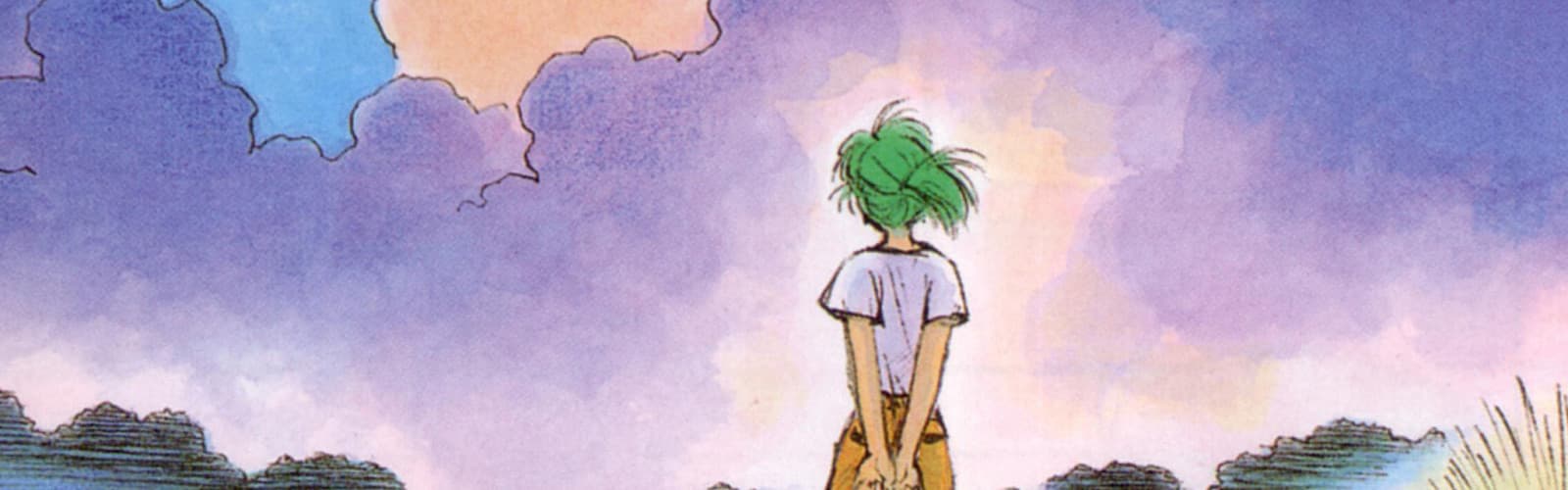

(Mono no Aware)

(Wabi-sabi)

These schools of thought have found themselves maintaining a prolonged popularity and having persisted despite the Information ages dependency on the immediate. Both having flourished and servicing as a source of contemplative commentary in the sanctuary of manga/anime, Specifically the tranquil sub-genre of…
(Iyashikei)
As previously mentioned a primary focus of these series is reconnecting with nature. An excellent example of this is Barakamon which focuses on an arrogant calligraph, despite the archetypical nature of his work, called Sei. Agitated by the rejection of his art, Sei straight up KO punches an influential and highly respected director of one of the art exhibits he's presenting at. This lands him straight up banished to an Island that is the complete opposite to the metropolis that is Tokyo. At first crushed by countrified life, the intimacy of the islands community and picturesque pastoral landscapes find a very welcome place in Sei’s heart thanks to the presentence of some particular locals. Barakamon uses Sei to highlight a connection between character development and the character’s environment, as well as the effects of a close community.
A justifiably extremely popular series with these themes at the core is Non-Non Biyori. Non-Non is a simple showcase of a simpler life, and also a breath-taking one too. Non-Non also introduces an indispensable and imperative theme that a great deal of Iyashikei share and that’s time. No matter how grand the mountain water will always flow down, flow through the rivers and the streams to the vast oceans. But that’s not the end of the journey. As sure as water makes its way down the mountain its evaporated back to the top. Non-Non similarly continuously cycles through a year in the small town of Asahigaoka. A year that just as it began eventually has to end.
Some of the mediums most legendary creators have excelled in Iyashikei. For instance, not so significant pre-eminent visionary Iaso Takahata directed what could be considered potentially the first proto-Iyashikei in Heidi. Pretty ironic that this Intrinsically Nihonese genre found it’s animated beginnings in western literature. Takahata would also direct Only Yesterday one of my personal favourite Studio Ghibli films, Although I’m not sure it surpasses the similarly spectacular My Neighbour Totoro Directed by his protegee Hayao Miyazaki.
Patience is a virtue which is definitely required with these series/movies. It’s also defiantly required in terms of this review as you’re probably wondering why I’ve spent so much time discussing amines that don’t have the title of the one you clicked on a review for. Well, that’s because series such as Barakamon, Non-Non Biyori and countless beyond owe a great deal to the incredibly innovative and influential wonder that is…
It’s not just Alpha that’s cheerfully going about this ataraxy apocalypse, there’s also Oji-san who runs the local petrol station and Koumi’ishi the local doctor who works on both humans and robots (I don’t know if it’s robotist to also call her a mechanic). The casual acceptance of the apocalypse also extends to the casual acceptance of robots who have seamlessly been integrated into society. Aside from Alpha there’s Kokone a reoccurring character of increasing significance to Alpha, these two are hyper-kawaii together.
 I mean just look at them they got reverse matching hair and eye colour.
But there’s plenty more to YKK then adorable androids and the sensational setting. YKK is an emotionally complex and contemplative series, it’s for me personally the crowning-jewel of Wabi-sabi aesthetics and the ultimate representative for the Mono no aware philosophy and style of storytelling that the industry has to offer. It does this through one of the most creative and clever displays of contrast in manga and anime.
With the flame of humanity petering out leaving only a few passively burning embers remaining, the reality of impermanence has never been so prevalent. Throughout YKK androids are occasionally referred to as “Humanity’s children”. This piece of terminology like many fascinating facets of YKK are purposefully left unanswered. I feel the androids have been created to carry on humanity’s legacy, although the reasoning I’m less certain on. Is their creation one last act of defiance against the inevitable. Are they perhaps like The Golden Record upon the Voyager spacecrafts evidence of are existence. Did we create sentience just to serve as documentation, a glorified certificate selfishly proving we were here. Or more optimistically did we simply want to spread the joy of life, allow the androids to succeed where we failed and live peacefully and harmoniously on the earth.
Permeance and transience. Humanity may fade out, but our memory will carry on (Welcome to the Black Parade faintly plays in the distance) through the scars we’ve inflicted upon the earth, the cities buried beneath the oceans and the stories told by those who remain, we’ll carry on as surly as Alpha, Kokone and many others will reminisce. Whilst bittersweet in nature, wistful and tinged with melancholy YKK is a beautiful story about the end, but also a story of a new beginning.
Speaking of new beginnings, how about a new chapter. Even better how about one that actually focuses on the OVA!!!
“Coffee… I seem to drink 80% of it myself.”
In 2 minutes and 40 seconds YKK establishes a tranquil tone in an exceptional manner. Despite the quite nature of YKK the soundscape certainly isn’t barren, in fact it’s teeming with life. The birds are cheerfully chirping, the breeze is gently blowing and with it the weathered weathervanes creak alongside the rustling of leaves and the swaying of overgrown grass. YKK sooths the senses and wholly engrosses the viewer, the aforementioned visuals are entrancing, the sound design is subtly spellbinding and if watched with a customary coffee you can even taste and smell YKK. There’s reassuring warmth that envelops me when I watch YKK this silent alleviating affirmation just washes over me and suddenly everything seems ok.
YKK provides the perfect hostess to help you feel at home in, Alpha. Despite the mechanical nature of her existence there’s nothing cold about Alpha. Her authenticity is greatly appreciated by those around her as is her positivity. Watching Alpha you tend to forget she’s a robot, even whilst the topic is prevalent throughout the OVA any differences posed are superficial. Alpha welcomes everyone in the same friendly manner weather their a robot or human and thus her generosity is returned. The same Alpha that seamlessly become friends with Kokone upon first meeting is the same as the one sharing a laugh with Oji-San later that evening. We see her excitement over receiving mail, we see her embarrassed over having a bad hair day and we see her deeply moved by the world around her. Alpha is quite the free spirit, she often ventures out into the world driving a yellow scooter which she made cool before FLCL was even a concept. These explorations have a great impact on Alpha, the first teaching her about moderation and appreciation for experiencing the now and the second is not only for Alpha but also for me personally a deeply moving scene. YKKs provides an emotionally euphoric epilogue, a truly powerful scene that has had a profound impact on me.
All over a cup of coffee
Takeshi Annou and his team embedded their adaptation of YKK with a marvellously meditative quality. Watching Alpha go about her days I can’t help but reflect on my own. The explorations she goes on, the discoveries she makes and the fun she has doing so really speaks to me. Seeing Alpha hypnotised by the sunsetting over the ocean and dyeing the sky a punch pink and lavender hue is overpowering to me. I sit there wondering why I can only remember one lavender sky of my own but can remember countless mistakes and problems I’ve caused. YKK fills me with the desire to be a better me and to find more lavender skies, more sunsets and get more out of life. The influence on my life YKK has made is as undeniable as the influence I mentioned it having on the industry. I often on my own travels find myself humming the opening theme to the OVA, travels that often detail a search for a coffee shop or some place to park-up and go for a stroll.
Artist in the “Age of Evening Calm”
I have the utmost respect and gratitude to Takeshi Annou and his team for successfully adapting the manga. They bring the anime a life of its own and although this maybe controversial I think they surpass the manga in what they adapt. YKK ironically was released during a transitional period for the whole industry. With the change to digital on the horizon Annou and his team utilised countless techniques mastered over decades of spilt ink and hard work. YKK isn’t just an ode to the manga it’s adapting but to the lost art of hand drawn animation. It’s pretty safe to say they absolutely nailed it, I would sacrifice it all in The Holy Grail War for an alternative reality where an equal in quality 50-episode series was made. Everything from the way glass surfaces bend and distort the scenery they reflect, the apt use of postcard memories symbolising photos taken by Alpha, the grass growing through the cracks in the road, the ocean, the puddles, everything to do with water. They even animated the shadows of the clouds dude, like damn it’s just so good. Nothing I can say truly does YKK justice, meaning I guess all that's left to do is to ask you to...
Watch
 This
This
 OVA
OVA
 Please
Please come again
Thanks for reading, hopefully you enjoyed this review and didn't find it too long or meandering, I really wanted to do this one justice. I guess all that's left to say now is bye and thanks for coming.
 ~~~~~~