MONONOFU
_To start, this is my first review here, so feel free to correct me if there's any mistake.
Now, many of you might ask, why did I decide to review this random manga? Well, this manga marks the first step in my long journey to becoming one of the few people who have read all the mangas from Shonen Jump. So, why this one exactly? I noticed that it's ranked among the top 150 worst-selling Shonen Jump mangas. But don’t worry—I plan to read all Shonen Jump mangas, in any random order, and review them. I’ll even read them in other languages if needed (which applies here, and I’ll get to that later). But now, after saying all that, it's time to actually start the review._

Oh
Mononofu, oh
Mononofu, you could have been my next Hikaru no Go, but your potential got stuck in a collection of great ideas with little execution and originality.
Mononofu was written and illustrated by Haruto Ikezawa, an author who is somewhat recognized in the magazine as a former One Piece assistant and with a previous Shonen Jump series called Kurogane. It was expected that the author would get a second chance to shine in the magazine, but unfortunately, this wasn't enough, and shortly after, his second attempt was canceled.
Mononofu lasted 43 chapters, collected in 5 volumes.
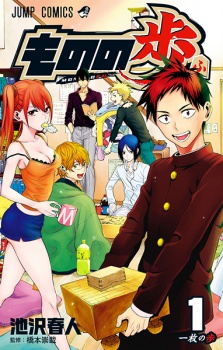
Mononofu starts with a great premise, as it follows the main protagonist, Takahara Shinobu, a socially awkward boy who was rejected at his previous school. As a result, he ends up moving into a shared house. What he doesn’t know is that in this house, everyone is aspiring to become a professional shogi player. Thanks to this, he slowly starts discovering shogi, and his passion begins to grow.

#
STORY 6/10
If I had to define the story of
Mononofu, I would say it has potential—like what I believe could have been the successor to Hikaru no Go. The story had a lot of potential to interest readers through this 'Japanese chess'. However, it fails when it comes to helping the reader understand the game. Perhaps it’s clear for experienced players, but for a beginner like me, it was difficult to follow the matches or games in
Mononofu.
The story, while it had a good pace for a shonen and sports series, didn't manage to delve into all the characters, making it hard to connect with most of them, with a few exceptions. The plot quickly (probably due to the rush of cancellation) became hurried and started escalating so fast that, even though there were more than 10 chapters left, it felt as if we were already in the middle of the series.
Leaving the negatives aside, the story also offers the typical entertainment found in sports mangas, showcasing the author's experience during tense moments in the games. Still, I feel like it lacked something—something I can't quite describe—that would have made it truly captivating. Perhaps, it was simply the challenge of making readers truly invested in the game of shogi.
#
ART: 8/10
The art is undoubtedly the best part of the manga. Haruto-sensei does an excellent job capturing the expressions of many characters, and their designs are incredible. Whether in black and white or color, the character designs are stunning to admire, and I never felt there was a drop in quality, except toward the end of the series, where perhaps the author had lost some motivation to draw. But other than that, the author always delivered correctly, and the artwork was consistently good (except for the protagonist, who, while his design was part of his personality, felt very flat).

#
Characters: 4/10
This part is going to hurt, honestly. The author made a very strange decision here. Originally, the main cast was presented as the members of the shared house, who appear in both the first and last volumes. However, throughout the story, these characters were barely developed. I imagine it was due to the limited time before the cancellation, but this might have actually influenced the series' cancellation. They introduced really interesting characters only to leave them undeveloped in 43 chapters. One of them (I can't remember his name, but he's the oldest—if this shows how little importance was given to these characters) got some development toward the end of the manga, but other than that, they barely appeared (and there were five of them).
That said, the characters the protagonist meets as the story progresses—his rivals—are decently developed, but even then, the author didn’t give them enough time for further development (though the YouTuber thing was a bit much…).
As for our protagonist, his development is slow, but at least it feels somewhat progressive. However, as a character, he ends up feeling flat and boring.

#
Enjoyment: 7/10
Honestly, I enjoyed it, but I didn’t love it. It was more of a 'I didn’t understand how shogi works, but I was excited when the characters I cared about won' (maybe it's my lack of intelligence). But at the end of the day, it’s a manga that can be enjoyed, especially if you liked Hikaru no Go. It feels like a worthy successor to read, but never enough to surpass it. With that said, I would give it a 7, maybe an 8, but it doesn’t quite reach that for two reasons.
1. It’s not translated from chapters 32 to 43, so I had to read them in CHINESE without knowing Chinese, using a translator.
2. Honestly, the chapters after the translated ones weren’t worth it. In my opinion, if you stick to the English-translated chapters, you get a decent ending with an open conclusion—yeah, but just enough for you to imagine what could happen in the future. But following what actually happened, I get why it declined in sales (it sold fewer copies than nothing, considering there were only 5 volumes and it barely reached 9,000 copies).
Verdict
Mononofu is a series with potential that ended in a mediocre way but with some good points to highlight, resembling the glory of Hikaru no Go. Unfortunately, it wasn’t enough for the series to survive the powerful axe of Shonen Jump, and honestly, that was probably for the best. Still, if you're a fan of spokon, Shonen Jump, Hikaru no Go, or even if you just like trying new things, I recommend it as a series to pass the time. You could even imagine it as a 31-chapter one-shot. That said, Mononofu resembles more a missed opportunity—something that could have been great but just didn’t quite make it.

