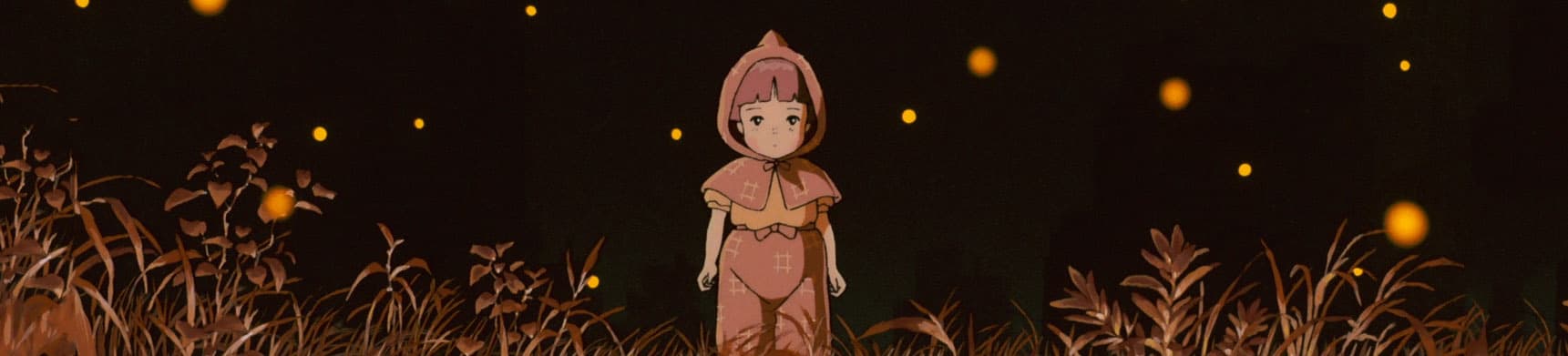
Man, I honestly can't believe it took me this long to finally finish watching Grave of the Fireflies in its entirety. I actually did watch this once before, way back in college. I took a class on how modern Japan was formed, and one of our assignments for that class was to watch two movies and compare/contrast them, this and The Flowers Of War. The other movie was about an American guy pretending to be a priest (or something, I don't remember) who was sent to China during World War II and witnesses the Rape of Nanking, but that's all I remember about it. Ironically, I actually finished The Flowers of War even though I didn't like it, but liked Grave of the Fireflies yet didn't finish it, though that was more due to other obligations than anything. I missed my chance to get the Sentai blu-ray and now that's both out of print and ridiculously expensive. That's what I get for not snapping it up when it was cheap. Luckily, Netflix put the subtitled version up recently, though neither the 1998 Central Park Media English dub or the Sentai Filmworks re-dub are on there. Why is that, I wonder? Still, I decided to finally sit down and watch it...and man, this movie really holds up in terms of depicting just how awful World War II was for everyone.
Based on the 1967 semi-autobiographical short story by Akiyuki Nosaka, Grave of the Fireflies centers on two children, 14-year-old Seita Yokokawa and his 4-year-old sister Setsuko in the year 1945, when World War II was still raging all across the world. The firebombing of Kobe kills their ailing mother, and last they heard, their Navy captain father is out at sea. They go to live with their aunt, but she isn't too happy with having them around, constantly griping that they don't do enough to help around the house or contribute to the country. Unable to tolerate living under her roof any longer, Seita and Setsuko decide to try living on their own, moving into an abandoned bomb shelter. But no matter what Seita and Setsuko do to make the best of things and survive, they are beset by starvation and disease, met with apathy or cruelty by adults, and death lurks around every corner. World War II is cruel and merciless, even towards the innocent.
If you're going into this movie expecting cute Ghibli whimsy, you better throw those expectations out the window. Not only is Grave of the Fireflies down-to-earth and realistic, devoid of anything like magic or supernatural or so on, it's also the darkest, most bleak movie in their entire repertoire. People are shown actually dying or dead on screen without any kind of censorship or sugar-coating, and the movie itself doesn't have a happy ending. Hell, the movie literally opens with its protagonist dead on the streets, straight up telling you that you're gonna be in for a rough time. That said, having seen quite a few war movies, I can attest that Grave of the Fireflies is definitely one of the better executed ones. It's definitely the most well-animated one for sure, and considering this was the third movie Ghibli made, it's honestly a technical marvel even by eighties standards. This is the first movie that Isao Takahata directed for Ghibli, and it's easy to see that he has a strong knack for realism and little details that you won't find in any other movie, like how Setsuko acts like an actual 4-year-old with the way her body moves and how she behaves, or maggots completely covering the body of Seita's dead mother because her burns are so bad. Takahata doesn't waste a single detail here, both in the smaller slice-of-life moments and the harder-hitting war segments. I don't have as much to say about the soundtrack, as I definitely enjoyed it, but it did get a little too sentimental at times.
The characters are the most divisive point of the movie, as there's much discussion to be had about Seita and whether he's a good protagonist or not. Some say his actions throughout the film are understandable, while others say he's an absolute idiot who should have sucked it up so his sister could live. In all honesty, I'm of two minds on Seita as a character. Yes, the movie doesn't really gloss over the fact that Seita's actions did have a hand in his sister's death. He's a dumb teenager who made dumb decisions and was way in over his head, probably due to thinking he had to fulfill the role of the protector and the "man of the house." But really, what teenager HASN'T made dumb decisions at some point in their lives, even during war time? There were probably lots of kids like Seita during that era. Not everyone managed to survive World War II after all, and even if they did, they're bound to have been irrevocably changed because of it, whether through their own experiences or the actions they had to take and decisions they made. Desperate times can make people desperate, and while I can understand Seita's aunt wanting him to help out around the house a bit, I do feel the way she went about it was needlessly cruel, even if she might have had her own reasons for her actions. Besides, who's to say she'd treat them better if Seita and Setsuko even did help out more and "contribute to the country" as she kept whining for them to do? I can see both sides of the argument, but in regards to Seita, there's one thing I can appreciate about his depiction: Yes, he's overly prideful and doesn't always know when to give up, but I like that he's never portrayed as being mean. Usually, prideful people are portrayed as being arrogant, selfish, and think they're above everyone else, but Seita never acts like that. Besides, as flawed as Seita is, would you really prefer him being an uber perfect Gary Stu who does no wrong? That'd be super boring. Plus, you have to remember that Seita is a stand-in for Akiyuki Nosaka himself, who wrote the original short story out of guilt over not being able to save his younger sister during the war. All I can say about Setsuko is that she's a good depiction of a four-year-old kid of that era, complete with all the neediness and energy that a kid that age has. And man, props to Ghibli casting an actual four-year-old to play Setsuko. God only knows how difficult that must have been considering how four-year-olds tend to act.
My only real critiques for Grave of the Fireflies is that I wish the characters had been fleshed out more. For as much as I sympathized with Seita and Setsuko's journey, tragic as it is, I never felt like I really got to know them as people. I wish the movie had been maybe half an hour or an hour longer so it would have had time to flesh them out more, or maybe give a glimpse of what their lives were like before the war. I do find myself liking Who's Left Behind and In This Corner of the World better because both movies managed to do that, focusing hard on getting you to care about the characters before showing them going through the tragedies World War II brought on. Though that's not limited to just war movies, as I personally prefer everything that does that in general. That, and I wasn't really a big fan of the Setsuko death montage near the end. I found it to be a little overly melodramatic and unneeded. Yeah, I admit, I didn't cry at this movie, and I know you're thinking "What?! You didn't cry at the saddest anime movie ever made?! What's wrong with you?!" I personally found other movies to be sadder, but don't get me wrong, this isn't an indictment towards Grave of the Fireflies. I still really enjoyed this movie, and I'd definitely recommend it to people who love this sort of thing, or war movies in general. It's absolutely NOT for the faint of heart, for sure.
And before anyone asks, yes, I'm aware that Grave of the Fireflies as a movie only shows one part of Japan's side of World War II and not everything else about it, including Japan's war crimes. That very same college class I took went into detail about Japan's atrocities during the war and how afterward, every piece of fictional media they made adopted a hardcore victim mentality (i.e. always portraying themselves as the victims) while sweeping all their war crimes under the rug. There's definitely no denying that. But I do think there's value to be had in Japan's war movies, Grave of the Fireflies included. It doesn't try to glamorize the war, nor does it try to hammer you over the head with some kind of message. Many have argued that the movie was made to guilt-trip high school aged delinquents into respecting their parents and falling in line, but that claim has long since been debunked by Takahata himself in a lot of interviews, one of which explained that Takahata was a staunch critic of Japan's societal demand for absolute conformity. The only real message Grave of the Fireflies espouses is that...well, war absolutely sucks for everyone, doesn't give a moment's thought to all that suffer through it, and not everyone gets out of it alive. It's a war movie that you can interpret in any way that you want, and it's one of many that absolutely stands the test of time in my opinion. Grave of the Fireflies definitely isn't for everyone, but it's easy to see why it continues to be so well-regarded even now. I'm certainly glad I finally got around to watching it, and now that it's on Netflix, it might even reach further audiences.
29.5 out of 30 users liked this review