Girls' Last Tour
a review by MIGVEL
a review by MIGVEL
"Maybe 'life' means something that has an end."
———
Girls' Last Tour — A tender eulogy for a dying world.
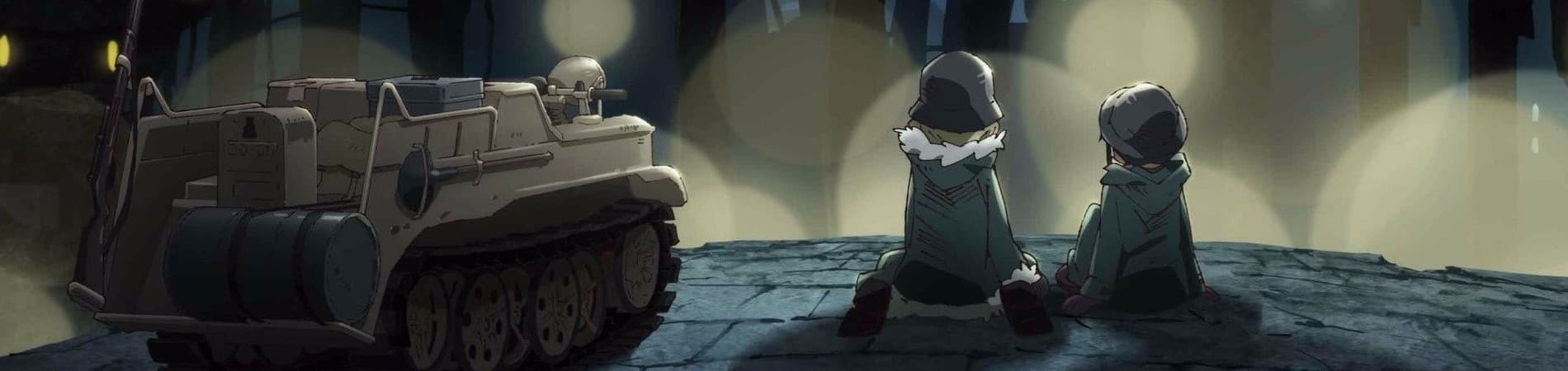
Its premise is simple: In a post-apocalyptic world, two girls — Chito and Yuuri — travel across a concrete megalopolis, aiming to reach the city's top-most level in the hopes of finding civilization. Said girls' personalities seem fairly cut-and-dry as well, with Chito being level and inquisitive and Yuuri being carefree and impulsive.
What's peculiar, however, is that there isn't much urgency or tension in reaching this goal. In fact, the series mostly entails the girls, sheltered and innocent of the world, exploring different aspects of the city, discerning how people must have lived before everything became so barren.
As such, the story's tone and pacing are ponderous, meditative, and even relaxed; so much so that there's plenty of light-hearted antics and dialogue between the girls, including a bit of slapstick here and there.
It's rather unexpected for a story involving mankind teetering at the edge of extinction and quite the risk: How can a such a bleak setting give way to anything close to a cozy and ponderous story? How can the protagonists' quirks and antics fare without clashing with the quiet, somber atmosphere the show clearly works to attain? Should the writing be weak, the characters be shrill, the humor be obnoxious, and so on, Girls' Last Tour would be nothing short of a piping-hot mess.
And yet, somehow, it all works to tremendous effect. I've yet to see another film or show that can be so light-hearted yet so melancholy without feeling disjointed or awkward.
One of my favorite examples of this is in a segment titled "House." In it, the girls find their way inside an abandoned apartment, sit back in one of the rooms, and brainstorm what their "dream home" would include: A bookshelf for Chito, a pantry for Yuuri, a bunkbed, a bath, and so on.
On the one hand, it's a mellow scene in which the two protagonists imagine how they would decorate their home if given the chance. I can tell you from experience and from watching house renovation shows with my parents that it is indeed a fun activity to dwell on.
And yet, an unmistakable sadness lingers. The girls regard mundane furnishings like beds and bookshelves not with sad reminiscence, but with curious wonder. Meanwhile, I regularly open my pantry to grab a quick snack without a second thought; in the world of Girls' Last Tour, however, pantries and decorating homes are but simple joys that became lost to time.
To hammer the point even further, I noticed that the only food shown on screen in their imaginary home are rations and fish — The only sorts of food they've ever really known. And yet, this seems to be more than enough for them as is. Such images had me thinking: Would it take the world ending for people to appreciate the small and ordinary pleasures life gives us?
"House" is a perfect example of Girls' Last Tour's effortless command over tone and atmosphere. Placing cute, quirky characters amidst a grey, cold megalopolis almost sounds clunky and jarring in theory, yet these elements weave together seamlessly; the end result strikes a remarkable balance between cheerful and somber.
The show's impressive atmosphere extends to its use of music as well. The score itself is stellar (Courtesy of composer Kenichiro Suehiro), mostly consisting of quiet, warm melodies that fit the story's subdued tone like a glove.
What's also remarkable, though, is how the series knows when to exclude any music, instead relying on simple ambience and sounds to help immerse viewers into its world, as well as allow the characters' dialogue and interactions to sink in. It exercises a level of restraint that I wish more films and shows would practice as well; too many blare their orchestral scores throughout their runtime in a feeble attempt to keep the viewers' attention, making Girls' Last Tour feel like a deep breath of fresh air.
There is, of course, the matter of the dialogue and characters, namely Chito and Yuuri. On the one hand, they almost seem simplistic at first glance.
Chito, the brains of the duo, drives the kettenkrad they travel in, enjoys reading, and often questions the world they travel through. Yuuri, meanwhile, is the brawn of the two, being more physically able and showing exceptional skill with a bolt action rifle. She exhibits a more devil-may-care and self-absorbed attitude, however, as well as a serious penchant for eating.
And yet, neither of them come off as one-note caricatures. For instance, the straight-laced Chito has plenty of moments where she lets loose and isn't above a little mischief herself. One segment even has her stuffing Yuuri's mouth with a rock in her sleep as revenge for cheating in a rock-stacking game the night before.
Yuuri, meanwhile, displays some moments of wisdom, drawing from her laid-back outlook to give her own thoughts surrounding hope and purpose. In episode three, for example, the question of why people live pervades throughout. Towards the end, Yuuri states that we don't always need some grandiose goal — "There are just nice things sometimes," like gazing at the city lights while munching on ration bars.
The girls' conversations and interactions feel deeply natural as well, flowing effortlessly from one topic to the next. Whether it be Yuuri getting on Chito's nerves or both of them speculating why people built temples and started wars, their personalities bounce off of each other and make for a captivating dynamic.
The duo's personalities may be simple at first glance, yet their chemistry is incredibly charming and displays an immense amount of staying power. Despite how simple their characteristics appear and how exaggeratedly adorable their designs are, they truly come off as human — Fitting, considering Girls' Last Tour is all about reflecting on different facets of human life.
I should also note that the girls' voice actresses, Inori Minase and Yurika Kubo, also do a phenomenal job bringing Chito and Yuuri's characters to life, respectively. They encapsulate the former's level-headed demeanor and the latter's untroubled energy perfectly, allowing the duo's charm and chemistry to shine through the screen.
It also helps that every episode introduces new locations and activities for the duo to engage in — Baking ration bars, helping a stranger build an aircraft, activating a colossal war machine, and so on — All of which either highlight the everyday pleasures of life or cover philosophical concepts such as death, hope, and religion.
One of my favorite examples of this lies in episode eight, titled "Memory." In it, the duo find themselves in a vast field of massive, rectangular slabs; upon closer inspection, they turn out to harbor rows of drawers containing small, ordinary trinkets like buttons, scraps of cloth, and a crank radio.
After finding a statue they had encountered in a previous episode, Yuuri excitedly begins taking photos of it with her camera. Kanazawa, a kindly cartographer who gifted them the camera in a previous episode:
Yuuri: "Who was Kanazawa again?" Chito: "Hey. He was the guy who gave us the camera." Yuuri: "[...] Oh, I remember now. I would've forgotten about him without the camera. Thanks, camera!" Chito: "Normally you wouldn't forget that sort of thing that easily... I hope he's doing well." Yuuri: "It's alright — As long as we have this camera, we'll never forget him." Chito: "Stop talking about him as if he's dead."
With that, the topic of remembering lost friends and loved ones arises — An example of how well the girls' characteristics work so well together and how naturally their conversations move from one concept or topic to the next.
This dialogue causes the girls to realize that they are actually in a graveyard of sorts; the objects they found belonged to the deceased. The slabs thus resemble a stacked or vertical cemetery, albeit one that houses trinkets instead of the deceased. Chito then insists that they put the items they found back where they found them, fearing that they will lose all meaning if they are not returned.
Despite the usual relaxed energy from Chito and Yuuri's dialogues, "Memory" is certainly one of the more melancholic segments in this show, both in its somber atmosphere and the sorrowful ideas it brings to the table.
People want to be remembered long after they pass from this world, often in the form of heirlooms — Whether they be jewelry, books, furniture, clothes, knick-knacks, and so on.
Unfortunately, humans are finite creatures; such memories can only carry over through generations for so long, no matter the lengths people will resort to to preserve them. They eventually will reach a point where people like Chito and Yuuri, seemingly the last two humans left on the planet, will have no idea of the context behind that shell casing or that piece of cloth.
As I rewatch the episode, I still can't help but wonder what those objects could have meant to the departed or their loved ones. However, neither the girls nor the audience ever learn what exactly those objects symbolized; only that they must have been significant enough for those grieving to preserve them.
The statue they found, seeming to represent a deity of some kind, is the only thing left to keep watch over the memories of the deceased, knowing what those trinkets actually meant (As Yuuri puts it, at least they've got "this guy.").
From a religious perspective, though, this could perhaps be seen as a ray of hope. After all, Christian images like crosses and angels are common in burial grounds, symbolizing eternal life and respite in God's kingdom. With that, such memories would never truly be lost.
Meanwhile, Chito remembers her grandfather, who the show cleverly depicts as a blurry silhouette in the distance; there is an unspoken fear that he will one day be forgotten as well. As stated before, she can never know what those items really meant to those people, but she understands their significance nevertheless.
Thus, she decides that all she can do is put those trinkets back where they found them (Though it later turns out Yuuri pocketed the crank radio since it might come in handy; it turns out to play a crucial role in future episodes.). It's a powerful moment for Chito's character, displaying a great sense of empathy and a glimpse into her own personal grief.
It's instances like this where Girls' Last Tour excels; everything from the protagonists' conversations to their surroundings intertwine beautifully, fleshing out the show's world, ideas, and its characters. Even its less philosophical slice-of-life segments like the aforementioned "House" or "Cooking" — The latter of which simply involves the girls finding a food processing facility, scrounging a few ingredients, and baking ration bars out of them — manage to paint bittersweet portraits of humanity.
Another favorite example lies in a segment titled "Temple." Chito and Yuuri enter an enormous temple but eventually get separated as their lantern goes out. The normally easygoing Yuuri experiences a moment of quiet fear, wondering if such darkness and isolation await her in the afterlife, and how she could ever cope without her friend. It's a sobering moment in which even a character as carefree as Yuuri harbors her own fears and doubts.
Just as the two bump into each other and reunite, the temple suddenly flashes with light, revealing an enormous room of towering statues and a floral oasis made from metal and glass. After soaking the sight in, they take a rest and deliberate on what purpose this place must have served. Chito deduces that it was to bring people comfort regarding the afterlife; the deity or god the temple ascribed itself to must have been a symbol of hope in the face of death. Yuuri responds saying she feels the same way about Chito, hence her relief upon finding her in the dark.
Just then, as they continue to snack on their ration bars, Yuuri experiences an "epiphany" of sorts, closing the episode on a humorous note:
Yuuri: "Maybe Chi-chan is a god?!" Chito: "How would I know? [...] You have to offer food to gods." Yuuri: (Looks down at her ration bar) Chito: "Gimme." Yuuri: "Now I feel like you're not."
Behind the show's simplicity lies a rich abundance in detail and intrigue, through how the girls interact with the world around them, how said world operates, and how it reflects on the human condition despite its futuristic setting. "Temple" is a strong example of this, using its setting and ideas surrounding death, piety, and the afterlife to reaffirm Chito and Yuuri's friendship in a heartwarming gesture.
They might not ever be able to fully comprehend the comfort faith gave people, but at least they've found comfort — Especially as the world continues to waste away. "Temple" proves yet another example of the stellar attention to detail the show displays for its world and characters.
Come to think of it, another small yet heartwarming detail in "Memory" shows when Yuuri praises cameras because "you'll never forget the things you took pictures of." She then, almost out of nowhere, takes a photo of Chito as the conversation moves on like nothing ever happened. Rewatching and reflecting on such moments is a rewarding experience, to say the very least.
On the flip side, though, I've seen a few critiques dismissing Girls' Last Tour as one of those slice-of-life shows that calls for viewers to shut their brains off, leaning on its "vibes" like a crutch to compensate for its lack of depth or substance. I can definitely sympathize with this sentiment, as I've seen plenty of films that fall into such a trap, yielding bland and shallow results (Especially ones airing since the 2010's.).
Considering the above and more, however, I can't help but vehemently disagree here; I've blazed through my fair share of films attempting to stir the mind surrounding topics such as life, religion, and philosophy, but few have kept my brain wide awake quite like this one. It also serves as solid proof that a story doesn't need intense or dramatic stakes to be an enthralling work of art, either.
All in all, Girls' Last Tour is in a league of its own. Its premise of two potato-headed munchkins wandering about in a concrete wasteland posed many risks, yet the end result proved a resounding success.
I see it as a personal landmark as well, since it was the start of my dive into atmospheric and philosophical films since my college years (My adoration of Andrei Tarkovsky and Terrence Malick would later follow.). Though the absence of dramatic stakes might not sit well with everyone, the charm, subtleties, and warmth it offers are beyond worth watching.
Having said that, it's such a shame a second season is rather unlikely (Apparently due to subpar disc sales). Having read the original manga, I can say with utmost confidence that its story deserves to have its circle closed, even though the anime adaptation ends on a perfectly solid note. That would also mean more time spent with Chito and Yuuri, which is certainly a welcome thought.
As it stands, however, Girls' Last Tour is a sweet and heartfelt swan song for humanity — One I consider to be an all-time favorite, even as the years go by.
43 out of 43 users liked this review
