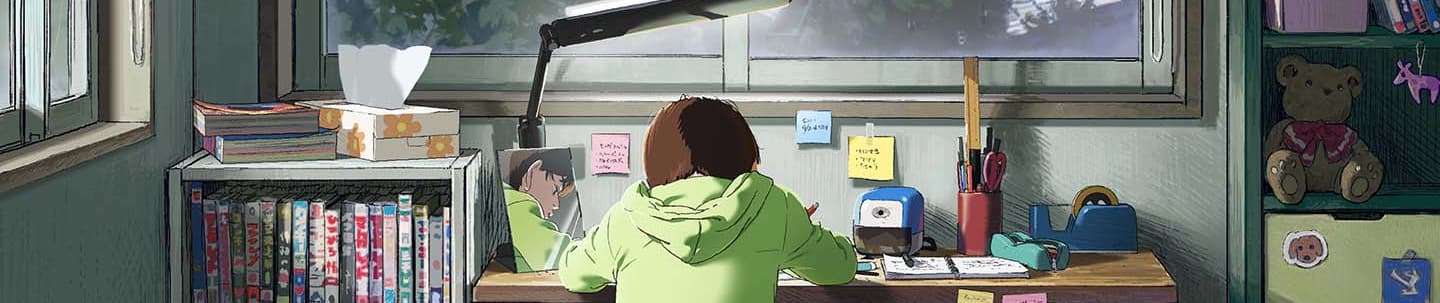
Watching Look Back was an experience that opened my heart to the dimension of the human soul. This work describes the human dimension, human behaviors, emotions, expressions, reactions, reflections, ambitions, shyness, insecurities, and negative emotions in an exquisite way. Fujimoto's work in this sense is incredible. The transparency and sensitivity with which I perceived the protagonist's emotions were incredible.
The story is beautiful—the way the protagonist evolves around Kyomoto’s behavior, the way we discover that her early "abandonment" of manga was actually just a lack of courage, and how, at the first push from her future best friend, the flame reignites: it’s as if she thought, "Now that I see this… I want to live again." Do you see how I feel compelled to give voice to what the characters think?
This is the beauty of Look Back, the way the characters, their emotions, and their psychology revolve around the story with a humanity and a transparency of emotions and behaviors so real that certain actions they take seem obvious—not because they are banal, but because they are human. I didn’t predict anything based on recycled material I’ve seen before; I predicted it based on myself, and this changes everything.
The characters, in every single scene, were so human, so real. Fujino, in every line, is consistent with her humanity, and her characterization happens through this, not through packaged scenes that spoon-feed me who the character is.
Fujino is competitive: she stays up all night drawing manga to avoid losing to Kyomoto. Fujino is selfless: she brings her friend out of her shell to show her the world outside. Fujino is jealous: she points out all the difficulties Kyomoto might encounter at art school, trying to pull her back to her side.
The characters are written in a way that they are built through the progression of the script; there is no pause in the narrative flow to explain who Fujino is. I understand who Fujino is simply by how she lives. And I understand it perfectly, much better than in other cases.
This is complemented by animations and facial expressions that are incredible, beautiful. And this is precisely the point of Look Back, being able to convey these emotions in an incredible way.
I also say that the editing, the cinematography, the screenplay, and the direction act like a flow of sweetness that accompanies these emotions with a sensitivity so delicate that it becomes an emotional flow itself. The direction, the editing, and the screenplay are truly sweet and accompany, with a flow of sweetness, everything that emanates from the characters.
The characters grow perfectly; their growth is justified, and so is their psychology. The choices of both characters are absolutely justifiable. And throughout all of this, the story neither falters nor lacks twists or moments where you would expect clichés that do not exist.
I find that the most beautiful part of the entire work is truly the final scene. Under the notes of that wonderful soundtrack, sweet and delicate like the heart of those who wish to embrace Look Back, that song is a testament to the acceptance of what has happened, the vision of what could have been, and the acceptance that the past is the past, and the realization that you shouldn’t cry over what has ended but be grateful for what has happened.
Fujino imagines a different version of everything, just as an imaginary Kyomoto lives what could have been, resulting in a 4-koma named “look back” which Fujino finds on the floor: in the end, the two planes meet, but reality always prevails. And this is what Fujino understands.
Asking Kyomoto to go out that day was the best choice; otherwise, she wouldn’t have met the woman who changed her life, the woman who, by imagining what could have been if they had never met, inspired her to return to work, understanding that the sweetest fate is realizing that even though Kyomoto is gone, the greatest happiness was having known her.
She returns to work because she understands that Kyomoto was the only reason she kept doing it.
And how does she return to work? With an advice given by Kyomoto.
The advice written on the title of Kyomoto’s manga.
She looked upon Kyomoto’s jacket.
By looking back.
43.5 out of 47 users liked this review
