Shizuku Tsukishima is at a very uncertain time in her life. With high school looming in the distance, and her middle school tenure about to come to a close, she isn’t quite sure what she wants to do with her life, and different forces seem to be pulling her in different directions. For one, she’s been tasked with translating and adapting the classic song Country Roads into Japanese, so that her version of it can be sung at her graduation ceremony. For another, although she does enjoy writing, her true passion is reading, and she starts to notice that a mysterious boy has been checking out every book she borrows from the library before her, which can’t be a coincidence. Of all things though, it’s a wandering obese cat who leads her onto an unexpected path full of life changing encounters and crucial decisions about her future. As all of this unfolds through her seemingly mundane routine, Shizuku is going to find out that the most powerful inspirations in a person’s life can come from some truly unexpected places.
For the longest time, I was under the impression that Whisper of the Heart was an Isao Takahata film, because it just had to be. Nobody at Studio Ghibli knows how to spin magic and deep meaning out of the most mundane stories possible more than him, I thought. But no, not only did Takahata seem to have nothing to do with the production of this film, it was the first Studio Ghibli film to not be directed by Miyazaki(who wrote the screenplay based on an old one-shot manga) or Takahata. Instead, it was actually the one and only directorial project of Yoshifumi Kondo, a long time animator for the studio going back to some of their earliest projects. He passed away not long after the release of this film from an aneurysm that was most likely caused by stress, which was one of the main reasons for Miyazaki’s occasional flirtations with retirement over the years, and it’s a shame because this film is absolutely beautiful.
To start with the animation, it is basically perfect, which is a testament to Kondo’s experience throughout the studio’s history. I don’t think there’s a single point in the film where I thought any kind of budget saving tactics were being used, nor were any corners being cut. The movement of the characters is consistently smooth and graceful, with a ton of extra effort placed into little gestures and unique motions that could have easily been cut without the viewer noticing anything, but which feel so hauntingly natural and believable that they help to flesh out the characters as real people performing real actions. One big reason this works so well is that while these motions may have been technically unnecessary, there isn’t a single scrap of over-animation in the entire movie. Like, how in some animated projects, particularly in the west, it feels like an animator is just showing off, over-exaggerating a character’s movements, mainly for comedy or to desperately keep a child audience’s attention. But no, every motion in this movie feels perfectly authentic.
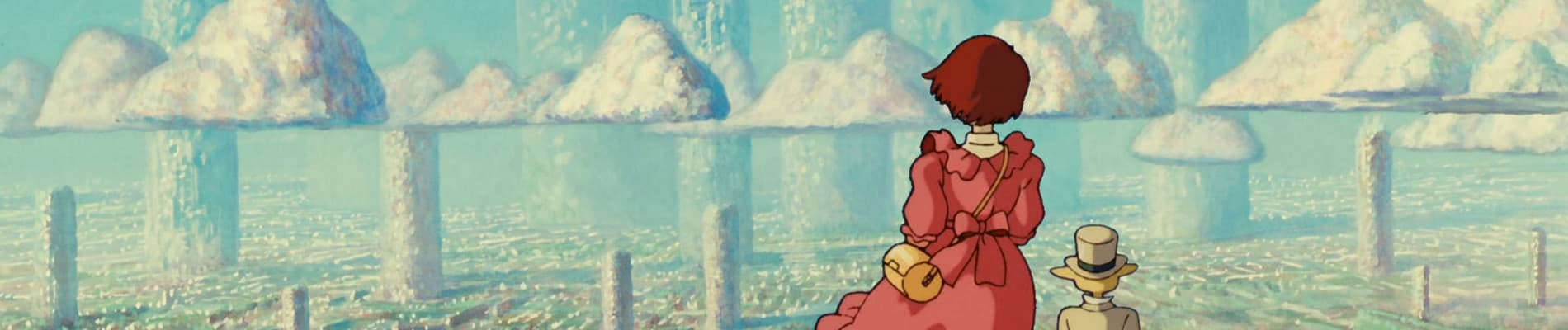
The character designs are your classic Ghibli fare, and I mean that in the best way possible. Bodily proportions are mostly realistic, with slightly simplistic faces for the sake of articulation and expressiveness, but with a loving amount of attention paid to the individual details that separate each character into their own unique look and design, even among the side cast in Shizuku’s class who could barely be called characters to begin with. This all plays a part in the film’s highly grounded and realistic presentation, which also bleeds into the exceptionally detailed and immersive backgrounds, which occasionally go as far as to contain easter eggs from other Ghibli projects if you’re paying enough attention. Shizuku’s family’s apartment has a ton of character to it, feeling either warm and cozy or oppressive and claustrophobic depending on the tone of any given scene, and it does feel like the very specific kind of home this family would have.
The english dub, however, is a bit more of a mixed bag. As far as the actual casting is concerned, it’s mostly pretty good... While most of the Disney distributed Ghibli movies were stuffed with celebrities who were popular at the time, the cast of this one is a bit smaller, with actors who were well known, but hadn’t quite broken out at the time of release. Shizuku is played by Brittany Snow, and while I don’t know much of what she did prior to Kingdom Hearts and Pitch Perfect, she pulls off a damn good performance in this movie, playing an emotionally conflicted character with a ton of range and voice control. Her best friend is played by Ashley Tisdale, who I’ve heard has been in some kind of musical when she was in high school, but more importantly, she was actually best friends with Brittany Snow at the time, and their chemistry definitely shines through in their interactions. Cary Elwes has a cameo as a talking cat in a fantasy sequence, and you know who he is, he’s exactly as good as you’re probably thinking.
The only sour note in the cast is David Gallagher, of Seventh Heaven and Kingdom Hearts fame, who sounds way too old for his character, and while I would normally look past that sort of thing if it resulted in a good performance, well, I’m not looking past it, am I? He’s fine in some moments, but can’t seem to hit the mark in others, and it’s a crying shame that he has the final line in the movie before the credits roll. It is his most hilariously bad line read in the movie, and the credits roll abruptly after he says it. What’s even more of a shame is that he isn’t the dub’s biggest problem. I’ve seen every Studio Ghibli movie at this point, and while I’ve only seen a few of them in Japanese with the subtitles on, one trend you start to notice when watching them in both languages is that they’re often rewritten not so much for cultural reasons like with 4Kids, but to make the dialogue a lot less subtle, presumably so younger audiences can follow the story better. I don’t think Whisper of the Heart is the worst example of this, that would definitely be Kiki’s Delivery Service, but the writing differences in this dub are still frustratingly noticeable and obvious.
I don’t want to go over every example, but there are conversations where extra lines were added to fill silence, entire explanations thrown in to add details that an astute watcher would have picked up on later on, some exchanges that sound quite a bit meaner than they were intended, etcetera, etcetera. The biggest issue is one that I guess was probably considered unavoidable, and that’s with the premise surrounding Country Roads. In the original material, Shizuku was tasked with translating and adapting the song, which makes sense, because it is an English language song. But how to convey that in an English dub? There are probably a bunch of preferable ways to go about this, but Disney decided to change the premise to “Shizuku has to write her own version of the song,” which is something nobody other than Israel Kamakawiwo’ole should ever do. Not only did they add a bunch of weird lines to justify this, using the word ‘corny’ like half a dozen times, but the new lyrics do NOT sound as good as Shizuku’s friends say they do. Her phrasing doesn’t match the song’s structure, and there’s just so much forced rhyming. It’s a good enough dub over-all, but I do strongly recommend the sub.
So before we go any further, there is one little cultural matter that I should address. I mentioned earlier that the rewrites in the dub don’t really address differences in culture, and there is one pretty major one in this movie if you are watching from the western world. To be fair, Japanese culture has a lot of peculiar differences from western culture, and while you’re probably familiar with most of them if you’ve watched a ton of anime, that might not be the case for people who haven’t explored the medium beyond Studio Ghibli’s work, of which there are many. Throughout this film, there’s a lot of discussion about whether Shizuku and another character are planning to go to high school or not, which from a westerner’s perspective, might sound really weird. For Americans, even refusing to go to college is often seen as throwing your life away(an attitude that colleges have ridden to the bank in recent decades) so the idea of skipping high school at all could sound damn near preposterous and unthinkably irresponsible to us, so seeing Shizuku’s parents react to this like it’s a reasonable option for her might weird some western viewers out.
The truth is, and you do kinda pick up on this if you’ve seen a ton of anime, high school isn’t compulsory in Japan like it is here. Rather, high school is kind of treated like College Junior... You have to apply to them, you have to get accepted, and not everyone goes down that path. This is also a very necessary piece of context as to why Shizuku is having such an intense crisis over her future at such a young age, because unlike most western students, she has some serious decisions to make about her future, despite only being at the end of middle school. Most Americans are not toiling over their future career path at that age, but for Shizuku, high school attendance is a legitimate question. It’s really weird that the dub writers didn’t make any effort to explain this concept, although they did make one mistake in the dialogue where her sister says she’ll be nothing without a ‘college education.’
But yes, even though Shizuku is only at the end of middle school, this is a coming of age story, and an exceptional one at that. I’m going to kind of speak in broad strokes here, because there are a lot of smaller moments in the story that may not be spoilers by definition, but that I do think you should experience for yourself, but this is a wonderfully written story, even with Disney’s revisions. Shizuku in particular is an insanely likeable main character. Right from the start, she is bright-eyed, curious, and assertive. She feels like a normal 14 year old, and just to not come off as boring, she has a few unique quirks that may or may not tie into her nature as a writer, like how she has a penchant for romanticising things, like calling the act of creation an act of magic. The exact nature of her relationship to her male counterpart is a bit on the predictable side, but I think it’s still effective, as it unfolds over a very natural and emotionally resonant story arc, with a few good surprises along the way.
For the most part, the story is well paced, and moves with a refreshing efficiency, at least when the story itself is in motion. If I had one criticism to make, it would be that there are a few scenes here and there that feel a bit superfluous, and while I don't outright hate them, I do feel like they could have still been cut for the greater good. Showing the audience that some parts of Shizuku’s life can be boring and frustrating does help her development later on to hit a little stronger, but looking past that, this is a nearly two hour movie that feels like it didn’t really need to be much longer than an hour and a half. Still though, these moments aside, the story usually knows when to move at a brisk and exciting pace, as well as when to slow down so the audience can sink in the ambience of the background or a more deep and thoughtful moment between characters.
But the strongest aspect of the film, and one that ties into all of its other qualities and subject matter beautifully, is the way it portrays the concept of inspiration. The title “Whisper of the Heart” wasn’t just chosen because it sounded pretty, it was chosen to describe something that very literally happens to Shizuku at multiple points of the film. As I mentioned above, Shizuku is in a transitional period, one where she’s trying to figure out who she is, what she wants to do, and how she wants to spend the rest of her life. As the story progresses, she has a number of important encounters that light tiny sparks in her imagination, each one acting as its own little murmur inside of her, until it all build to that one solid realisation; And that realisation is the whisper of her heart, that one moment some people have when everything suddenly clicks into place, and you realize what you were put on this earth to do.
And all of that’s not even factoring in my feelings towards it as a writer. Sure, I’m not a professional, I only write as a hobby, but I see a lot of my experiences reflected in Shizuku, from my early attempts at writing even to my work decades later. From the depression and doubt over a project that you don’t know if you’re ready to write, to the exhilarating rush of finally putting everything down on paper, only to realize it still takes you months to figure out how it all fits together. From the crippling anxiety over putting a finished piece out into the world, tormenting yourself over every perceived flaw you already know about and losing sleep over the question of whether you’re good enough, waiting for someone’s feedback with baited breath, wondering if they’re being honest or just polite with their praise, to the bittersweet end where it's all behind you and you suddenly have time for other things you'd previously shunted aside. Just about every step of Shizuku’s journey feels real, not only to every writer who’s ever existed, but to anyone who has ever had the urge to create something and put it out into the world.
Whisper of the Heart was originally available from Disney, but can now be found on DVD and Blu-Ray from Shout! Factory.
Out of the few down to earth Studio Ghibli movies that don’t contain a hint of supernatural or fanciful moments, Whisper of the Heart is probably the best one. I’d honestly hold it up as one of the top five greatest films from the Studio Ghibli catalogue, a testament to the creative spirit and a heartfelt expression of the passion that drives the creative dreamers of the world. It’s cozy, relatable, impeccably directed and produced, somehow feeling both intimately personal and accessible and timeless at the same time. There are parts of it that may be a little culturally impenetrable, and the pacing could be tightened up so the film could have a better length, but these don’t seem like huge issues in the grand scheme of things. It’s delightful, it’s adorable, and it’s so darn sincere that I can’t recommend it enough for viewers of all ages.
I give Whisper of the Heart a 9/10
19.5 out of 22 users liked this review