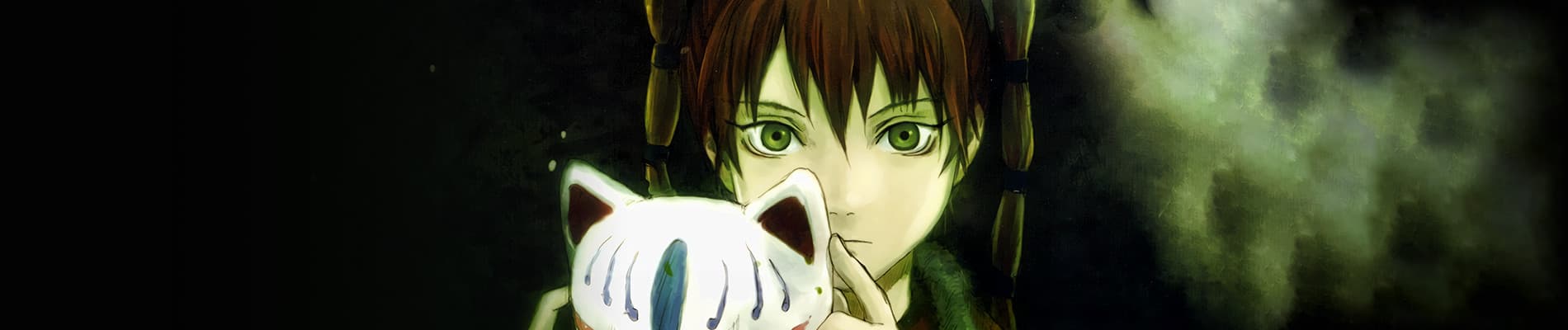
Texhnolyze
a review by nicebenji
a review by nicebenji
Texhnolyze is a tough piece to discuss.
Undeniably grueling, some parts infuriating, the first several episodes allow the city to speak for itself. Even when the plot propels itself away from the downtrodden and dialog-sparse, its shape liquefying and molding to the demands of a far more traditional crime thriller, Texhnolyze's aesthetic initiative is persevering. This is perhaps what I find so confounding about the show: its clearly aptitudinal ability to speak so eloquently to one's artful viscera, while remaining so unapologetically verbose in its nihilism and abnegation for traditional (especially for the medium of anime) plot dynamics. Much has been (perhaps exhaustively) discussed about the latter, far better than I could ever hope to achieve, and so I'd like to focus on the former.
A sprawling melting pot of concrete—artificial light bleeding into its damp, inconsolable chambers—the city of Lux stands statuesque, bathed in the production's unrelenting bloom. A man wanders through the inky, swallowing, crushing shadows on one poor leg, the fuzz and grain of standard definition roughing the peripheries of every object placed purposefully in each of the show’s desolate frames resulting in an almost dream-like effect. I think of the grating, grinding blades of a fan suspended above a quiet, irreparable Ichise as he stands in a room of grimy grout during Texhnolyze’s first episode, or to the blinding, ethereal confines of Kamata's laboratory as she lay nude and isolated. Texhnolyze engages in masterful abstraction in its filming of Lux's cityscape, a keen obsession with atmosphere undeniably paramount in its production. The mise-en-scène is deliberately barren in some parts, while crowded in others—large groups of people congregate in some spaces, and shy away from others. Texhnolyze employs a "montage of attractions" (as famed filmmaker Sergei Eisenstein posited) in order to masterfully achieve its vision. In essence, there is a clearly conscious effort on part of the creators to establish a distinct, unique aesthetic that is sparsely seen in the larger medium the show occupies. It succeeds at this.
Though likely unintentional (but equally likely part of a long-standing tradition evolved upon throughout the duration of the 20th century across multiple mediums), I see analogs to the Russian film theorist Dziga Vertov (Дзига Вертов) and his writings on the “kino-eye”—the necessity for the camera lens to supersede the human eye, the ability for the ordinarily imperceptible to perceptible—in many of Texhnolyze’s visual offerings. Vertov is famous for his montage, documentary-style films throughout the 1920s and 1930s, offering views of realist city-scapes stitched together with clever editing and stark camera angles. The activities of the mundane, the stark lines of architecture, and the dizzying concoction of steel beams and wire marking beacons of industrial prowess are put onto a pedestal by Vertov. There is a distinct lack of intertitles or dialogue, the audience left toiling about in the fleshy soup of their brain to create their own reason and meaning, devoid of traditional (panned at the time by Vertov as the detestable Russo-German psychological style) narrative. It was, as Vertov called it, “an affirm[ation of] the future of cinema art by rejecting [the] present… purging [cinema] of its hangers-on… and [moving] into the open, into four dimensional space, in search of our own material, meter, and rhythm” (Vertov, ‘A Version of a Manifesto,’ Kino Fot, no.1, August 1922). Indeed, the so-called “city symphony” (which would arguably be perfected later in Godfrey Reggio’s more famous Koyaanisqatsi) is birthed in part due to Vertov’s efforts. Texhnolyze is equal parts a crime, psychological thriller as it is symphony for a city that does not exist.
Much more can and will be discussed in far greater detail (and by those far more intelligent than I am) in terms of Texhnolyze’s narrative and visual offerings, but I felt compelled to put my piece out there as a largely passive, grossly obsessed observer in large part to fill a gaping hole left in my brain upon completion of the series. Texhnolyze is an awfully visceral visual and narrative experience that, even if sometimes dragging in its direct presentation (shots linger, dialogue is sparse), is nonetheless striking and worthy of appreciation for its wholly unique contributions to the medium of anime.
34 out of 35 users liked this review
