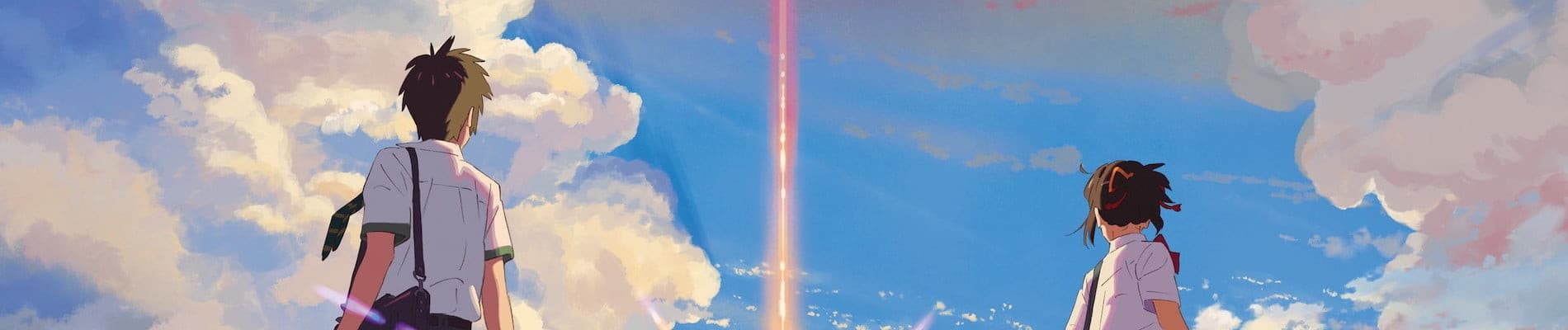
Your Name.
a review by Kroioo
a review by Kroioo
Your Name is an absolute masterpiece of Eastern animation. I firmly believe—absolutely believe—that just because something is widely loved doesn’t necessarily mean it’s a masterpiece. I don’t justify calling something a masterpiece simply because the masses appreciate it. Mass enjoyment doesn’t have to define the objective quality of a product. But Your Name is an exception. Your Name is loved by many, and it truly is a masterpiece.
Perfect animation, breathtaking soundtracks, intelligent and well-crafted direction, and one of the best screenplays in anime films—it flows perfectly.
But what is it that truly makes Your Name special? Beyond the main focus of this review (which will be something else), I want to briefly highlight how Your Name takes such an overused and recycled theme—body swapping—and makes it feel like something never seen before. And how does it do that? Through its screenplay choices, storytelling, narration, and the seamless blend of animation and music. The Your Name soundtrack, paired with its animation, genuinely elevates and ennobles a theme that has been recycled to exhaustion, transforming it into something entirely fresh.
The Zen Zen Zense scene by RADWIMPS was tear-jerking for me. The way that, through that song, those drawings, that animation—that artistic fusion—the film introduces and portrays the moment when the characters truly realize they are swapping bodies was priceless.
I’m the kind of person who, unless faced with a scene that is objectively obscene—unless I’m watching someone fart and then sniff their own fart—will always be moved by a scene with even a hint of emotional depth. And if that scene is told in a completely normal way, it’s already impactful. But if that same scene is enriched with a breathtaking soundtrack, with direction and screenplay choices that aren’t just there because they look nice, but because they were designed to enhance that moment, to revolve around elevating that scene—then, for me, it takes on an entirely new meaning. And Your Name did exactly that.
But now, I want to return to the main focus of this review: why is Your Name so unfairly criticized by the masses or by so many people who have either seen it or haven’t? The main critique is that it’s just a “simple little film” with a “tiny plot.”
Well, do you know the concept of lore? If you’ve played FromSoftware games by Hidetaka Miyazaki or if you’ve watched Evangelion, you know what I’m talking about. Lore is an unspoken story. It’s a narrative that isn’t spoon-fed directly into the viewer’s or player’s face. It’s a story that’s there but also not there, that exists but requires discovery. It’s a narrative that demands deep engagement, a maximum connection between the experiencer and the experienced.
Well, believe it or not, Your Name has lore. And if you watch the film multiple times, you’ll realize that Makoto Shinkai did an outstanding job in creating a dual-layered experience in Your Name. There’s a lighthearted layer for those who just want to enjoy a film about two kids and their love story. And then there’s a deeper layer for those who want to understand the ancestral narrative reasons behind this mystical story.
So, folks, today I am here to tell you about the lore behind Your Name.
A comet falls approximately every 1200 years in the same spot in Japan. It has fallen at least twice: the first time, it formed a lake, upon which a shrine was later built; the second time, it gave rise to a village whose inhabitants became a dynasty of devotees to this shrine.
The comet is a kind of cosmic divine entity known as musubi: it not only falls periodically in the same place, but it also possesses the power to change, intertwine, and influence people’s destinies over time. In the film, the trails, colors, and aura the comet emits are anything but natural; its fall and the trail it leaves are the material expression of its divine essence. But what exactly is this essence?
Hitoha, Mitsuha’s grandmother, explains: “Musubi is the old term for the local guardian god. This word holds deep meaning. Tying thread is Musubi. Connecting people is Musubi. The flow of time is Musubi. These are all the god’s power. So the braided cords we make are the god’s art and represent the flow of time itself. They twist, tangle, sometimes unravel, break, then connect again. Musubi—knotting. That is time.”
Here, we arrive at the first important conclusion: the comet is the god of the Miyamizu, an entity that transcends time.
Musubi thus holds the power to intertwine and transcend the time of those who worship it. In Itomori, the Miyamizu culture, which built a shrine on the site of the first comet impact and depicted the comet as a divine symbol, established a priestly cult centered on a fundamental ritual. The Miyamizu fully understood their connection with the comet and its powers, creating a ritual to consolidate their relationship with the deity: the sacred dance that Mitsuha and Yotsuha perform at the start of the film.
This dance serves to create two things:
1)The red thread, containing the connection between the Miyamizu and their past.
2)The kuchikamisake: a fermented sake representing a part of the individual, offered to the comet as a sign of devotion.
Thus, the purpose of the ritual was to create two objects symbolizing a half of oneself: one remained with the individual, while the other was entrusted to the comet.
In 1813, a fire destroyed all written records about the meaning of these rituals. Although the efficacy and value of the rituals remained unchanged, from that point on, the Miyamizu civilization would no longer remember its connection with the comet or the true meaning of the rituals: all they know is that they worship a deity connected to threads and that the rituals are part of their tradition.
In 2013, Mitsuha, a girl from Itomori, discovers that she cannot remember anything from the previous day. She later realizes that when she sleeps, she finds herself in the body of Taki, a boy from Tokyo who lives in 2016, three years in the future. Between one swap and another, however, Mitsuha loses her life in 2013 due to a new fall of the comet.
At this point, we understand the meaning of the exchange and the reason for everything that happens. Musubi, the comet, can intertwine the fate of a Miyamizu with another person by swapping their bodies across time. It does this because, in the lives of both the first and second person, the Miyamizu dies.
The body swap serves to save the life of those who worship Musubi: by entering the Miyamizu’s body in the past, a person can foresee their death and, by returning to the past, gain the opportunity to save them. For example, Toshiki, Mitsuha’s father, once experienced a swap with his wife Futaba to try to save her, but he failed. Toshiki himself says, “I couldn’t save her,” after his wife’s death.
Another important detail about these exchanges is that they occur during sleep: one night for one person corresponds to an entire day of possession for the other. This cycle continues until the exchanges stop, which are not simultaneous but happen like time-traveling journeys, living an entire day in a single night.
Key questions:
1)Why do they stop swapping?
Musubi creates a connection between Mitsuha and Taki, separated by three years. Mitsuha, in love, looks for him in Tokyo, but he doesn’t recognize her. She then gives him her red thread, making their timelines strictly bound by the exact three-year interval: from that moment, every event in one timeline must happen exactly three years after (or before) it occurs in the other. For this reason, their swaps are interrupted. Mitsuha dies at the exact moment Taki wakes up crying.
2)How is the swap restored?
The kuchikamisake, representing half of the Miyamizu, allows Taki, by drinking it, to reconnect with Mitsuha and reactivate the swap. This triggers an unusual exchange, in which Musubi decides to reopen the link.
3)How do they meet?
The Kataware-doki is a sacred event for the Miyamizu: at twilight, worlds merge, and time is transcended. Given the exact three-year interval between them, this allows them to meet briefly. When Taki returns the red thread to Mitsuha, the bond between them vanishes.
4)Why do they forget each other?
When they go to the temple together, Hitoha explains that to return to that sacred place, one must give up what is most important. Taki and Mitsuha sacrifice their memory of each other to save their community.
However, the bond that Musubi created remains intact, which is why they continue to feel a subtle connection. In the future, they both feel as if they are searching for someone without knowing who it is. Until, on that staircase, they meet, and they ask the only question that can reconnect them to that inexplicable bond.
I hope everything is clear. Thank you, Shinkai Sensei, for this masterpiece.
30.5 out of 33 users liked this review
