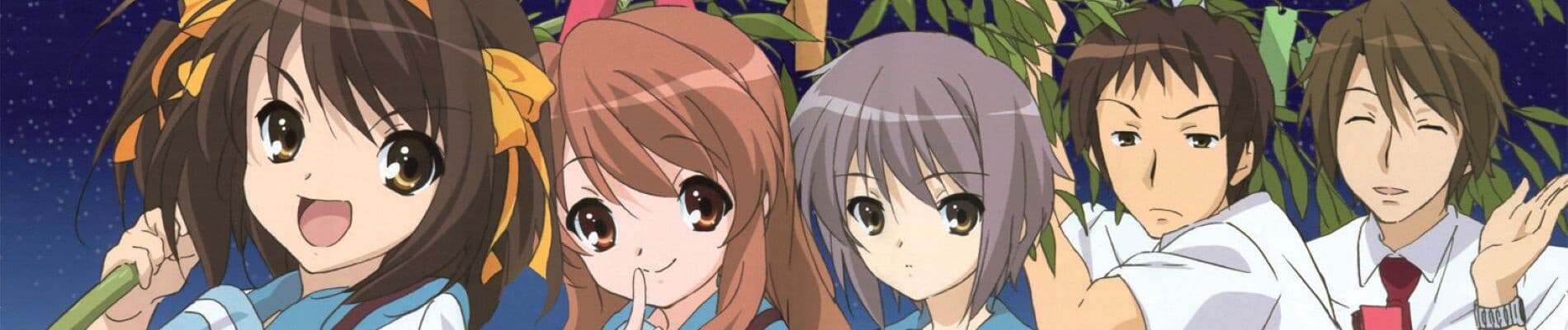
Have you ever considered the world around you, and just how boring it really is? Why is reality so painfully normal, while all of the cool supernatural shit is relegated to fiction? Are there seriously no aliens, time travelers or people with genuine psychic powers out there living among us? Are there no ghosts, no monsters, no miracles? This is how Haruhi Suzumiya started thinking when she was a child, and it occurred to her how not special she was, in a world filled with billions of other people. To cope with this, she decided to dedicate her life to hunting down the supernatural wonders of the world, but what she doesn’t realize is that they’re closer to her than she thinks. Not long after entering high school, she befriends a small assortment of oddities who she coerces into joining a club with her. This group is composed of a time traveler, an alien, an esper, and a perfectly ordinary boy whom she chooses as her ultimate lackey and sarcastic soul mate. Together, these four club mates have taken on the responsibility of keeping her under control, placating her and preventing her from destroying the foundations of reality with her own undiscovered god-like powers. Whether they’re filming a movie, arguing with a cat or navigating a time loop, it’s a thankless job, but somebody has to do it.
Before I go any further, we need to stop for a second and iron out exactly what kind of review this is going to be. The Haruhi Suzumiya franchise has had a long and confusing release history... The first season was originally aired out of order on TV, much like Fox did to Firefly and Titus, and later released physically in proper order. This was due to the fact that if they told the story in the order the light novels told it, the story structure of the season would be harshly unbalanced, with the climax hitting at the halfway point. Scrambling the episodes produced a much tighter structure, at the expense of a far more confusing story, so you can imagine it was kind of a catch 22. As for me, I was NOT involved in any major online anime platforms at the time, and I have NEVER kept up with seasonal releases, so my exposure to the series was through the first two US released DVDs, so basically the main story and the baseball episode, which I watched to nearly the point of wearing the disks out. When I got disks three and four, I just sort of treated them like extra material, so the poor structure of the first season never bothered me.
To this day, I have never seen the series in the scrambled order, despite numerous fans telling me that it’s the right way to go, and I don’t know if I ever will. But hey, at least there’s no confusion over the second season, right? I mean, I bought the US DVD release when that came out, and that just had all 14 new episodes in order, and I never watched it any other way, so that’s fine, right? Wrong. I learned for the first time this week that the 14 new episodes weren’t originally released as a new season. Rather, they were spliced into the first season, mixed up to appear in chronological order, and released as the full 28 episode series, and I’m sorry, I can’t, I’m not doing that. I’ve already reviewed the first season, and while it may be one of my weaker reviews, I don’t want to retread old ground. But I also didn’t sit through all eight episodes of Endless Eight for the first time in 15 years just to cancel the review, so despite what the listing I’m posting this under may say, I am only reviewing the second season, as I know it, from the stateside DVD release all those years ago. This is a review focusing exclusively on the 2009 material, and I’m doing this for more than just the fact that this is what I’m used to.
Another reason is, if I were to watch it in spliced chronological order, I imagine there are a few jarring inconsistencies I’d have to get over. For one, each season has a different opening theme, and I can’t imagine a good solution to that problem. For another, there’s the rising and falling animation quality between episodes. The Haruhi Suzumiya franchise was produced by Kyoto Animation, one of the more infamous anime studios in operation, as well as being both critically acclaimed and commercially popular. The flipside to that detail is that this season came out in 2009. Now, back in the early to mid 2000s, Kyoto Animation was known for having high budget, immaculately polished animation with solid models, graceful movement and beautiful lighting, and a directorial vision that was highly avant-garde and quirky. The direction could have almost been compared to the work of Akiyuki Shinbou for the Monogatari franchise, although director Tatsuya Ishihara was far less pretentious and indulgent about it.
Well, that may be how Kyoto Animation’s output looked in 2007, things took a drastic turn in 2009. If you were paying attention at the time, you might have noticed a sharp change in visual style, as Kyoto Animation transitioned pretty quickly from the solid, graceful animation of the past to a far more low budget style that prioritizes facial close-ups and constant animation loops, with any extensive motion giving up solid frames for what is popularly referred to as the “Runny eggs” approach that animates characters in cheap, simple broken shapes that are not on good terms with the pause button. The director of this series is usually clever enough to shoot these shots from a distance, which is something most runny eggs anime don’t give enough of a shit to do. KyoAni would use this approach for K-On! and the second season of Clannad, and I distinctly remember JC Staff abusing it on quite a few of their shows around the same time, and while I mostly try to excuse it in Toradora, I am not a fan of this aesthetic.
There are a few impressive CG effects here and there, most notably with the water when the cast visits a public pool, but it’s not enough to distract from how obviously cheap this season looks compared to the first season. The visual direction also feels less inspired and a bit more bland. Either way, I’d have to assume that these differences must make watching in chronological order feel like a roller coaster of production quality. Things get better in the final story arc, but even then, background extras and unnamed students at Haruhi’s school just remain still, which is disappointing when they used to have so much life in them. Still, I give them credit for not taking Endless Eight as an excuse to recycle animation. Or maybe they did, I don’t know, I’m not going to start comparing shots.
The English dub is basically the same as it was in the first season, with the entire cast reprising their roles, and really nobody else being added. I’ve never been in love with Wendee Lee’s portrayal of Haruhi, I could think of some much better actors who could have provided a better take on Aya Hirano’s trademarked spark of peppy insanity. Still, she does it well enough, and there is at least one scene she nails, where her and Kyon have an uncomfortably explosive fight. Crispin Freeman is still iconic as the snarky, long-suffering Kyon, although maybe his references this time have gotten a little too obscure for my tastes. His phrasing can also come off as too ‘forced casual,’ but he does his job. Stephanie Sheh has to do a lot more emotional acting than she did with Asahina the first season, because her character gets put through the wringer this time. Poor Johnny Yong Bosch and Michelle Ruff are stuck on exposition duty, and it’s a bit rougher this time around, having to repeat the same explanations eight times. I’ve heard Bosch in an interview state that this was so frustrating, they tried to ask the Japanese showrunners if they could do something wild like trade characters between themselves just to shake things up a little, but it never went through.
Much like the first season, this new batch of episodes is sort of an anthology series... Rather than one continuous story, it offers a bunch of smaller stories from the lives of these characters, with an obvious focus on Kyon and Haruhi. And also much like the first season, they are not subtle about it. Anyway, because of this, I feel like the best way to review it is to look at it segment by segment, starting with the one-off first episode, Bamboo Leaf Rhapsody. Out of all the new episodes, this is the only one you absolutely cannot skip. In addition to just generally being a good episode, it has an important role in the main story of the series, as it resolves some previously introduced mysteries, offers some more coverage of the show’s core concepts, and sets up the movie. I won’t spoil what happens in it, just that it’s a lot, and I’d go as far as to say that in my opinion, the best way to watch this series would be to watch the six episode main story of season 1, followed by this, and then the movie.
It’s probably not promising to say things are all downhill after episode 1, but that is kind of the case, because the next segment is arguably the most infamous detail about the franchise, Endless Eight. What essentially happens is, Haruhi wants to spend the summer with her friends, but she feels unfulfilled at the end, so the cast gets stuck in a timeloop, reliving the same two week period over 15,000 times. If you're reading the light novels, this story only happens once, and you only have to sit through one of those loops, with the title of the arc just being a reference to the infinity symbol looking like an 8 when tipped over. If you’re watching the anime, Kyoto Animation made the incredibly ballsy decision to stretch this story across eight entire episodes, just reanimated, reshot and rerecorded with slight differences. As you can imagine, this has been a massively divisive decision, and may or may not play a role in the franchise’s rapid decline in popularity after 2010.
I’m not going to lie to you, I think this was a bad idea. The only reason I can think of for why they went through with it would be because they were drunk on their success and decided they could get away with literally anything, like that Family Guy joke about Brian Cranston winning an award for sneezing. And again, this story happened one time in the books, and I personally think three would have been the right number for the anime. The first summer, folowed by a random one where they discover their circumstances and try to fix things, and a conclusion where they do. But no, you see the same fucking episode 8 times, with any differences being cosmetic at best. It’s even mentioned that some loops did different things or skipped an activity or two, and we don’t even get to see THOSE loops. It’s honestly kind of hard to sit through, I did it this week for the first time in 15 years, and it was tedious as fuck. Even the small joy of seeing the female cast in different bathing suits each episode doesn’t amount to much, thanks to the lowered animation budget.
It’s not high praise to say that the best thing about a story arc is the fact that it’s easy to skip, but gorram it am I glad you can easily glide right past 5-6 episodes without missing anything. Not even anything important, just ANYTHING. That’s not to say there’s nothing else good about this story though... I like these characters more than a lot of people do, and I like seeing them fuck around and have fun, so I have no issue seeing them enjoy the summer together, I just don’t want to see it eight fucking times. I also do like seeing Mikuru, in tears, saying “classified information” over and over again while trying to explain the situation. You could make the argument that seeing all eight episodes puts you in a certain characters’ shoes so you can understand the actions she takes in the movie, and I guess you’re not wrong about that, but that’s nothing you couldn’t accomplish by just seeing the time loop three times. Beyond that, I’ve yet to hear a positive argument for this arc that wasn’t making excuses for it, downplaying it, or praising it for being such a successful troll on the audience.
For the final story arc, we have the backstory for the movie that the SOS Brigade showed at the culture festival for their school, and I’m going to call this arc the optional one, because there are reasons it’s worth watching, and reasons why it’s really not. To start, it’s one of the only long term, continuous stories that the franchise has, or at least just one of the only two that isn’t the same episodes eight times. It’s worth watching because it explains away every single bit of weirdness and awkward filmmaking that was in the festival movie, and it does not disappoint, these details are fascinating to discover and to watch them play out. I’ve said many times I like seeing cool and interesting ideas get explored, and this franchise has always been pretty good about leaving none of its toys unplayed with, but this arc takes it several steps farther. We see a lot more of what Haruhi and Yuki in particular are capable of, as well as some tantalizing clues to the true dynamic between Mikuru and Itsuki maybe not being as cordial as it appears on the surface, and all of that is really cool.
It’s also kind of not worth watching, because Haruhi gets downright nasty in this arc. Yeah, I know, she has some behavioral issues throughout the rest of the franchise, but there’s always some level of charm behind it, or a feeling that she values her friends more than she lets on. In this arc, however, she is filming her movie, which not only begins to screw with reality in some genuinely scary ways, but she gets drunk on power and takes her abuse of Mikuru to a whole new level. And yeah, that also existed before... Haruhi sexually exploits Mikuru, while Kyon makes some feeble attempt to object, although he ultimately just complies while ogling and objectifying her as well. In this story arc, though, it stops being funny and becomes uncomfortable. I’m pretty sure that was intentional, as when Haruhi takes things TOO far, the music starts to become ominous and Kyon finally snaps at her for it, but the resolution to this conflict falls flatter than a week old can of coke.
This was also the arc that made me realize just how much the Haruhi franchise loves the sound of it’s own voice. Yeah, there was a lot a lot a lot a lot of talking in the first season, but I liked pretty much all of it. I liked hearing each character describe the nature of their abilities to the tune of trippy visuals. I found Itsuki's lecture on the anthropic principle fascinating. But hearing Yuki and Itsuki describe what was happening in Endless Eight every time? Annoying. Having Kyon continue to reject Haruhi’s godhood long after it had been proven, and the amount of boring conversations it took them to realize how the movie was affecting her powers? Stupid. There’s a point where they try to introduce Mikuru’s take on Haruhi’s godhood, that she doesn’t change reality, she just finds abnormalities that are already there. This is fucking stupid, because if that were true, then Haruhi just happened to conveniently find multiple contact lenses that shoot laser beams. Why are you actively disproving a concept you’re just now trying to introduce? I mean fuck, even the Kyonism theory makes more sense than that.
So that’s one really good episode, one really bad arc, and one arc I have mixed feelings toward. That doesn’t add up to a high recommendation, does it? Well, speaking as someone who was at one point a hardcore Haruhi fanboy, I just don’t feel the same magic in this one as I felt in both season one and the movie. It just feels like a bunch of optional content, like a glorified OVA that somehow went full length and aired on TV. Hell, being aired on TV WITH the first season content was probably a godsend for it, because it wouldn’t have survived if Kyoto Animation had sent it out on its own. And no, I don't think Endless Eight is the worst anime story arc of all time, but that’s only because the Lost Island arc from Nadia still holds that distinction.
The Melancholy of Haruhi Suzumiya was originally available from Bandai, before getting picked up by Funimation, who are now owned by Crunchyroll, so that’s probably where it lives now. Several analog series, including two chibi spin-offs and an alternate timeline featuring the theatrical version of Yuki as the protagonist, are available from Crunchyroll as well. Manga adaptations of both the series and a chibi spin-off are available from Yen Press, and the original light novels are available from Yen On. The DVDs contain some pretty fun live action vignettes following the ASOS Brigade, they’re pretty charming, check them out if you can.
At one point in history, The Melancholy of Haruhi Suzumiya was on top of the world for otakus both stateside and back in Japan, and yet instead of enduring as a titan of the medium, any steam the franchise had died only a few short years after it began. Not only does it not get discussed online much anymore(Watchmojo anime lists rarely ever mention it for anything) but nobody asks for more of it, despite the fact that there’s a ton of new material in the light novels that they could animate, and some of it’s genuinely good stuff. We will never know for certain why this almighty star has fallen, whether it’s due to the tastes of the otaku landscape evolving, or whether it’s because it was so influential that everything that was good about it has been beaten into the ground by lesser titles, but I have to imagine that season 2... Especially Endless Eight... Didn’t help matters any. This season was extremely hit or miss, with a good first episode, and then the occasional good moment peppered here and there throughout the rest, and while the movie may have earned back a lot of the good will this season squandered, it was too little too late.
I give season 2 of The Melancholy of Haruhi Suzumiya a 4/10
31 out of 55 users liked this review
