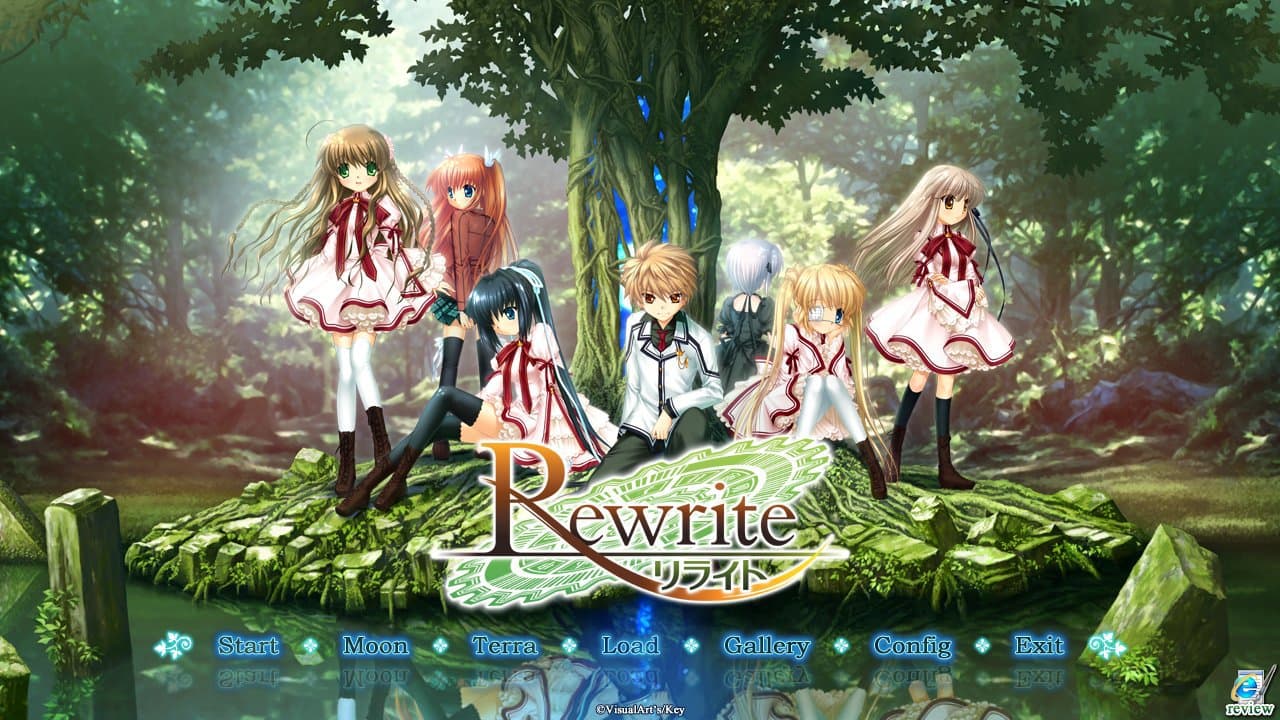
I suppose I should get my biases out of the way as soon as possible. Despite being a huge fan of visual novels, I’m far from one of those typical haters who claim that most visual novel-to-anime adaptations suck. Quite frankly, I don’t expect modern anime budgets or modern viewers to have the time to sit through a 50+ episode anime that fully adapts a 50+ hour visual novel. Even if they're watching weekly, that’s a huge commitment. The only exception most people make is Clannad + After Story, and that’s only because people simp for Kyoto Animation. When JC Staff adapted Little Busters!—which had similar writing quality and structure to Clannad—people ignored it just because it wasn’t KyoAni.
That said, Rewrite, despite being a visual novel by Key (the same developers of Clannad and Little Busters!), has a much different writing style and genre. While it features a similar male protagonist and five-heroine harem setup, it’s not a romance-heavy series at all. It leans more into fantasy action or, as visual novel fans call it, "chuuni." It also focuses on environmentalism, but in the original visual novel, this aspect was a plot twist and genre shift—one I doubt modern audiences would have the patience to wait for in an anime adaptation.
Since Rewrite isn’t a romance-heavy slice-of-life series like Clannad or Little Busters!, and since each heroine’s route goes in drastically different directions, adapting it faithfully would be nearly impossible. The only real way would have been using the omnibus format like Amagami SS, which most companies refuse to do for some reason. Rewrite would have needed at least 30–40 episodes just to cover all the route content, including the lengthy common route.
With that in mind, I think Rewrite Season 1 opting for an anime-original ending doesn’t get enough credit. Many of the original visual novel fans were upset that their favorite heroine routes weren’t adapted, but I don’t think it was possible. Instead, this original arc was the best way to tease the visual novel while providing an ending that actually makes sense within the universe—especially with Season 2, which serves as the true ending and is a much more faithful adaptation.
Now, conceptually, an anime-original ending isn’t a bad idea—but what about the execution? I think it’s decent but definitely flawed, though nowhere near as bad as people claim.
The decision to spend a few early episodes focusing on slice-of-life comedy before diving into serious plot elements was a good call. A fully faithful adaptation would have required 5–10 episodes of pure slice-of-life, which would bore many anime watchers. Even in the visual novel, I thought the buildup to the fantasy action took too long.
Minor visual novel spoilers: there isn’t a single non-true route where all the main heroines stick together after the common route due to serious drama reasons. This means that Rewrite Season 1 actually provides an anime-original ending that allows the club members to stay together, making for a relatively cathartic conclusion to the slice-of-life camaraderie. Could it have been executed better emotionally? Sure. But the wholesome character interactions were handled well.
The anime tries to tease backstories for the heroines without fully developing them as in the visual novel. If Rewrite Season 1 had at least 26 episodes, it might have been possible to flesh out the heroines better, but with a typical 13-episode budget, they did what they could—even if the pacing was all over the place.
A lot of people take issue with Kagari’s personality change for the anime-original ending, but I actually don’t mind it. It better sets up Season 2, where she becomes the proper main heroine. In the visual novel, she often felt like a plot device, and Kotarou’s romantic feelings for her didn’t make much sense. The anime gives her more presence, which I appreciate.
That said, the season still has flaws that hold me back from loving it as much as I wish I could. While the comedy was generally good, I was disappointed that some of the funniest moments from the visual novel’s common route didn’t make it in—like Kotori’s famous “Shake it now, baby now” Engrish. Some anime-original jokes were hit-or-miss, such as Kotori’s repeated “Fushidara NG” (localized as “Keep it PG”), which was used only a couple of times in the visual novel but four or five times in the anime.
The way character backstories were handled was messy. Shizuru, for example, gets a serious episode but is then largely ignored. Lucia seems like she’s starting character development, but it’s immediately regressed because it wouldn’t fit with the rest of the plot. I liked the idea of making viewers care about the heroines more quickly than in the visual novel, but the execution felt sporadic and could have been much cleaner.
Overall, Rewrite Season 1 serves as a decent teaser to see if you care about the world and characters. If you do, I highly recommend checking out the original visual novel to get the full story (you can buy it on Steam as: Rewrite+), some routes are pretty important for Season 2. As a standalone product, Season 1 is a fun time, but it’s not the first fantasy-action title I’d recommend unless a particular character interests you or you’re curious about the visual novel.
Alternatively, if you were a fan of the original visual novel and just want to see certain scenes and characters animated, this could work. But if you’re someone who gets angry about incomplete adaptations, you might want to reconsider watching—because your favorite route likely won’t be there.
6.5 out of 8 users liked this review
