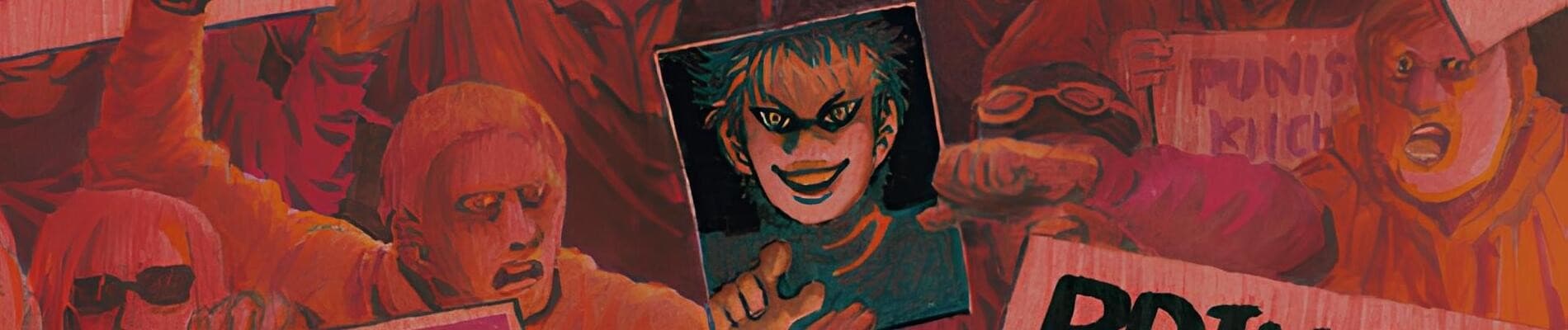
Kiichi!! ended with an awakening of Japan. Kai and Kiichi had achieved to broadcast the prostitution scandal and send out a message to the country. Ten years later the fight is still ongoing but in a much different way.
Raw violence is not the solution to change the system. To truly create a better world they have to gain political power - Kiichi has to become prime minister. At least that's what Kai thinks. His and Kiichi’s relationship has become much more tense after the timeskip. He is a realist that has to deal with the logistics and finances of the company while Kiichi relaxes and dreams about a better world.
The Kurita warehouse affair becomes the main subject for the second volume. After the government abolishes laws that overview the health standards of meat, a disease starts infecting cows. To save costs and avoid profit loss a company called “Green Pastures” starts repackaging imported meat as Japanese meat. Employees are pressured from above and have no choice but to comply as they are reliant on their wages.
When calling Mr. Kase Kurita gets a song lyric as a response - “From tomorrow on, I’ll live like today!” The lyrics basically depicted the point of the story. It contradicts itself and shows the never-ending cycle of compliance to the system. Becoming an accomplice to the system is the safest choice and Kurita slowly realizes how he had never questioned this way of living. He himself thought that marrying his daughter would ensure a safe life for her, although he was opposed to it originally.
As soon as the scandal comes to light, Green Pastures manages to twist the situation. They show their fired workers and picture themselves in an empathic way. The media attention quickly dies down and Kurita is left with a failed company. Unemployed workers become mad at Kurita even though he did the right thing.
“Justice and integrity, we don’t fill our stomachs with that”
Kurita did the right thing, he exposed companies that were willing to sacrifice the health of consumers for extra profit but the media twisted the narrative and even his own workers became mad at him, as he had ruined the company. If standing up to injustice results in nothing then what is the right thing to do?
“Why does no one help those who fight against the state? Because there is nothing to gain from that.”
Changing the system might require you to give up all your comfort, sacrifice what you have built and there is nothing you will gain from it. It’s not surprising that most people do not possess the strength to do so.

“So open your fucking ears now, those who fail to protect the country are deceiving you, stop believing in them!! The rich are also deceiving you! They are your enemies, stop believing in them!! The police is at their orders, stop believing in them!! The law? Bullshit to serve their interests, stop believing in it!! The ones you see on TV, the ones who write the newspapers, they only defend those who drool over money, stop believing in them!! The deities and the buddhas, they’re just tools to make more money, stop believing in them!! All those things you used to have faith in, stop believing in them!! Because me, from now on, all of you who never doubt, all of you who never get angry.. I don’t believe in you anymore!!”
Kiichi’s final speech in the Budokan arena is the highlight of the first few volumes. He declares war to all of society, to all of those who put profit over people and to all of those who ignore what is happening. It also causes Kiichi and Kai to finally have an eye to eye talk. It has been 10 years since they met and both of them have changed. Kai has grown into a full fledged businessman who has to manage the company to ensure that Kiichi’s revolution will succeed. This is where the conflict between both of them ensues. Kiichi is an idealist, partially reliant on the fact that he is simply too stupid to understand revolution from a financial standpoint, who does not agree with Kai’s way of working. Contrast to this is Kai, who has become sick of Kiichi’s inflexible dreams and ideals. They have a heated debate that results in Kiichi realizing that he will finally have to act.
“Kai if we’re going to rip everything out, we have to remove things down to the roots”
“We swear that neither them nor their associates will have a single day of peace. We swear it! They will shiver in their sleep.”
The Haramita Theatre Group is a group united by anger and hatred. Each member was in some way abandoned by society and now bears a deep grudge against it. Kiichi resents this deeply. When Aya first tells him of their agenda he tells her that anger does not suit her. Their reason for rejecting the method of killing government leaders is that it is a selfish act for one's own pleasure. The Haramita admit to it as well, their plans are not for any greater good. They simply have been done wrong by the entity called the nation and want to let their anger out.
But this anger will never go away. Politicians will be replaced or even gain sympathy after their death. Kiichi tells Aya that she should not dirty herself and stay beautiful the way she already is. Taking the easy route and letting your anger out is seen as dirty by Kiichi. In contrast to this is accepting what has happened and learning to live with it. His parents were humans that were killed by another human. Aya is beautiful because she has been enduring the pain of losing her son for so long. She shouldn’t fall victim to her anger and become a slave to it.
In a way it’s an analogy to the greed and selfishness of the average citizen and also shows how hypocritical the members of the Haramita are. They pretend they are something better by criticizing society constantly but all of them only follow their own interests. There is no difference between them and the average citizen, both follow the easy way and chase their own desires.
“The people who keep blabbering about the world yet do nothing, only cause they hate violence, those who want to change the world, yet think that as long as they themselves are fine, everything, just everything with the current situation is all right. If you don’t drag tose people in your plan too, and try to change them and the world altogether. The anger that you have, it will never ever go away!”
Revolution cannot be done with a pretentious group that only cares about themselves. To truly change society you have to take the people with you. Even if they are dumb, oblivious and compliant. You have to help them too.
In the final scene of the hanging Aya threatens to kill Kiichi if he doesn’t cooperate. He himself kicks away the ladder he was standing on so that he dies. He will not let Aya dirty himself and would rather kill himself. A true testament to his iron will.
So far Kiichi VS has been centered around Japan only but it does not stop there. Although the occupation of Japan officially ended in 1952 the US still has military bases in japan which are used by soldiers. When soldiers commit a crime in Japan they are often protected by the US who won’t allow local police to prosecute the soldier even though they might be guilty. Aya’s son was killed by a speeding US soldier and the military instantly found an excuse to free the soldier from any punishment.

Kiichi’s version of russian roulette is his way of showing that he is finally committed to his revolution. He tells the four killers that they should forget about what is to gain or lose and to just follow him. After it he calls Kai and tells him he won’t be returning to the company. He is ready to die for his goals and no longer fears anything.
Following this is the start of the three kidnappings. They gather info on their targets and Kiichi visits old man Toraji who tells them an interesting story about a goldfish he found:
“The fish who hates the world he lives in, I want to see if he has the power to destroy its own aquarium. So once you’ll be ready to change the world at the risk of dying with it, I’ll lend you all my power”
Kiichi has not yet proved to him that he is ready to die. He might have told him about his plans but so far he has not done anything.
“And our thing it’ll be just like the elections: After we’ve done it, nothing will have changed! Shit, it’s not because we kidnap 3 big jerks that the world will shake in fear!! It’ll just be another subject of conversation for those who have nothing else to do. But it still has some meaning!!”
The kidnapping won’t suddenly change Japan but it will set the country on fire.

After reuniting with Kai and teaching the group of kids the truth about Japan’s political system, Kiichi finally reveals the reason for the kidnapping: It was to save the woman he loves. If he had not intervened Aya would have become dirty.
In his final public speech he admits that he won’t be able to change the world. He wants to do what he likes and not fight for any longer. Now it is the public's responsibility to do something. Every person has the responsibility to keep the system working. Following the reveal that he is the one who kidnapped the politicians the public becomes conflicted and some rebuke his actions. Others question if there even is any choice left other than what Kiichi did.
“If the state becomes oppressive and starts doing whatever it wants without caring about the citizens' lives. And if neither protests nor elections shake it anymore. What means of opposition are left for the people? Other than terrorism, what solution is there? The state as soon as it finds the slightest crack in people's private information. It always takes the opportunity to monitor and control. It’s its obsession. I feel like it doesn’t want to leave any space for the freedom of people.”
In the final few chapters before the bombing of Aokigahara, Kiichi dies and is born again. The person he was, his rebellious self, is no more and he has become someone new. It might seem hypocritical of him to sidetrack from the goal he had all his life but that is not what Arai is trying to tell us. Is there a way we should live our life? Does Kiichi have to change society, just because it was what had fueled him all those years? There is no end goal to your life. You can’t betray someone by suddenly switching your objective. With each new thing we learn we change, and our goals do too. Kiichi was so obsessed with revolution all his life that he never even had the chance at a normal childhood.
Before joining the Haramita, Kai has a talk with Kiichi in which they reflect upon their youth. Kiichi questions if the path they have chosen really was chosen by them or if it was promised. Sometimes it may feel like the road ahead is no longer the road you want. Maybe then it is time to choose another road.
“The war is over and Potchi died for nothing”
Kiichi may have not accomplished a revolution but he surely did not die for nothing. For the first time in his life he was truly alive.
“Thanks for giving me a chance to live. If you think this once in your life, it means you’ve won. This time I’m sure I’ve won”
“Acting for the sake of the world is important too, but you have to take care of yourself first, no?”

The Story of Samson
Before ending this review I want to interpret this metaphor in the context of the ending, given that it is an inspiration for the story as a whole.
In the Book of Judges, Samson is described as a powerful Nazarite who was born by an infertile woman that had made a promise with an angel. He possessed superhuman strength and fought the Philistines in multiple battles, always decimating their soldiers. To beat Samson the Philistines sent Delilah to find his weakness. Samson fell in love with her and after giving her wrong hints he would ultimately tell her his weakness:
“If my hair was cut, I would be an ordinary man”
Delilah later betrays Samson and cuts his hair. The Philistines gouge his eyes out and make him push a giant grindstone. In the Opera “Samson et Dalila” by Camille Saint-Saens, Delilah later regrets her decision as she had also fallen in love with Samson. In the final scene of the Opera Samson regains his power after praying to god and destroys the temple of the Philistines alongside him and Delilah.
Kiichi is a representation of Samson. He has been gifted with an iron will and never stops until he achieves his goal. When he meets Aya (Delilah) he falls in love and gets his haircut by her (Chapter 40). His goal of destroying the Philistines (changing society) is halted by her and he gets captured by the Philistines (police/government). In the final moments he regains his strength and symbolically destroys the temple (Aokigahara).
Aokigahara and Mount Fuji are a motif present through the whole manga, it’s where it starts and ends. Both of them are a representation of Japan as a whole (Fuji often being the symbol of Japan). The bombing of the forest is the same as the temple crumbling after Kiichi destroys the two pillars.

Although Samson returned to god just for a short time he was able to break free and fall in love with a woman. For just once he had the chance to be alive and even if he died under the rubbles of a temple, he won in the end.

22 out of 24 users liked this review
