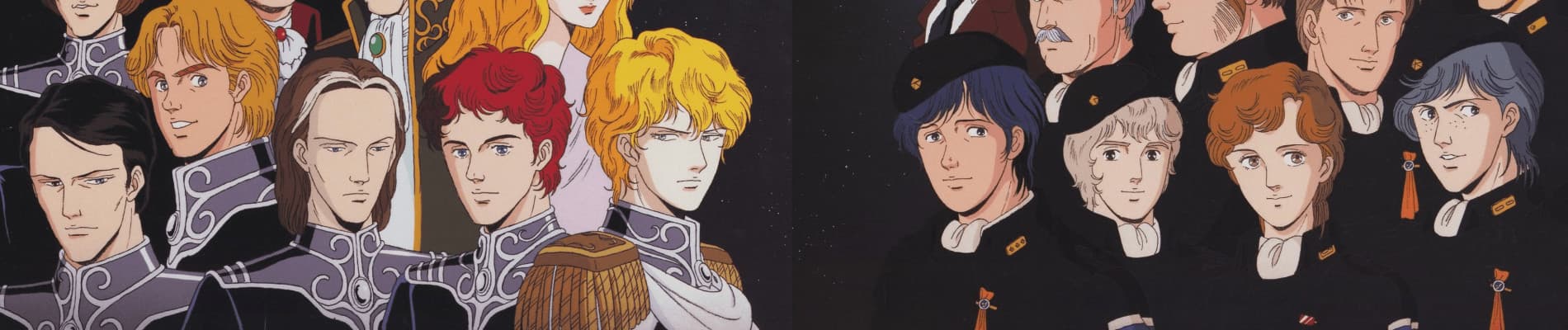
Legend of the Galactic Heroes is a science fiction story that first and foremost functions as a vehicle for its examination of the theory and practice of politics. While it is certainly showing that age in some areas, particularly in how dated the various academic schools of political and historical thought it draws from are these days, it is still incisive in its observations and conclusions. Of course, this also makes it difficult to recommend because to many viewers it has an understandably dry and cerebral subject, relying more so on having interesting ideas and themes to engage someone rather than captivating them with a particular grace or style in its writing and storytelling. But this less than ideal or charismatic writing is par for the course in science fiction that places a primacy on its ideas. The viewer is expected to put in effort to understand the narrative, though LOGH still does have the benefit of its complexity being in its political discussions and the many moving pieces of the plot instead of a more literary narrative’s ambiguity and symbolism that might not have any definitive meaning by design. LOGH is almost always direct thanks to the narrative being framed as a historical recounting of events. Though that leads to a significant amount of simply telling the audience dense amounts of information instead of showing it, which while efficient, can certainly be lacking in charm at times. This generally cerebral narrative style and tone no doubt contributes to some extreme expectations when it comes to the show, with some viewers believing it is comparable in depth to an academic work or are conversely critical that it does not reach that level, even though neither of those are a reasonable expectation to have for a piece of fiction. Ultimately, the acknowledgements of LOGH’s limitations and imperfections should not detract from how incisive it is when so many other stories are often ignorant of, misunderstand, or grossly caricature the politics they inject into their narratives. There are simply few other pieces of fiction that tackle politics on a grand scale with such depth and rigor, not only distinguishing LOGH, but arguably making it close to unique.
The politics of LOGH, namely its analysis and comparisons of democratic and authoritarian systems, is certainly profound for any piece of entertainment, even by the standards of science fiction. It would be too long to list all the things it gets right without essentially describing republicanism and various juxtaposing authoritarian ideologies in detail. But to highlight a specific strength, LOGH is one of the few narratives that recognizes complex power structures within government types and has the plot involve them in a reasonably thorough manner, unlike most other shows that use ideas of a republic or empire as aesthetic labels. However, it has to be stated that LOGH is still drawing on generally undergraduate level political philosophy. Advanced as that might be, it still mainly rests at the complexity of having the Free Planets Alliance and the Galactic Empire represent general overviews of their respective theories of state while examining flaws in them that have been well recognized by political theorists for ages instead of giving some new and novel insight. This is not meant to be pejorative or to claim that LOGH is somehow inadequate because of that. If it really did have some new and stunning insight, then it would have been published as a piece of research instead of fiction for our enjoyment. Still, turning these often very abstract and academic ideas into a compelling narrative is certainly no easy feat, even if not one necessarily requiring an exceptional imagination given how much it borrows from historical events, then is still an immense feat of intellectual labour. As much as it is tempting to lionize LOGH because of its exceptional polish by the standards of fiction and entertainment, it is simply unreasonable to claim it is a substitute for or comparable to an academic work. That being said, anyone with extensive knowledge and formal education in the field will acknowledge that LOGH clearly knows what it is talking about, even if it has to simplify or omit certain nuances for the sake of telling a story.
At the same time, it is definitely apparent that much of the academic foundation that LOGH draws from has become decidedly dated. This is not criticism, per se, since LOGH is ultimately a product of the 1980s and would understandably draw on the historiography of the day. Though still firmly in that period’s academic mainstream, many of LOGH’s historical ideals were also already decidedly old fashion like Carlyle’s Great Man conception of history, the Whiggish idea that history has a natural course that is progressing towards some end state or telos, and even older ideas like Gibbon’s Decline and Fall of the Roman Empire being the blueprint for structural forces that affect the narrative. Despite having fallen out of favour in modern historiography, it is not as if these conceptions of history have been repudiated as invalid models of analysis, more so as too narrow or dogmatic in their views to offer comprehensive explanations. Yet drawing from these ideas of history still produce an incisive narrative within that framework, particularly aided by the political theories LOGH draws on being more abstract and therefore timeless in nature. It is difficult to say what specific political works are referenced because of how the narrative functions more as a summary or aggregation and might reasonably be conceived from secondary sources instead of Tanaka having read many of the original text. Yet LOGH clearly draws ideas from works that, while foundational to western political canon, are also not necessarily advocating for democracy like Plato’s Republic, Aristotle’s Politics, and Hobbes’s Leviathan to name a few prominent ones.
Likely as a result of this dated historiography and the narrative examining ideas not solely advocating for liberal democracy or republicanism, there have been no shortage of viewers who accuse the series of being pro-authoritarian, and yet some others who like LOGH because they believe it is advocating for a form of enlightened autocracy. This perception is not entirely undeserved since the show does not do itself many favours by having the narrative take the course it does in trying to cover the scenario of how a popular autocracy establishes itself and a democracy might faulter. While this creates the surface level impression of having an unambiguously pro-autocratic conclusion, that reading completely ignores the contents of what the characters have been saying and debating the entire show despite it being a rather clear Socratic dialogue. It is certainly not ideal to have the mechanical plot ostensibly demonstrate one thing while the character discussions all point towards something else, or at least a more nuanced conclusion. Covering how constitutionalism can establish itself in an autocratic system would have done much to dissuade this simplistic reading and would have made the narrative more holistic in exploring and commenting on more avenues for political change. But that might understandably not have been a particularly compelling narrative to write in fiction since it would be a story predominated by peace and negotiations leading to it being more parts treatise or description than space opera.
However, this choice of plot trajectory is still not without good reason. Pitting an efficient autocratic system against a dysfunctional democracy is the only compelling permutation for a narrative to explore. Almost every other comparison would result in democracy being the obvious choice and leaving the story with little interesting to say. For instance, maintaining LOGH’s initial status quo of the FPA facing off against the Goldenbaum Dynasty leads to the very obvious conclusion that even a republic that fails to live up to all its ideals is preferable to the literal ancien regime. Serious democratic thinkers also cannot simply ignore the challenges the concept of an enlightened autocracy poses all because it is still a contemptible form of government. LOGH does not build a strawman for either side, not pulling its punches in how an autocratic ruler can gain real and principled popular support, while at the same time also still recognizing the inherent dangers of autocracy in showing the worst excesses of the Goldenbaum Dynasty. More importantly, LOGH does not dismiss or belittle the value of moral authority derived from a democracy and how potent a force it can be, but there is also no pretense that this will necessarily lead to effective government or can substitute for one. Perhaps then no one accuses LOGH of being anti-democratic because it is not taboo or suspect to consider how a republic might fail as a cautionary tale. Even if envisioning a functional and idealized autocracy is unsavory, there is sufficient thoughtfulness at work here to dismiss the idea that LOGH uncritically advocates for autocratic rule.
Of course, this does not fully make up for how the plot and characters at times bend to accommodate scenarios that allow for ideological discussion. The show occasionally uses chance events or a confluence of them to alter the course of the plot in ways that conventional storytelling would view as unsatisfying. This is not to say these events are inexplicable or unreasonable, but that it draws a significant amount of attention to the hand of the author at work. The justification for this heavy handedness, beyond it being in service of the ideas and themes of the series, is that actual history contains numerous coincidences and accidents that would seem contrived or absurd if deliberately written in fiction. While that makes this narrative meddling serviceable, especially if you find the historical framing of the narrative compelling, it does hurt the immersion of viewers that might be more drawn in by the drama and stakes of the grand narrative. Yet as a result of this storytelling choice, the somewhat ambiguous ending of the series with its political trajectory left up in the air feels halfhearted and lacking in substance. The entire narrative style hinges on facts and causation being clear while the judgements or conclusions the show attempts to draw are left up for debate. To turn around and withhold information as a sort of last-minute literary flourish can only feel incongruous with the prior dedication to and reliance on a more historical or academic style of narration. This does not help how LOGH seemingly writes itself into a corner and Jullian not being a particularly compelling character to follow beyond his role in tthe narrative. But despite these less than ideal choices, the events at the tail end of the series are still undoubtedly used to cover important consequences of each political system and comment on them, although in a manner more rushed and rougher than earlier parts of the series. But given that Tanaka seems reluctant to have major time skips that might have benefitted the story given the scale of events it is covering, this is an understandable if not ideal way to wrap up an already lengthy story.
LOGH’s view of history also notably leaves non-state actors like the Phezzani and Terrarist influence on the plot feeling particularly convoluted or incredulous at times. Their objectives of somehow controlling the universe with manipulation simply comes off as laughable or delusional relative to the amount of power and influence the narrative shows them to have in comparison with the FPA and Empire. While they do serve a function as third poles of sorts in the conflict, it is executed rather clumsily as just a means to engineer specific situations in the plot or to move pieces that have outlived their narrative usefulness off the board. What the Phezzani and Terrarist do have to say about economic and religious forces in history both feel decidedly outdated and an attempt to concentrate what ought to be societal level forces into particular actors or factions. Especially so for the Terrarist which have a distinctly pre-Global War on Terror view of religion and terrorism as a political force. Though much of this can be excused due to LOGH being written during the height of the Cold War and prior to social history being fully integrated and taught as a core part of the discipline, the way the Phezzani fit into the narrative seems to have been clearly left incomplete. While they seemed poised to play an important role through their supposed economic influence and serve as a commentary on how capitalism interacts with democracy and authoritarianism, they simply amount to little more than pointless political schemers. The lapses or abandonment of certain plot threads are understandable given the sheer complexity and bloat of a long running series like LOGH, as well as discussions about economics and religion being ancillary to the narrative’s primary focus on political ideology. Yet it is hard also not to be disappointed with the missed potential after the very clear set up.
On the military side of how the plot is advanced, while it is certainly done with much more thought and fanfare, it is not particularly compelling as a narrative end unto itself once you peel back the curtain. For those that have not already realized it, the way battles are conducted in LOGH are closer to Napoleonic linear warfare than naval engagements, especially considering the formations and time scales combat takes place in. There has still definitely been a concerted and significant amount of thought placed into including some elements of space warfare, such as the use of different ship types, space superiority fighters, naval mines, etcetera, but these are often times limited to flavour or are inconsistently applied as key elements of a battle. The tactics used seldom consider the fact that combat is occurring in a three-dimensional space and are more comparable to Napoleonic concepts such as the concentration of fleet artillery fire being analogous to a Grand Battery. In particular, the idea of commanders having a very direct effect on how fast their fleet maneuvers or the devastation of their fires makes far more sense when viewing the fleets as infantry formations. There the personality of a commander and the morale of the troops has a far more tangible effect on their fighting capacity compared to naval warfare where things like speed and fire power are more a function of a ship’s technical characteristics and limitations. Even the numbers make more sense in that context with a fleet of thousands of warships sounding incredibly unwieldy or impractical but a division or corps numbering ten thousand men being a sensible combat formation.
None of this is said to take a jab at the series for not being more intricate or through in considering the mechanics of space warfare. It is incredibly difficult to write about a type of warfare that has yet to be developed, especially when considering the current hypothetical models for space combat are all highly technical and not necessarily compelling for a grand space opera narrative. The same can be said for the strategic concepts LOGH utilizes or the historical battles it alludes to, with Astarte being a classic defeat in detail, Amritsar being a product of a scorched earth strategy, and Marr-Adetta being Thermopylae by another name. Despite the heavy borrowing and allusion, there is still a substantial amount of creativity at work or on display, particularly in the clashes involving Iserlohn fortress and how it is conceived with liquid metal armour (though the latter is an OVA invention). It also still took a great amount of effort to understand, translate and apply these military concepts convincingly into a fictional setting. The use and allusion to Napoleonic style warfare dressed up for a space opera also aesthetically furthers the story, highlighting the romantic notions of war that are often lost in more high technology settings, allowing for a sharp juxtaposition at the sheer amount of blood being spilt for the characters to ruminate on or find contradictions in. While this might be disappointing for some science fiction fans who are more invested in the technical hardware of a story, it has to be said that LOGH still demonstrates a relatively high-level understanding of the abstract principles of warfare, at least those found in the Napoleonic era, and far surpasses many other shows whose battles often have no semblance of even basic tactics. As noted by Clausewitz, war is politics by other means, and for LOGH that means the battles, while entertaining in their own right, are ultimately still a vehicle for its ideological conflict. After all, why someone is fighting is often the more compelling question for a story to tackle instead of just showing how they fight.
The characters similarly reflect this order of narrative priorities with most of them being there to further the discussion of ideas and, at times rather transparently, to represent certain sides or positions in a debate. Outside of a select few members of the cast, the rest are fairly straightforward or even one dimensional in their characterization. This is not to say they are unconvincing or flat, particularly with the advantage of voice acting to put on a charismatic performance instead of having to solely rely on writing. Again, the framing of LOGH as a historical recount pulls a lot of weight by creating the expectation that the narrative is mainly concerned with a character’s public facing persona and role in influencing the narrative as opposed needing to immerse the viewer in their internal life. Even for Yang and Reinhard, we learn of their complexity as characters as a consequence of it being directly related to furthering the show’s discussion of their political philosophies. For Yang, much of his depth comes from him attempting to square the circle of his loyalty to democratic principles yet having to suffer the limitations of them when faced with an ineffectual government. On the other hand, Reinhard has a more personal struggle with his autocratic tendencies undermining his ideals of a just government when they are not tempered. Yet there are still writing shortcomings with even the central characters of the series with Reinhard’s character arc not feeling fully realized, never delving into the latent contradiction between his desire to rule yet yearning to recognise Kircheis as his friend and equal, which would be directly relevant to discussing the nature of an autocratic society. Arguably only Yang feels fully realized both in his intellectual role in the narrative and as a complex individual. In particular, the examination of his contradiction at being a gifted strategist yet having no desire to be a solider being one of the few convincing and compelling internal character conflicts of the show. Despite this being strong character writing by any metric, not just relative to the expectations in stiff and idea driven science fiction, this depth only present in a handful of other characters at best.
The OVA does attempt to better characterize members of the supporting cast, but they often come off as rather one note or clumsy. The amount of time spent showing the back stories of prominent characters like Mittermeyer and even Reuenthal is somewhat unnecessary given how straightforward they ultimately are. In a lot of these cases, simply telling the audience about their values and temperaments using the narrator while framing it as a historian giving their assessment of an individual would have the same effect while being more efficient. It is far more interesting and moving to see the characters attempt to live up to their ideals or suffer the consequences of adherence to them, even if they are fairly straightforward, like the show did with Bewcock. Yet the direct and literal approach does not always succeed in being convincing, such as the especially egregious and hamfisted attempt to give Heydrich Lang depth by showing a very shallow and literal contradiction in his values. The only character that is successfully given a compelling amount of ambiguity is Oberstein. But that has more to do with the narrative going out of its way to avoid giving any confirmation of his intent unlike almost every other character. More than likely it is primarily done due to this lack of clarity being a necessary part of interrogating the idea of (probably) well-intentioned Machiavellianism that Oberstein represents instead of being a decision made for the sake of his character or compelling drama. Other characters with even hints of complexity like Schonkopf and Baghdash are mostly there for the narrative role of playing devil’s advocate. While the cast overall is adequate, if not at least charming, most characters will be remembered more for their ideological stances and deeds in the narrative rather than for their complexity as individuals.
While these are still limitations that are standard for the genre, other issues are less easy to overlook when it comes to the imagination of the writer. Notably the distinct lack of female characters in the narrative that could have better highlighted the ideological conflict between the egalitarian FPA and the traditionalist Empire. Although there are some female soldiers present in the background in the FPA, the only prominent female character is really Fredrica, and perhaps to a much lesser extent Katerose. Even then their role is mostly limited to being the eventual love interest of other characters and written in a way that can only be described as less than convincing and reminiscent of Isaac Asimov’s regrettable attempts at romance in the Foundation series. Even when Fredrica gets to play a more prominent role later in the series, she is often sideline for Jullian to be the main actor, which blunts a lot of the themes and ideological messages about democracy at least somewhat. More prominent female characters on the FPA side would have not only served to demonstrate they live up to their more egalitarian ideology but would also have emphasized how unique Hilda is on the imperial side. Of course, this can be explained as being a product of the 1980s when LOGH was written where most militaries had at most non-combatant roles open to women, yet it is still disappointing since it takes away from the timelessness of the story. Even with the existing characters, it seems like a distinct missed opportunity not to have Jessica Edwards play a more prominent role in the narrative for longer. It would not only provide an opportunity to follow some of her perspective to examine and comment on electoral politics, but perhaps also a way to explore how a republic can potentially begin renewing itself with the right leadership in showing her attempting to help Yang through her political office. At the very least LOGH does write its female characters as capable, even if not quite breaking out of traditional roles.
Although the OVA largely works within the limitations it is dealt in terms or characters, it does make improvements in other areas using its new medium to its advantage. The animation and designs are, of course, a little dated since it was adapted in the late 80s and 90s, particularly some of the now retro-futuristic elements, or even just the campy idea of engaging in hand to hand combat with tomahawks over a thousand years in the future. Yet it excels in giving each faction and location a distinct design language that is logical and conveys a significant amount of information to the viewer. The FPA starships having a simpler, more utilitarian design in contrast with the ostentatious imperial ships is representative of not only the culture of each nation but also indicative of their economic capacity. Similarly, the visual difference between the dense and urbanised FPA cities, the semi-agrarian imperial settlements with anachronistic architecture, and the Phezzani being somewhere in between conveys the nature of their society effectively. All this is tied together with excellent choices of classical music and some incredible original compositions like the FPA anthem to create an outstanding adaptation that really brings out the best qualities of the original novels and lets them shine.
Overall, while there have been a significant number of shortcomings and imperfections pointed out here, it cannot be emphasized enough how despite that, LOGH is exceptional and outstanding in delivering on its core aim of being a story about politics and ideals. The narrative can feel as if it is repeating a lot of Aristotle to someone who did political science or philosophy in university, but it is none the less appreciated and impressive that Tanaka distilled and demonstrated these ideas in a fictional narrative. Although much of the praise has been given to the intellectual underpinnings of the series, it still does have its share of emotionally stirring and moving moments, particularly on the FPA side where characters demonstrate their willingness to endure what they must for the sake of their beliefs. That likely does not resonate with many viewers, but it is also proof that there is heart behind the series as a space opera instead of just being a cerebral and distant examination of politics. With that, Legend of the Galactic Heroes is undoubtedly a 10 out of 10, almost one of a kind and excels precisely in the areas that it promises to and are most important to its identity.
40.5 out of 43 users liked this review