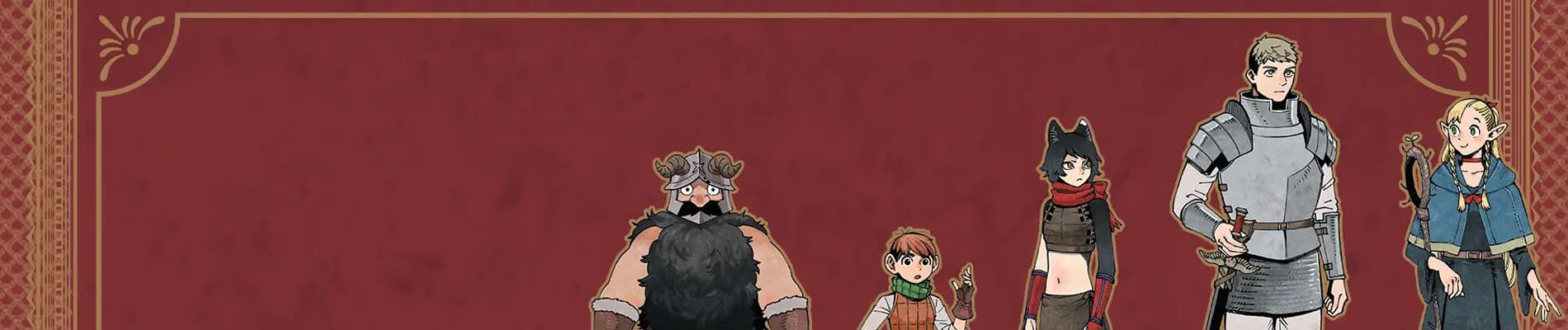
Dungeon Meshi is a unique story that pulls us in with its comedic charm, but as the story progresses, more serious and complicated plotlines are introduced. Even when the stakes are at their highest, Dungeon Meshi still maintains the comedic value that drew us to the manga in the first place. What makes Dungeon Meshi stand out from other manga is its ability to have you laughing on one page and then crying on the next. It features a large cast of brilliantly written characters, a fantastic world with complex moving pieces and rich lore, and numerous life lessons that will stay with you forever. Dungeon Meshi is a modern classic.
P.S. There will be spoilers.
Story
Right from the beginning, Dungeon Meshi starts off with a unique premise. Typically, in anime, we’d get well acquainted with a character like Falin before witnessing a retrieval arc. However, in Dungeon Meshi, that’s precisely how the manga begins: we see Laios and his party attempting to save Falin from the red dragon. It was a risky writing choice that left me wondering how the mangaka would make me care about Falin, but those doubts quickly vanished when I saw the horrified expressions of the main cast as Laios suggested they eat a monster. Their expressions truly spoke volumes: I could see the motivation to save Falin instantly overshadowed by the desire not to eat a monster, especially in Marcille’s face. From eating living armour to dragons, Dungeon Meshi follows an episodic structure in which the main cast cooks a new monster each chapter on their journey to save Falin.
Even though each chapter’s structure is largely episodic, details in every chapter become important later. An early example of this is the “portrait chapter.” There were these magic art pieces you could travel through, and Laios went through each one in search of food. Each portrait took place during a different time period of the Golden Kingdom, but eventually, the lunatic magician caught on to Laios and expelled him. During the chapter, the fact that the lunatic magician was present wasn’t really highlighted, but many chapters later—when the unfortunate incident with Falin occurred—it became relevant. Details like this make Dungeon Meshi feel so alive. In a typical anime, threats are dealt with as they appear, creating a two-dimensional feeling in which the background details don’t really affect the plot. In Dungeon Meshi, these details ensure nothing comes out of nowhere, rewarding you for paying attention by showing their importance later on.
The ending of Dungeon Meshi was great. In a manga where each chapter is spent eating a new monster, it’s only fitting that the demon was ultimately killed by having its desires devoured. It’s a poetic ending: the demon tricked many dungeon lords before Laios, and when it finally became a dungeon lord itself, it was only because it had been tricked too. It’s not uncommon for manga to stumble when a main villain is revealed to have been manipulated by a greater evil: often, the reveal comes too late, becomes too convoluted, or both. Dungeon Meshi avoids these pitfalls. The winged lion is introduced at a logical point in the story, and even before then, it appeared in the town’s statues, on Laios’s sword, and in Marcille’s nightmare through the book’s power. Even the reveal about how the previous world was destroyed and why the demon was sealed in a dungeon was presented in a way that’s easy to understand.
World-Building
To me, building a good fictional world broadly consists of four pillars: world politics, lore, design, and side character relevance. If handled well, these four elements can make a world feel truly alive, immersing us beyond just the main characters and allowing us to become just as attached to the history, cultures, characters, and themes of that world. This, in turn, enhances the overall enjoyment of the story.
In Dungeon Meshi, there are many races and species with their own cultures, but they aren’t all completely isolated. Each has its own dynamic with the others, with the longest-lived races—the elves and dwarves—holding the most political power and influence. Early on, the mangaka makes it clear that the western elves will play an important role. This is seen when it’s revealed that the western elves are trying to intercept the dungeon. This is yet another example of the mangaka planting seeds for future plot developments so that when those developments happen, they don’t feel forced. The way the history of the western elves and their interference with past countries is revealed is masterful, especially when paired with the winged lion’s warning to Laios about the canaries. Usually, I’m sceptical of characters such as the winged lion, but in this case, I couldn’t help sympathising with the cast for being manipulated—because I was manipulated too!
The lore of the world is fantastic. It answered all the questions I had, such as why using certain types of dark magic is forbidden (even if it doesn’t seem harmful), and it perfectly explained the existence of dungeons. It wasn’t complicated, which I appreciated, but something I really liked about how Dungeon Meshi reveals information is the way it does so through character backstories. In Kabru’s backstory, for instance, we learn about the fall of Utaya, which explains his motivation to enter dungeons: he doesn’t want to see another Utaya. This is great for Kabru’s character and also feeds into the broader world history, helping us understand why the western elves’ methods are controversial. The same principle applies to other backstories, such as Mithrun’s. It explains why Mithrun is so relentless—revenge is all he has left—and also does a great job showing how the winged lion grants wishes in exchange for desires, as well as why Thistle sealed the winged lion in order to prevent it from influencing him. None of these backstories are wasted; they all contribute to the broader narrative and history.
The ecosystem of the dungeon and how it’s maintained demonstrate the care the mangaka put into designing it. We wonder how long Senshi has been in the dungeon to have acquired such knowledge, and it explains how he’s managed to survive so long by maintaining good relations with the orcs. The designs within the dungeon—such as the art pieces and the floor that turns out to be a town from the Golden Kingdom—were great touches. However, my main issue with the world’s design is that everything outside the dungeon feels rather bare-bones. It would have been nice to see more fleshed-out designs for the elves’ and dwarves’ countries. Moreover, most of the floors in the dungeon aren’t particularly memorable; they often blend together.
I touched on side character relevance earlier, but it truly is my favourite aspect of Dungeon Meshi’s world-building. At the beginning of Dungeon Meshi, we see the main cast when it still has a full party. Initially, I assumed that the members who left would be sidelined and never return, but much to my pleasant surprise, Namari and Shuro both come back with important roles. I could sympathise with their reasons for leaving—especially Shuro, who simply decided on a different approach to saving Falin. This perfectly highlighted the severity and complexity of their situation. Some chapters change perspective from the main cast to Kabru, who acts as a foil to Laios. These are some of my favourite chapters because they demonstrate that there are many characters in this world, each with their own motivations and goals for entering the dungeon. The side characters help make the world feel larger than life.
Characters
You can tell the mangaka poured a lot of love and care into the characters she created. Not only is the main cast superb, but the side characters are also thoroughly enjoyable.
Enjoying a character’s personality is very subjective and up to personal tastes, so I won’t go into why I adore each main character’s personality. However, I love the way each character’s moral compass and beliefs have a clear origin. Laios loves monsters because humans treated him poorly throughout his life. Senshi is very protective of children because the adults in his life sacrificed themselves for his future. Marcille wants everyone to live a long life because she wants to end the inequality between short-lived and long-lived races. Chilchuck demands payment upfront because, as a half-foot, he has been exploited in the past. These are just a few examples of how the author seeds these strong traits early on and expands on them later. This added depth enhances the characters’ overall quality.
The dynamics between the main characters and side characters are also written extremely well. My favourite interactions are those between Mithrun and Kabru, but for this review, I’ll focus on Laios and Kabru. Kabru acts as Laios’s foil: although they both share the goal of conquering the dungeon, they couldn’t be more different. Laios is socially awkward, while Kabru is highly attuned to others’ emotions. Laios is fascinated by monsters but has little interest in humans; Kabru cares deeply about humans but finds monsters difficult to handle. Laios’s knowledge of monsters means he’s brimming with tactics to face any beast, while Kabru’s understanding of humans allows him to defend himself against nearly any person—enough that he manages to stall Mithrun and prevent the canaries’ interference. They highlight each other’s strengths and weaknesses, helping us better appreciate their traits.
Art
I usually don’t have much to say about art. I can recognise excellent art, but even if art is mediocre, I’ll still enjoy a manga if everything else is good. For me, good art is a bonus—but Dungeon Meshi’s art is so noteworthy that I have to mention it.
There are some insanely detailed and high-quality pages in Dungeon Meshi. The fact that the mangaka is capable of such detailed artistry but uses it sparingly makes pages like the demon devouring human desires, or the winged lion consuming the dungeon, even more terrifying. It puts into perspective how horrifying these monsters really are—this is what the main characters have been seeing all along.
Where the mangaka truly shines, though, is in capturing characters’ facial expressions. The emotions come across as raw—there’s often no need for text, because you can understand everything by reading their faces. My favourite example is when Laios hugs Falin after defeating the red dragon. Up until that point, Laios had always been engrossed in hunting monsters and cooking them. But here, we see a stern expression of protectiveness and relief. It reveals how much worry and doubt he had been suppressing. The mangaka portrays emotion better than any other manga artist I’ve read.
Enjoyment
If you couldn’t tell by now, I really enjoyed this manga. I’m prone to recency bias, so my current score of 9/10 may eventually drop to 8.5. Regardless, the story, world-building, characters, and art were all excellent.
The final topic I’d like to discuss, which I enjoyed the most, is the theme of self-care.
“A balanced diet, regulating our daily rhythms, and moderate exercise.” I love how it came full circle, with these lines ultimately breaking through to Marcille. It makes perfect sense because that’s exactly what the characters have been doing throughout their journey. You have to take care of yourself if you want to overcome life’s challenges; it’s not the other way around, as we see with Shuro doing the opposite. So remember: practice self-care, and you’ll have the energy to take on anything.
I’ve frequently said things like “usually in anime this happens” throughout this review. I’ve avoided naming specific examples because I don’t want to tear down other series for the sake of elevating Dungeon Meshi. Besides, it’s perfectly fine for those anime to tackle their writing in that way. Dungeon Meshi’s approach simply suits my preferences.
__Scores
Story: 8/10
World-Building: 7/10
Characters: 9/10
Art: 10/10
Enjoyment/Overall: 9/10__
(Note: My overall score isn’t an average of the other categories but rather a reflection of my personal enjoyment.)
15 out of 15 users liked this review