"I don't know what cruel god out there made us humans, but... Come on please, just once... Can't you let me win, just one god damn time? Well? If not... Why did you give me a heart to feel such pain?!" -Riku Dola
 SPOILERS
No Game No Life Zero, a movie tied to a series that I find incredibly uncomfortable and boring for a multitude of reasons. Known as the show with egregious fan service and power fantasy elements with no tension, the movie does its best to avoid the lighthearted tone of its origin to be something greater. While the movie does have its very few moments of sexual humor, it quickly brushes over any attempt at being "loli-bait" like its counterpart. I address this now rather than later, because the few people I recommended this movie to have that as their central complaint of why they didn't enjoy the film. But I'll touch on that more in depth soon. What I want to give credit to this movie for is its direction, sound design, music, voice acting, animation, and just about every part of a product that one would deem vital to the quality of a product. No Game No Life Zero is truly a well crafted movie that doesn't get enough love due to the fanbase that makes up the majority of the show's community.
A possible reason for that treatment may reside in the fact that No Game No Life Zero does the exact opposite of what the show embodies. The movie is neither a power fantasy or filled with ecchi. As I mentioned before, the movie is not free of these jokes on a select few occasions and ultimately can be chalked up to the series bleeding its way into the narrative. The scenes in question being the very first scene the two protagonists meet, the one quick scene with the two in the same bed, and the proposal rejection. Each scene relates to the characters and the subject of intercourse (or procreation). With the former two on paper definitely being an eyesore, the first one very clearly demonstrates that our main character does not entertain the subject at all. This type of humor has no value in the world they inhabit, and the main character does not entertain the idea of physical intimacy. And without ecchi, the other main characteristic of the show of a power fantasy is next on the chopping block. Riku Dola is the counterbalance to Sora, where Sora wins everytime, Riku never wins. He struggles from before the story begins and through the entirety of the movie, never being triumphant. It's a much more compelling characteristic to give to the main character. How does this person continue living despite all the losses, all the sacrifices, and all the misery. Dawning the mantle of more an underdog character rather than "I win cause I'm the main character."
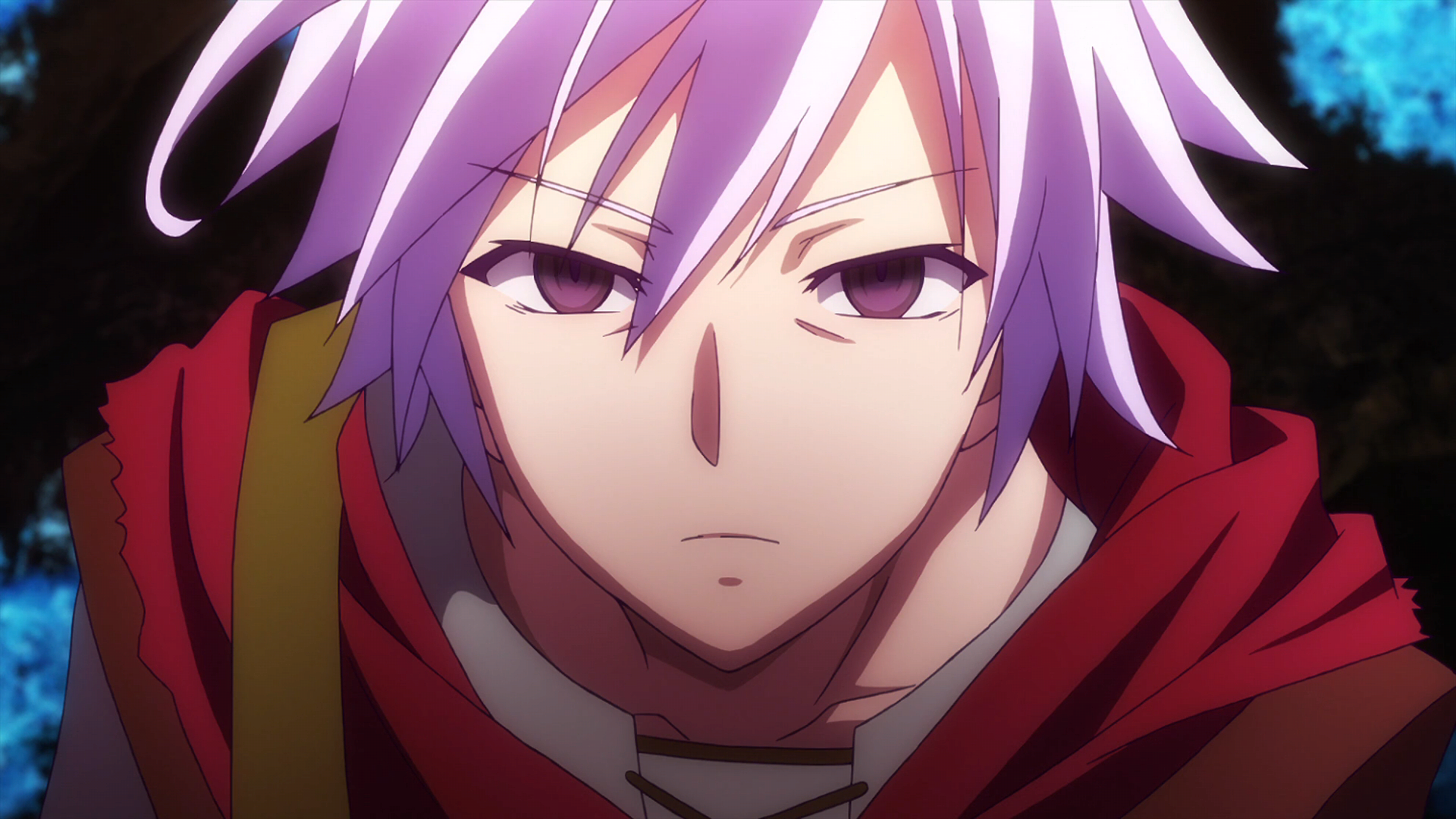
Riku Dola is the kind of character that was designed to be rooted for. Being an ant within a hurricane of power and war, with only his wit and knowledge passed down through generations. We see the full extent of humanity's resourcefulness, learning the other languages, deciphering information from wreckages, hiding away from other monsters and races, and so on. Their will to survive is given center focus as a main driving force for the human heart, despite the fact that no one would want to live in the world they inhabit. Humanity itself is given the role of something that has no place in this world, only able to hide and run and hope that one day the war will be over. The only race without a godlike figure at its helm, only man. With such little hope and no knowledge of the war itself, the why, as well as when it could ever end, Riku is our look into the world to see just how powerless and hopeless their lives are.

No Game No Life Zero's first 15 minutes are nigh perfect. It immediately gets you into the world with flying colors. A dragon and ex machina battling near a human village, and in the process of their battle, the entire village is seemingly wiped out except for our main character. From this battle alone it gives you the scale of war with how quick and destructive these battles become, but also how powerless and affected humans are in the war. It also opens the gate into what is possible in this world, your suspension of disbelief is quickly set into stone as something incredibly hard to break because of the rules of this world that are set in stone within just a few minutes. And when we cut back to the past where the movie takes place, we see a decimated planet with nothing but a dark sky, black ash, and destruction. The scales of war that were formerly presented to us make sense in this world due to just how devastated their world has become. Which is something that other series lack weight in. When powers that are powerful enough to rupture a county, state, or country are normalized within the context of the story, why does the world look fine and unaffected? Cutting into the real start of the film, we're introduced again to our main character all grown up as a young adult, making ground in swift and silent motions as they approach a wreckage of a dwarven ship that puts most ships to shame. Despite it looking quite old, it's clear when they find a map of the world, that it's not as old as it may seem. Riku orders them to cross reference their map of the world with this one and make corrections, while reading a message from the Dwarves, showing they plan to use a new kind of weapon resembling a nuke to destroy most of the world themselves. This scene makes two things clear, the black ash that hurt Ivan, one of the recon members who's lost his arm to the ash, has eroded the ship as well to look incredibly aged despite it apparently not being that old. And the other being that Riku can understand Dwarvish. Without just relaying the rest of the plot, only two return home, with Ivan being ordered to die by Riku, allowing the other two to survive. Forced to keep a steady face as their leader as he tells a child that her father is dead. What isn't mentioned is that he ordered his death when faced with the circumstances that all three of the recon troops could have died. It's told through offhanded dialogue and visual cues as to why Ivan, the father Riku ordered to die, was chosen. When the recon mission starts, we see the black ash has taken Ivan's arm already, making him crippled. He's also a father, who's already given offspring to have humanity survive longer, and much older than the other two present. Despite the other younger member of the recon making mistakes like being too loud as well as trying to take some of the gear with them, he wasn't chosen to die purely from the fact that he's still young and could survive longer. All without any clear dialogue to say why the choices are made, only through the small hints does it all come together. Riku's descent into despair had already reached its culmination within the first part of the movie and we see all the emotion and guilt that he carries. Angry, afraid, on the brink of giving up, desperate and alone. All of this within the first 15 minutes of the film is outstanding direction, writing, pacing, and starts the incredible showcase of sound design and raw voice talent from Yoshitsugu Matsuoka that are seen consistently throughout the movie.
I'm aware this review is quite slow in its own pacing, but if you're still reading I appreciate the patience you have in learning the full depth this movie has to offer. I promise I won't go super into depth about scenes moving forward.
NGNL0 attempts at a multitude of themes to varying degrees of success. Love, machine's becoming human, war, grief, human will, and sacrifice. Almost all succeed, except machine becoming human. This theme is incredibly hard to do due to a gradual process being clearly seen while progressing the character themselves. While it can be argued that Schwi doesn't show a gradual process of becoming more human, she does progress as a character. She still approaches every instance that Riku throws at her with a robot's interpretation, despite trying to mimic what the human heart finds most soothing. But she does progressively become more understanding and careful about her words and how she tries to make Riku happy. It's a complicated argument due to Schwi giving half the progression to satisfy the theme of becoming a human. While it doesn't matter too much, as it's more a nitpick than anything due to the story giving her full focus as a human once she's been proposed to.

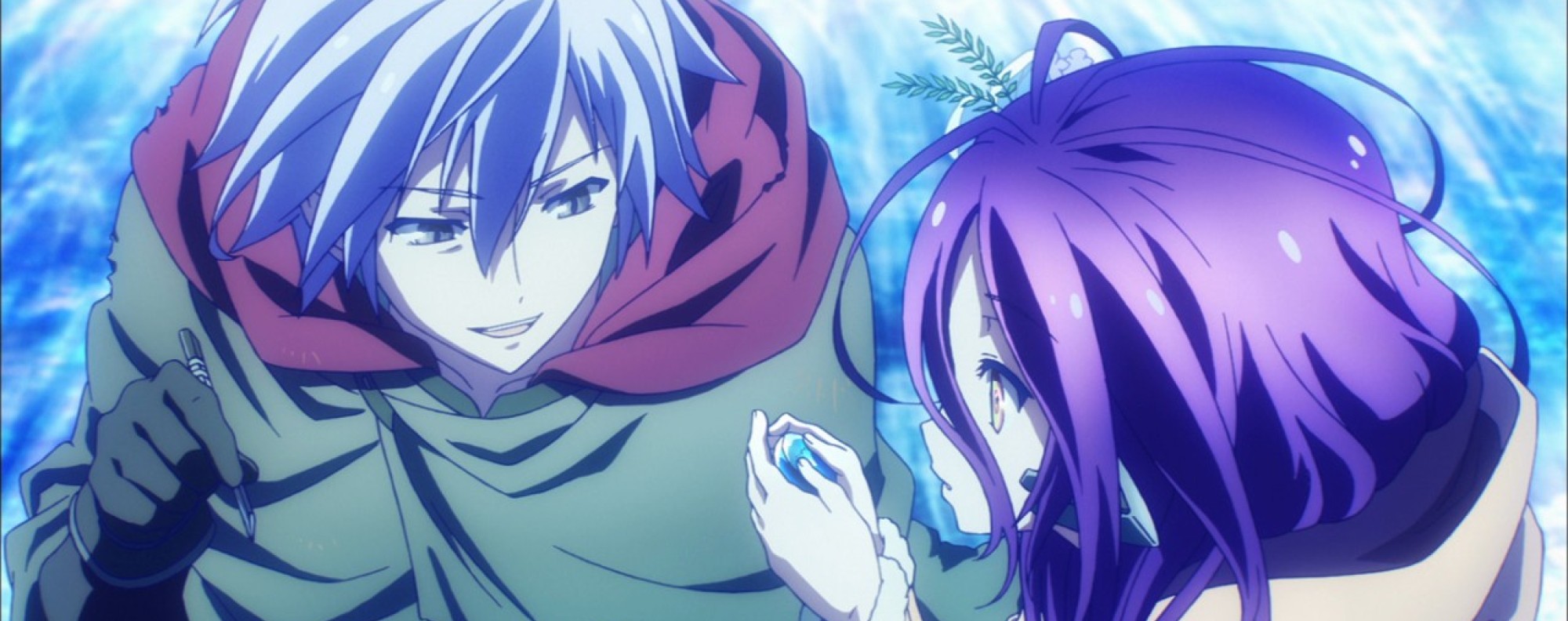
As for the other themes, the more prominent and more interesting ones that are played with are love and sacrifice. The two ultimately blend together to set the stage for the end. But to tackle one at a time, love is handled quite maturely in the movie, as like I said before, the ecchi part of the original series is quickly brushed aside as that's not what love is. Love is more mental than anything physical. And with Schwi becoming closer and closer with Riku, ultimately he asks her to marry him. Not with any sexual intention, but as he explains he wants her by his side as a life partner, the closest two people can be and a sign of eternity in a world where they may not be alive much longer. In Riku's arc, he believes that through wishing what he wants, that he's finally found purpose and love in a world where he practically doesn't exist and love is but a forgotten luxury. In Schwi's arc, it's the culmination of her becoming human, able to cry real tears, and a genuine wish for what she wants. While Schwi's is, as discussed, a bit rushed, it's still a happy conclusion where these two characters have found their purpose and happiness in a hopeless world.
Sacrifice is seen as a necessity where people can die without a second passing. To sacrifice is to die honorably, as Riku puts it,
> "No human born into a world like this could die without a good reason. It's the same as having a reason to live: The mind won't accept death if it has no meaning."
With human's able to be swept away like dust, the most they can do for each other is make sure the other survives to see another day. Hence why Riku's grief is so miserably high already. He has ordered 48 sacrifices in his name as humanity's best chance at survival. But if he himself does not accomplish this goal, then all their sacrifices were for nothing, and how many sacrifices does he have to order? Down to the very last person alive? Sacrifice becomes the ultimate loss for him in Schwi sacrificing herself to still maybe have a possible chance at success. And in doing so, Riku is forced to sacrifice an uncountable amount of Schwi's comrades. In doing so, his guilt boils over and he breaks down, ultimately being his undoing as his body fails at the last second, unable to grab the Suniaster. Sacrifice in the context of the world human's inhabit is seen as finding meaning, but to Riku it's seen as a burden too heavy to handle. However, it wasn't all for naught as Tet renews the world for Riku. And thus begins the real truth behind Sora and Shiro's identities and purpose in Disboard. However if you want something that would take itself seriously, then it's best to leave it as an open-ended ending.

With this movie I want to give the most amount of props to the voice work from specifically Yoshitsugu Matsuoka and Ai Kayano, who voice Riku and Schwi respectively. Both of them did an incredible job in showing such vulnerable and emotional characters in such a raw and believable way. Both displayed incredible lengths of emotion from forced monotone to breakdown anger and despair. The characters are so incredibly believable and it wouldn't have been possible without either of them. I also wanted to give props to Yoshiaki Fujisawa for his breathtaking composing. The entire soundtrack to this movie was phenomenal, and taught me the weight that music truly does hold in a scene of any tone. It's by far one of if not my favorite soundtrack of all time. And much love to the rest of the team that worked on this and all those at MADHOUSE.
No Game No Life Zero is a movie not held in the same regard to the show, and it's incredibly disappointing to see that, given the show is but a fraction of the same quality as the movie in terms of it's direction, music, sincerity, maturity, subtle world building, and so much more. I urge others to see this movie for the quality it truly is, the loli-bait it isn't, and the master craftsmanship that went into every part of production.