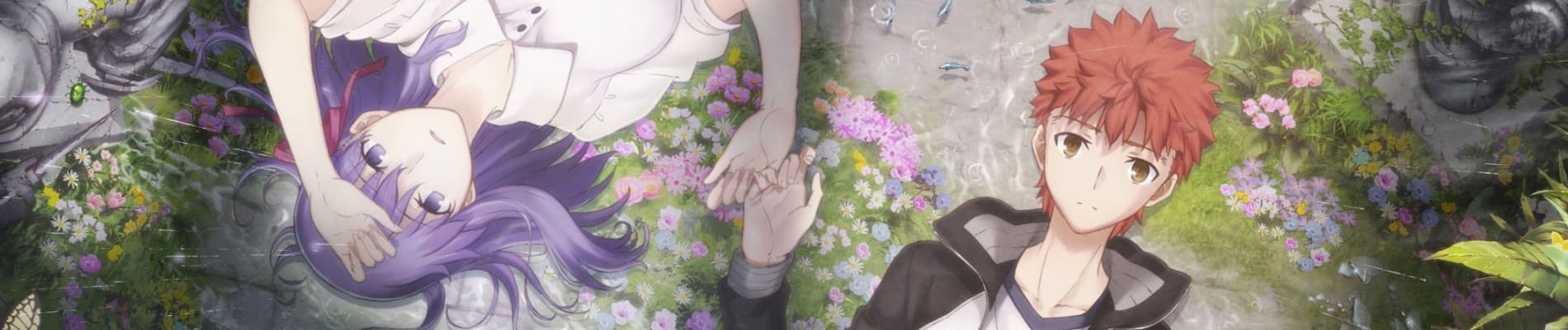
Intro
After spending a couple years slowly and kinda slogging through the Fate route to get the through the story of the Fate/stay night (2004) visual novel without missing a lot, I became so invested that even if I only considered that route to be a 7.5, I had bought the game on Switch, and while I'm more interested in playing other things and haven't continued to the other routes in the visual novel, I've gone forward with the /anime/19603/fatestay-night-unlimited-blade-works TV anime (I gave it a 9) and now am watching the Heaven's Feel film trilogy. I'm working on a larger review of both seasons of Unlimited Blade Works, but I was so moved by these films, that I am now completing these first.
I don’t recommend reading this beyond the summary unless you’ve seen this film and the previous one. I’ve covered a lot of metatextual elements previously, so I will have to go in depth on the film for this review to have any worth.
Summary
”If you’re going to keep sticking to your beliefs, that’s fine. The results should be obvious. However, if you stray onto a different path, Shirou Emiya will have no future. Make that mistake and you will lose everything”
—Archer
Fate/stay night the Movie: Heaven’s Feel II. lost butterfly
This film shook me to my very core. Every so often I will come across a film that will that will move so much, that for a time it will seemingly have the greatest emotional impact for me than anything before or since, until something else comes along to usurp it. Now obviously it is quite hard for me to tell if things this good are better or worse, but fans of this film will be happy to know, I put this film alongside /anime/21519/your-name and /anime/100178/liz-and-the-blue-bird for me. From one perspective it is arguably superior. I think there are 5 general categories that make a film exciting for the average person:
Few films succeed in all categories, and while obviously not every film needs everything, I think this is the perfect film as it demonstrates excellence in all categories. Even elements are obviously extensions of the first two odd ones. They are the quintessential elements of exciting media, whether I think that way or not, to the point of creating crass ones. To be able to use any effectively, let alone both, I think deserves great praise. That said, the plot of the film requires that I focus on the latter 3 elements, and I think it is more important.
This film shines in how it turns the previous ideas on its head, creating intriguing development for protagonist Shirou Emiya in stark contrast to what came before. This film shines in the depth and horror present in Sakura Matou’s reality and the development of her relationship with her upperclassman. This film shines in how it demonstrates great mental strength in the face of despair, and how the people around you can give you strength when and where you may have lost it. Like I said in my previous review, it is true beauty in abhorrence. These films write a remarkably uplifting message that requires sifting through worms, mental darkness, and dead bodies to find, just as Shirou and Sakura continuously struggle to find it themselves.
Plot
The Beginning
The film picks up directly from the end of the previous film. While I think that is an odd choice, especially since it had been two years since the previous film, I’m not really bothered by it since I approach sequels like this making sure I remember everything before starting the sequel. In this specific case, I started watching this less than 24 hours later, so it was not a problem at all.
The previous film ended with Shirou no longer being a master, with Saber’s apparent defeat at the hands of the shadows and Zouken Matou’s True Assassin. Faced with many questions and no answers, Shirou goes into town to look for answers and while doing so, he’s found by Illya. This scene immediately reminded me of a scene from day 7 of the Fate route known as “Day 7: Noon / Winter girl - Illya (II).” If you’d like to look at the scene yourself, you can here. This scene is meant to juxtapose how Illya was characterized in her introduction, to what is said to be her true nature. Naturally the scene in this storyline is based on the previous one; Shirou and Illya have similar reactions to each other after all. However, there’s no reason to establish Illya for the audience. Instead, expectations are turned on their head as this scene ends as quickly as it began. While the scene in the Fate route gives crucial backstory information, we already know all this. The reason for Illya’s departure at hearing the name of Kiritsugu Emiya, is obvious to us now. Going to see the original scene is also eye-opening since she’s specifically talking about Kiritsugu, but neither Shirou nor we know it is about him.
Foreshadowing
Since I’ve spent too long on a small scene I’ll move on to the actual important stuff. Illya and Gilgamesh don’t get much screentime in this film at all, and while I don’t care about them much (outside of the Emiya connection), it is a legitimate flaw to consider. The true focus of the film is naturally on Sakura and Shirou. The first interesting scene addressing both is a scene after the Illya one, in which Sakura experiences a nightmare on a train. In the nightmare she is a young child that realizes she’s on the wrong train and chases a train with another girl her age and a man, only to fall flat on her face and get consumed by bugs that come in from the cracks. It is an unsettling scene that did not make any sense to me while watching it, but this is one of multiple instances of foreshadowing in the narrative. Sakura and Rin while biological sisters were raised separately. During season 1 of Unlimited Blade Works, Rin asks Shirou about the experience of adoption, but at that point all you’re expected to consider is how her father left to get milk. However, what that could actually represent is how she was taken away from the Matou family. And from Sakura’s perspective, her big sister was taken away from her. I think this is especially true since Rin asks Shirou this when they’re checking up on Sakura to see if she made it home. Ultimately however, the separation of the sisters left Sakura to be sexually abused. Which is naturally and unfortunately represented by Zouken’s bugs…
The previous route, Unlimited Blade Works, can be considered a character study of Shirou by way of Archer. Throughout the story, the similarities between the two culminate in the reveal that Archer is Shirou from the future turned into a heroic spirit. While neither figured out the details immediately, they always knew something was up with the other, explaining Archer’s insistence on scolding Shirou in all the routes and bringing up Kiritsugu’s words. As a result, he is the one that foreshadows what a massive change Shirou has brought about for his character by choosing to accept Sakura. I’ll go over what that means for Sakura and their relationship later, but for now I’ll focus on Shirou. Shirou’s goal, which he inherited from his father, is to be a hero of justice, as is shown in Unlimited Blade Works. This means trying to save as many people as possible. To do so, some sacrifices may have to be made, foreshadowing how Kiritsugu was able to save Shirou and give him a good childhood. This mentality led Shirou to put others over himself, to the point of basically throwing his life away. We see this here too naturally, but seeing Sakura at her lowest point, open up to him, and begging for help, he changes. Shirou now has chosen to apply his ideals to save just Sakura. Which is obviously remarkably commendable as I’ll go into later, but throughout the film he will struggle with the reality of what that means. Sakura’s suffering has also become the cause of the city’s suffering, so the right thing to do is to kill her. This is the hard choice Rin landed on even before all this was revealed, since it was unlikely Sakura would survive her affliction. This is precisely the struggle Archer hinted at with the quote from the summary. Just like in the previous routes, it makes Shirou confront the difficult question, is it even possible to save everyone? Is it worth sacrificing either the city or Sakura for the greater good? Just like the latter episodes of Unlimited Blade Works season 2 filled with yapping, I found this clash of ideals to be one of the best parts of the film.
Sakura Matou and the Struggle of Abuse Victims
The most important element of the plot is everything involving Sakura’s struggles. I must note ahead of time, I am not a victim of abuse, nor do I know any, so I might be wrong. At the very least I feel I can talk about the film itself, so please keep this in mind.
The story of Sakura is horrific beyond words. Hints that large mage families only care about magecraft and the Holy Grail are confirmed here, and the inhumane nature of the fucked up ritual is laid bare. Further hints towards this were present before, from Kotomine’s evil scheme rant at the end of the Fate route, to Rin and Shirou talking about their upbringing. The latter is most applicable here, I think. Rin was raised as a mage first and foremost, but Kiritsugu didn’t teach Shirou much if anything. Come the summoning of Saber, Shirou knew nothing of magecraft, not even the very basics. Kiritsugu prevented him from learning many things and never passed his Magic Crest onto Shirou. Instead, Kiritsugu strove to be a good father to Shirou. Fujimura attests to this claim as well. This is in stark contrast to how proper mages are raised. While Rin may have certain arguably bad personality traits, it is certain she was not raised as an object and sex slave for his biological grandson, as Zouken treated Sakura, but its clear mages care not about family the same way normal people do.
Another big aspect of Sakura’s character is what actually happens to her. There’re no bones about it, she is a victim of vicious sexual abuse. Not only from the worms violating her insides, but her worm of an older violating her himself. Right before the very end of the film, Shinji says these words, in a classic form of victim-blaming and gaslighting abusers perform, “どのくらい汚らしく交わったかってことをさあ!” This (technically half sentence) can be literally translated as “[I’ll tell Emiya all about] how obscene our intercourses have been!” While completely accurate, it is also very stiff. Not fitting of his wretched delivery. The language he used to begin with isn’t very normal, but the English dub takes this and makes him say, “I’ll tell him about everything! About every single time we fucked!”, which such visceral malice placed on that most powerful of English obscenities. It is truly chilling and frankly a phenomenal translation as it conveys so simply just how vilely he defiled his own adopted sister. It also succinctly conveys just how little he cares for her, and how much his jealousy for Shirou Emiya and lust for power has corrupted that sad little bitch.
Shinji is not the only one that gave Sakura hell. To Sakura, life itself was hell until she met Shirou. While it might be kinda bs for the sake of developing a romance story, she did not have people close to her that didn’t treat her like shit. Sakura falls into the category of people in Japan that represent the ideal for women. She is quiet, soft-spoken, and very respectful. Her outward personality and how she presents herself represent that Japanese ideal of femininity. In the real world, people like Sakura would naturally have dark black hair. Think of any Japanese woman with long black hair in fiction, and she is precisely this idea. Being the ideal sadly, while good for society and good for adults, is not always good with other children in school as far as I understand. Since just as much as this classic shyness is praised, it is also hard for such people to make friends, and easy for them to be targets of bullying. The problem however is that the goal of Japanese society, the goal of their collectivist society that celebrates fitting in and not sticking out, is that you should not fight back. No matter how frustrating this might be for a westerner, this is Japanese fiction, and it’s based in their culture. In this case it makes for a particularly interesting character. Sakura’s strength is in how she struggles to be this type of person despite everything. She unlike Rin is portrayed to not have a natural disposition for a sharp tongue. So, her strength is in how long she endures and shuts away all her emotions.
In all this time she has shut herself away, but when she finally finds someone she can be open with it (mostly), what makes her a failure to her is thrown out into the open. Because of her abuse she is no longer a virgin. This is not only something normal abusers will gaslight into their victims, or something victims will believe, but Japan like the rest of Asia cares more about the purity of women than the west does. I don’t live under a rock, so I know about the body count controversy here today, but that really doesn’t apply here since this story doesn’t talk about dating or cheating. I don’t think it’s abnormal in this situation to feel like you don’t deserve to be loved, especially when that purity is valued so highly. But I really like how this lack of purity contrasts with her appearance as the Japanese ideal of femininity, that ideal of purity. And yet in the face of all this, Shirou chooses to accept all of her, to help her and protect her. To take her struggles in stride so she can have a better life and always have place to call home. This scene was beautiful beyond belief. And past this scene, Shirou and even Fujimura would continue to give her strength, saying that they would always help her become a better person than she is now. Sakura’s character shows people deserve second chances, especially those who are wronged due to no fault of their own, which is such a beautiful message.
Something I can’t speak on much yet since the film ended with it, is that Sakura herself is the problem assailing the city. She is the shadows terrorizing the people and can no longer be controlled by Zouken. I think this is a magnificent representation of shaming the victim. It is obvious the things that turned Sakura into this are not her fault. It is the fault of Zouken, and perhaps also Shinji. Through constant sexual abuse she has turned into something distinctly unhuman that can be conveniently used for their ambitions, and to shame her to the point of suicide. Sadly, Japan has a dark history of victim-blaming. There’s a reason why victims of sexual assault in Japan, that often don’t get defiled as much as Sakura was thankfully, are unable to speak up. They’re told to maintain order and social harmony. To not call attention to themselves. To let their boss have their way with them. Elders matter more than they do. They have the right to do it. This belief makes me unbelievably sick and is part of one of the things I hate the most about the country. It is frankly shocking that something that was originally an adult visual novel addressed such problems and did it so well.
Other Aspects
I’ve spent a lot of time and words on what I love about this film and what I think makes it so good, and even then, I’ve skipped a lot. I haven’t talked much about the sex scenes in the film and how it might be problematic to have victim of sexual abuse only able to heal through sex with the main character, as one review online puts it. I personally don’t find this to be much of a problem as it is a broader matter of excepting her for everything she is and giving her a place she can call home, beyond the sex. I’ve seen a lot worse, since I read the sex scenes in the Fate route and found them hilariously terrible. It is filled with the writing found in a porno. This is not that and serves as a great culmination to their relationship.
There’s also the action and the gore, which I’ve praised. The large battle of Berserker, True Assassin, Saber Alter, and Archer was unbelievable to behold. What stuck out to me was Archer’s sacrifice mirroring his sacrifice in the previous routes, with the fan service of him using his Noble Phantasm. I also think having this battle play out when it did a great job of increasing stakes naturally. The gore too was well used. The visceral shredding of Sakura by Gilgamesh is a great example of this, as the entire scene used the gore to demonstrate Sakura’s subconscious abilities as the shadow.
Then there’s the question of Saber Atler. For me, the biggest shortcoming of this narrative is that little time was spent on it. Fighting a shadow of yourself is a concept that’s been done often in fiction. My favorite example outside of video games is perhaps the battle between Scott and Nega Scott in the Scott Pilgrim (2004-10) comic book series and the film based on it. And there is of course Persona 4 (2008). But there really wasn’t much of it here. Saber Alter is clearly not a different person, so this can’t be done in the same way, but I was really looking forward to seeing more exploration of her character and the conflict between her desire for the Grail, and desire to help her master, but I suppose it was for the best to focus the narrative on Sakura.
Closing Comments
With how good this film was, it’s hard to see if anything else can be done. Can the quality of this film be topped? I’m not sure, and frankly I don’t care if it does. I think until this point, everything has been developed well. Simply wrapping everything up would make for peak fiction, and I hope the next film is. One of the few things that would ruin it for me would be a pessimistic dark ending which would fly in the face of the beautiful themes of forgiveness and paving a shiny future lined with the sakura blossoms of spring, of new beginnings.
Stay tuned for a review of the final film in a couple days!
32.5 out of 33 users liked this review
