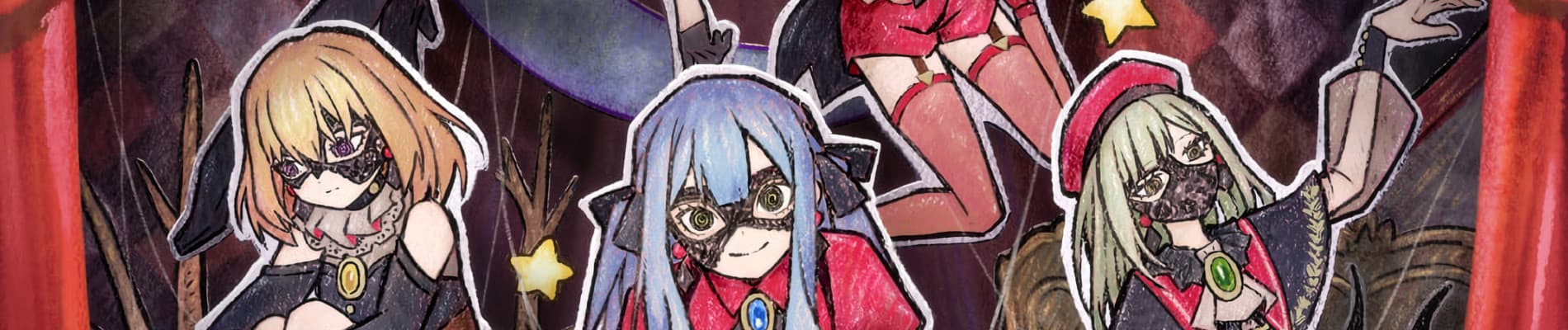

Note: This review contains a spoiler-free section, but will discuss spoilers including sensitive topics featured in the anime from then on. This is a follow-up to my review for BanG Dream! It’s MyGO!!!!!

To those familiar and those unfamiliar, Welcome to Ave Mujica’s world. I think the most important thing to keep in mind first and foremost is that BanG Dream! Ave Mujica is a direct sequel of BanG Dream! It’s MyGO!!!!! so do NOT start with this season. MyGO!!!!! is where the series started off the franchises’ next Girls Band Generation with a more focussed, intricate project filled with passion and a crucial understanding of both existing and new audiences, making for a new entry which could even be a new entry point to the franchise for some. As its sister band and season, or perhaps even the Shadow to MyGO’s Sonic if you will, Ave Mujica picks up right from where MyGO leaves off, letting it start sprinting into the plot without delay since MyGO set it up all throughout its own season. Yet at the same time it is able to take its time to gradually build everything up, from its characters and many different internal and external conflicts. This sense of familiarity is vital to how Mujica may interact with one’s expectations and vice versa. As such, I find this follow-up to be a faithful and simultaneously fruitful effort in treading plenty of new ground for the series, particularly conceptually and stylistically.
Spoiler-free section ends here.

Introduced in MyGO, Ave Mujica starts as a band of masked individuals under the guidance of Sakiko, who formed the band in desperation as she continues her attempts to escape the inevitable fates in her life. The band is thrust into the height of popularity, meaning the public and entertainment industry has all eyes on them, ensuing the characters’ conflict of self between the stage and reality, which becomes increasingly blurred. While the bands being or becoming professional has been an idea the franchise has explored before, it has yet to reach this scale of prominence or focus prior. This aspect of the band allows it to become even more drama-heavy where words are not minced and phrasing is crucial, as words have much, much more weight on them than one may initially think. On top of that, Mujica takes the interpersonal drama deeper as familial relationships shape much of the plot and conflicts for these characters, which brings us to why they had masks in the first place.

Ave Mujica’s doll imagery and theatrics are ever present; it’s in the opening, the ending, it’s vital in Mutsumi and Mortis, and even outside of the anime, in the live intermissions. While MyGO frames its main characters as children of free spirit damaged and at a crossroads on their own, building their own ‘moments’ for a lifetime, Ave Mujica’s characters are truly young people cast away as insentient beings only acknowledged for an ideal they provide: The next heir to the Togawa group, the daughter of famous actor Minami Mori and comedian Wakaba, a versatile, “self-sufficient” bassist in 30 bands, Sumimi’s Uika, and rising Youtuber Nyamuchi. Throughout the season, we find that their integral family units, intentionally or not, have damaged all of them and set them on paths which eventually bring them to a point of desperation, needing this band in particular. Not only does this play into the live performance scripts Sakiko sets up for the band as they, consciously or not, take on some of their own insecurities as a performance for the audience, but these issues are taken into their personal lives as the drama becomes more and more interpersonal and inescapable, including the members’ families, with lots of moving parts over time. Hatsune lays down her life on the stage, perhaps the only way she knows how, even to an audience of none in Episode 11, which is perhaps the most defined rendition of these. “This is - the beginning of the secret ~~(- the beginning of the liar)~~”.

Because of how it plays with its theatrics, Ave Mujica excels at subverting expectations, particularly narratively. The masks were a vital part of the band’s brand and aesthetic, yet the defiant star Nyamu swiftly takes control of the narrative ~~(Position Zero!)~~ with a massive domino effect for the rest of the season. Not only are the audience’s expectations subverted, but those of the characters, and the in-universe audience witnessing what they believe are all intended theatrical performances. The presence of Ave Mujica in the entertainment industry brings higher stakes and consequences to each characters’ actions. Things are just as personal as before, but now there’s a spotlight illuminating it all through thick and thin. On top of that, the element of performance also brings an array of surprises. In Episode 2, the band begins playing the song Ave Mujica, which gives a feeling and sense of familiarity, as we heard this song prior in MyGO Episode #13. However this time around there is one underlying factor to performing this song the band hadn’t accounted for: their mentally strained rhythm guitarist, Mutsumi, whose struggle is conveyed purely through her movement and facial expressions as they prepare to perform. This is a bit reminiscent to how Tomori was left to perform for herself at the beginning of MyGO Episode #10, only there is more weight to Mutsumi’s isolation as a massive crowd and her own bandmates are watching, expecting her to perform as usual, as she has become known to perform quite well and ‘not make mistakes during live performances’, as Uika states.

Such cases really establish what sets MyGO and Ave Mujica apart – where MyGO is a spontaneously assembled band rising while helping each other move forward, Ave Mujica is a band conjured by Sakiko solely which rises to the top of public attention and gradually falls before they make amends after spiralling in their own personal lives, realising that they do truly need this band. Everyone starts off ready to use this band as a means for another goal, whether it be to reap their own benefits or for someone else’s sake, or in some cases both. Yet this is really the start of a new part of their life, as Mujica’s perspectives and values center around basking in their internal pains with the band as a means to express themselves on a deeper level, yet masked as performance which shields them under Sakiko who holds herself responsible for ‘their lives’, as she invited them to the band in the first place and has at least some involvement in making them reach a breaking point. As if to rise once more, the dolls become knights by the finale, marking a new age for these personal heroes who can’t help but return to stand alongside those who were once simply their peers, to proudly take the stage as their calling, now as desired and treasured individuals, who know how to put on a SHOW.

Just as MyGO sets up Ave Mujica, the latter has MyGO carry out and continue their own state of taking on the world, with them serving as a key to unlocking some of the most vital doors in this maze of drama. From individuals within the bands to the phenomenal tie-up of the CRYCHiC story from the very beginning of the entire AveMyGO saga. It’s rare that I tear up while watching something; it’s usually after the fact if I do, but I felt it all when Sakiko played the opening notes to Haruhikage in Episode 7. All of the drama surrounding this band, where the characters are now, the power of the song itself, and the knowledge that they got to have a conclusive ending to this chapter all acknowledging how important this period of time was for each of them. In general, I am very appreciative of how MyGO is integrated into this story. The focus is still on Mujica, but MyGO has some of the missing pieces to Mujica’s puzzles. Uika envisions Tomori’s lyrics which she helped spark out of Tomori, furthering her desperation and then her own lyrics all the while Mutsumi is trying to reform CRYCHiC through Tomori. Tomori’s also a figure of the past that Sakiko still holds onto through her cycles of suffering, still looking through all of the sticky notes. You will always be famous, Tomori. Taki understands and to an extent can resonate with Mutsumi’s family situation, as the first person to call attention to this, and she’s also the necessary cable needed for Umiri to realise her detachment from all of her bands can’t make something genuine, which she actually seeks. Even ANON TOKYO herself looks into Sakiko’s actions and deduces part of her reality, which can often seem contradictory due to the constant odds she really is at. MyGO also keeps up some of the humor and more light-hearted aspects of Bandori, though Mujica still has some of that to claim for itself as well. With the finale especially, MyGO’s presence in this season is integral, lining up but also distinguishing the two bands’ different callings and approaches as they continue onward.

A strength of MyGO that also holds true for Mujica is the finer details in the directing. The umbrella motif from MyGO makes a return, the doll imagery and performances, to Sakiko having the police station saved as a contact, and Uika’s many trails of Sakiko-obsession lying around, are crucial in adding complexion and making things all the more gut-wrenching in this blurred world of harshness. Once again, the directing creates a space where angles, facial expressions, lighting and sound are precisely executed to convey what they need to, with perhaps my favorite example of this being Episode 5. Episode 5 follows the disbandment of Ave Mujica and we witness its aftermath. As Sakiko returns to her former life before Ave Mujica, she becomes numbed to her quiet and still life, unignited by things she would usually have a more visceral reaction to. The only words she utters this entire episode are 「私は... 私が嫌いですわ。」”I… hate myself.” Just one example of how Avemuji particularly focuses and communicates the weight and power of these characters’ words and phrasing, and how much new territory it covers for the series.

Another major point of note and discussion when it comes to this season was its handling of Mutsumi and her Dissociative Identity Disorder, which is explored in-depth throughout the season in the form of primarily, Mortis. Early on, Tomori refers to Ave Mujica as “A cry from a Saki-chan I don’t know.” Just as that is to her, I see Mortis as a cry from a Mutsumi which nobody else knows of, and it isn’t just a one-time thing; Mortis’ presence is integral as her unique self to bridge what would otherwise be unlikely ventures for Mutsumi. Even after she’s seized the narrative and made her best efforts to keep the band together, she is not forgotten but internalised, getting to live alongside Mutsumi while risking her own consciousness. As a result, I think Mutsumi’s DID was handled and integrated very well, not only in how it is portrayed, not only how the two entities affect each other and the people around them, but also how it matches the vision Sakiko had for the band itself; initially a state for Mutsumi which arises from experiencing the most confronting, harsh reality, amidst and partly because of, her own turmoil, which has grown for itself and is living, with a purpose to protect its inhabitants. Sakiko doesn’t initially acknowledge Mortis’ existence, but after witnessing Soyo who fully acknowledges and calls Mortis by name, she is able to reflect on and realise that Mortis is her own being just as the Mutsumi she knows is. Mortis is acknowledged as her own individual by the characters of the show, and ultimately makes HER OWN decision to get Mutsumi to return with their reconciliation, after becoming overcome by her own guilt and fear of losing her worth and thus consciousness - death; she is every bit as desperate as her fellow Mujica members. When she makes her choice, Mortis’ initial introduction in the band comes to mind: “I do not fear death.” With them finally being able to make their guitar sing and stand on stage with the rest of Mujica, Mutsumi and Mortis’ arcs make for incredibly gripping character building and writing to me, marking a high favorite and my definite favorite from this cast.

Sakiko’s scripts reflect her strong feelings and desire to create an escape for herself, and her consistent fight despite the waves that crash over her time and time again. It was incredibly gratifying to watch her finally grab hold of her own fate, her own narrative, and take on her calling, coming to understand the ‘responsibility of another’s life’ for herself. The introduction of a major family conflict was teased in MyGO, and looking at it all now, watching how Sakiko handles and reacts to the rainy atmosphere and the crashing waves around her still hits narratively and emotionally.
Nyamu is perhaps the most dynamic when it comes to how she operates with the band. In the beginning, she’s putting makeup on a face that is going to be wearing a mask anyway, as if to protect what lies under as much as she can. Yet she runs the show and sets the stage for the rest of the season with her sudden unmasking, truly understanding her audience and telling of her desires in the band, the goal-oriented individual she is. Yet watching her become drawn to Mutsumi and Mortis’ acting prowess is unique and potent in the dynamic between them and how she interacts with the band from then on. “I do not fear love”..

Uika’s role as an observer who commentates over the events of the episodes due to her own lack of self-identity, where she can’t help but mimic the actions of those around her (similar to Mortis) while trying to ignore the darkness of her sins and indulging in her light with Sakiko, which heavily recontextualizes her actions and the entire Togawa family conflict established early on. Furthermore, throughout the season itself, it feels like her words and actions do not align – she’s always talking about being on Sakiko’s side, but there’s a very clear disconnect between what she decides to address with Sakiko, and when she agrees with the others over her. As a WTC fan, I can’t help but mention some of the similarities to that series when it comes to her. It’s fine, I just wasn’t expecting it to be When They Cry… (that isn’t where the similarities stop either.)
Umiri’s arc comes across a bit more unserious, especially as a majority of it takes place on the real world stage, but Mujica still manages to craft a very solid character out of her despite lower screentime which can definitely be resonated with. Over the course of the season, we see her slowly starting to care for her peers, particularly Mutsumi, with Taki’s words dropping the last weight on the scale to set off her spontaneous and desperate tendencies, whether it be her human connections or her own diet. I’m personally quite proud of her and can feel the panic in her actions. As she finally acts upon her concerns for Mutsumi, she becomes quite the motivator and a key part in bringing the band back together as well as supporting Mortis to help her find purpose and solidify her sense of self. Certainly more to explore, but a strong foundation for a key character in this series.
Of course, this anime can’t be spoken about without mentioning the insert songs and the performances surrounding them. I already mentioned the self-titled song performance, but that really is just the beginning. Haruhikage (春日影) is brought back once more for CRYCHiC’s story to be tied up quite nicely, as is the 人間になりたいうた (Wanting To Become Human Song) being modified for Episode 7. Performance wise, it’s even messier than MyGO’s performances, which is how it should be, because they haven’t performed together in a very long time, and this isn’t anyone’s band anymore. Just a fleeting sendoff to the past which was never resolved or closed off before, only run between. Super satisfying payoff for Soyo’s arc, I will mention. The one who did everything she could to bring it back understood best how they couldn’t return, how it wouldn’t be the same. Everyone’s changed since then, especially Soyo herself.

As for Ave Mujica’s songs, there’s plenty of outstanding work here, with songs covering the forming of their band and their approach, to pieces of yearning and obsession, to which it becomes glaringly clear why Uika was chosen as the vocalist for the band. Georgette Me, Georgette You is for sure one of my favorite EDs and hearing it weekly gave me both a second to breathe and dread after many of the show’s heaviest plot points or cliffhangers. There’s multiple new songs that debuted in the latter half of this season, though since they have subtitles now I don’t feel as obligated to go over them lyrically. The performances of said songs however, are very intentional and once again stand out in reflecting the state of the band. Episode 10 has the official reunion of Ave Mujica, and though one may think it’d be smooth sailing from there, but an underlying feeling of facade takes prominence here, as opposed to MyGO’s reunion in which they came back together through genuine expression and understanding between its members, while Ave Mujica is more of a calling, an incomplete form of what is to come. This intentional disconnect is key to conveying the way in which they are connecting to the band. The members are letting themselves be drawn to the band after acknowledging that it is all they have left; so dream on they did.

Some bonus thoughts, as usual:
The voice acting performances were top-notch in this. Particularly Yuzumoon voicing all of the alters for Mutsumi and Sasaki Rico’s Episode 11 performance are nothing short of phenomenal.
I will admit the latter half episodes can feel a bit jumpy and scattered, some of which is partly due to the lack of a common location for the Mujica members before they reunite – there’s Umiri and Uika’s school, but besides that it has to very swift with its individual focus episodes.
I’m not really sold on the idea of introducing a twin sister just to set up Uika’s backstory, but I understand that this isn’t her story. It’s possible we see her in the game or something later down the line, but that is something I feel a bit conflicted about. Still, nothing knocks this down enough for me to really lower my opinion of it. Watching this weekly and being able to write at length about my thoughts on this series has been a joy. (Find my episode-by-episode notes here.)
All in all, Ave Mujica has proven itself to be a beast of its own, reaching another scale of drama and angst through diving into its characters’ deepest depths with a big underlying plotline all carefully set up, just as Saki does with the band. The relationships are plenty twisted, yet it stands out as a one of a kind experience, carrying on the greatness of its predecessor, while forging a world within itself, the land of the dreamers. There is plenty of life and potential which is tapped into throughout this entire saga, and with a sequel already on the horizon, I applaud this masquerade and its actors for all they have encompassed thus far.
