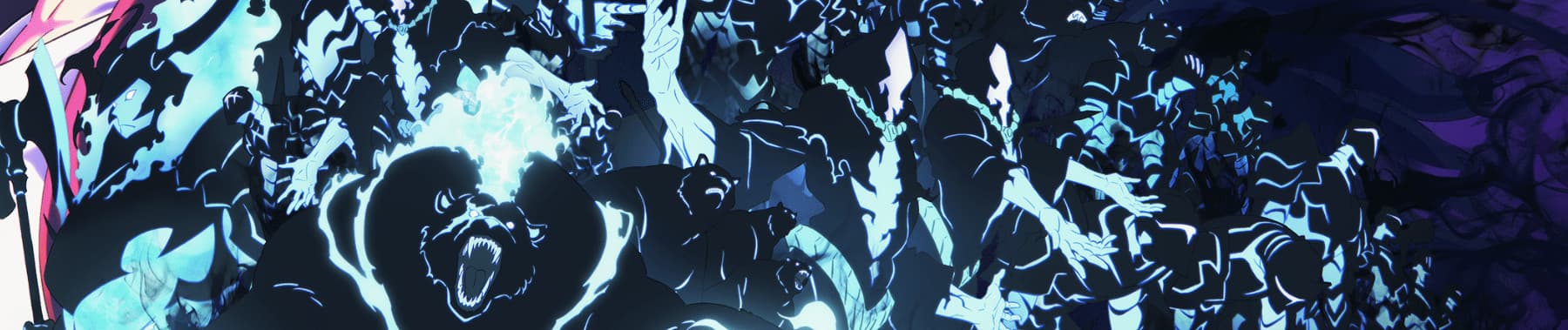
I already enjoyed the first season of Solo Leveling, so the second season unsurprisingly was enjoyable as well. Most of the primary strengths of the series, such as Jin-Woo’s charisma and the inherent satisfaction of a progressive power-fantasy, are retained and in some ways even stronger than ever. You could say the production team assembled behind director Shunsuke Nakashige and action directors Yoshihiro Kanno and Hirokatsu Maruyama “leveled up,” as they managed to meet rising demands to keep up with the sheer ambition of adapting a power fantasy as flamboyantly as possible. It’s very difficult to animate anything on a larger scale, such as multiple characters fighting each other. It’s difficult to animate non-human creatures and animals. It’s difficult to maintain a high floor for the action throughout an entire cour, packed with action scenes. And nonetheless, they managed to keep up with the ambition, and managed to follow Jin-Woo’s journey as the fights he partakes in become bigger and crazier with no end in sight.
Watching Jin-Woo is also simply enjoyable as well. Most people, and the show itself, call it “aura,” and it is an apt term, but it’s really a substitute for what we call charisma. It’s the same reason why I like watching Robert Downey Jr. play Iron Man or why I like Seto Kaiba in Yu-Gi-Oh. Charismatic people are just entertaining to watch; they grab your attention in a particular way. It feels good to watch this show.
img70%(https://imgur.com/Y8Y2PdK.jpg)
Another thing I enjoyed in the first season was the tone of the show most of the time. It feels weirdly dry and sterile in a way that makes sense because of how non-fantastical the cast and the setting outside the gates themselves are. There is a deliberate contrast between the very “hype” and “aura” moments, which are Jin-Woo and his rise to power, and the human experience that applies to most of the other characters in the show who aren’t Jin-Woo. It’s a fine line, where the show still indulges common aspects of a power fantasy, but at the same time doesn’t try to make the act of fighting creatures in gates seem pretty. It also helps that the majority of the cast is adults, and as such, we have grounded side plots where characters have to reconsider if they are even suited for battle and what they want to do in life. Or how to deal with PTSD and survivor’s guilt. While the series doesn’t lean heavily into this aspect, I still like that it makes room for these kinds of character beats, and it also makes Jin-Woo interesting for me when you consider his role in the narrative.
In addition, I kind of like the pacing of this season too. It’s fast, and you can tell, but it adds to the viewing experience because it feels like the show doesn’t try to waste your time. And they still managed to add anime-original content for side characters, which is pretty impressive. I also think the cliffhangers for this series are very good, and I’m someone who loves good cliffhangers. It’s simply a good viewing experience when episodes constantly make you want to go to the next one immediately.
img70%(https://imgur.com/htlWTB2.jpg)
Now, moving on to the negatives. Firstly, while the production team truly did an amazing job with this season, especially toward the end, you could tell that the schedule was catching up. Episode 12 is the best example, with a very overt and noticeable quality gap between the climactic fight and the rest of the episode (I want to stress that the fight itself was amazing, though). Season 2 was more ambitious, but it failed to deliver a polished standout episode like season 1’s episode 11. And it personally throws me off, as I can’t properly immerse myself into an episode or say that I found it extraordinary as a whole, when it’s clear that significant parts of it are severely limited due to time constraints. So I hope in season 3, they find a better sweet spot to give the team enough time to polish the episodes, as it would be unfortunate if they can’t always put out the very best possible end result. The pacing in the fights could use improvement as well, with the end or climax of a fight happening kind of abruptly – I had this issue with the Igris fight, and in this season, the best example would be the Baran fight.
And while I did praise the tone of the show, sometimes its attempts at comedy are ones that I just don’t find entertaining or interesting, to be honest. Lastly, the post-processing/compositing can sometimes be better. Season 2 fights sometimes are simply not readable. They did strike a much better balance in season 1, as the Igris fight, for instance, was very fast-paced and intense, but you still knew what was going on. So I hope they also continue to aim for more clarity going forward, as I do like a lot of visual choices, such as the rain in the Baran fight - But they need to be implemented in a way that doesn’t distract from the action and choreography itself.
In conclusion, Solo Leveling Season 2 – Arise from the Shadows – was a good time overall. I think it retained its strengths from season 1 well, but ultimately, it sometimes feels bogged down by an unforgiving schedule and a limiting script, despite the talent assembled. These criticisms, however, don’t detract too much from the positives, and Solo Leveling can be intense and amazing when it wants to. Yoshihiro Kanno, you are the goat. I’m looking forward to what you have in store for us in the future.
Thanks for reading this thus far, and if you have any feedback for this review - Feel free to let me know with a profile message.
img70%(https://imgur.com/zAs0s0Z.jpg)
24 out of 32 users liked this review
