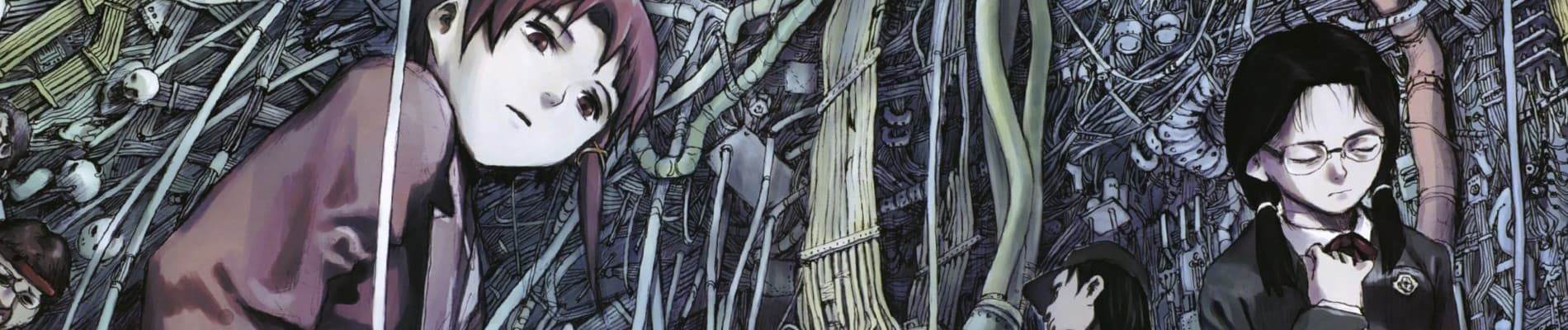
Connection and memory. These are the core attributes of a networked society, and of the prescient Serial Experiments Lain. Though very much of the era of its creation and purposefully abstracted, it carries an emotional weight no matter the time you view it.
As an avant-garde horror show, Serial Experiments Lain is not best judged on standard metrics for a well-rounded narrative. The plot is relatively thin, but it never for a moment makes you think that the literal events are most important. The story is about the feel of the world, the implications of the events, and what is experience by both you and the characters. It's more grounded than most avant-garde art pieces and the narrative reveals are satisfying - just don't expect a typical format of "event, reaction, character reflection". Others have summed this up as "non linear", though I think non sequential is a better term. Sequences don't tend to wrap up, they always build towards heightened emotions rather than new story beats.
Serial Experiments Lain holds a carrot just out of reach for its entire runtime, effectively guiding the curious viewer down a hole of discovery. Explanations don't really start appearing until Episode 7, which was when my personal tolerance for pure abstractness was starting to run thin. Even then, you simply must accept that the logic is beyond standard comprehension. You are forced to confront its surreality head-on, not searching for answers to the pieces that are illogical but to the parts that make very clear sense. Throwing out the abstractions is not the point - they are truly necessary for the narrative power of the story.
However, when it attempts to touch upon traditional storybeats, it does have some trouble really making those mean something. For example, the character Myu-Myu seems to have some semblance of an arc and is given signifcant screentime, but it never adds up to anything. Along with a certain amount of repetition of certain elements - such as Lain's endless blank stares at things that never communicate much - it shows that this series was very restricted in budget more than ideas. As much as the emotional resonance comes through, there were clearly many challenges in production.
One of the most fascinating parts about watching Serial Experiments Lain is how it gives even a novice viewer incite into how anime is made, whether they're looking for it or not. To be frank, this show is janky. There's so many clear animation issues and reuses that it's clear that Triangle Staff was a no-name studio. At the same time, the show uses this to its advantage. You can hear the room of the voice actors. Liberal use of filters make you question whether or not something is actually a mistake or a cue to the existential dread lingering at the edge. Blank space - like the dead silent audio bed and the colorfully dancing shadows against a sea of white - is one of the most unsettling things in the whole show. Many of the repeated elements are absolutely intentional and amplify the concept of recursion as part of the narrative. It definitely wears aspects of the digital age on its sleeve, even if it exists in the space between the move from analog to digital.
It's impossible to get the most out of the show without understanding the time and place that it was made in. Only at the very cusp of the ubiquity of the World Wide Web, the story's Wired envisions a world of pre-internet thought conceptualizing the basis of a global network. Untamed visions of connection without standardization, rapidly changing and evolving for everybody, not just technology people. This vision of a future which seemed plausible - in a twisted way - singling out the cyberpunk vision of Serial Experiments Lain as a companion to Ghost in the Shell and The Matrix which sandwich it between them. With its focus on the idea of connection, Lain turned out to be the one with the most relevance to the evolving, technological future.
More than its vision of what we might now call the present, the series also is a view of the late 1990s. Clothing, music, grungy aesthetics, the place of social dynamics about to be shaken up by the ever-present surroundings of digital devices. That makes Lain a time capsule. It is inescapably of a time period which this reviewer grew up in and therefore cannot help see a world through young eyes like Lain's. That doesn't necessarily make it nostalgic, but it adds a certain potency to the world communicated by the creators.
What this anime does perfectly is create an atmosphere. I really cannot fault the directorial vision, even as its production needs sometimes show too readily. Their efforts in bringing this cohesively disconnected world to life remains admirable and intriguing. What it doesn't do great is giving sufficient depth to all the concerns and subjects brought up. There's so many small crises in the story about what the eroding layer between the digital and physical world means, yet only about two major topics get explored in much depth. So much more could have been said about the subjects it really seemed to understand from its brief glimpses - including memes, the way forums change the nature of discussion, how technology could affect education, etc.
What does this recommendation come down to? If you want to experience something truly unique that will give you an appreciation for the abstract without overwhelming your every waking thought, Serial Experiments Lain is a story with a satisfying arc and conclusion amongst the avant-garde. I couldn't tear my attention away from it, though I wouldn't necessarily call it "suspenseful" in the same way as a Heavenly Delusion. I can completely understand why others call this a masterpiece, but too much potential slips through the gaps for me to feel the same way. The vision makes it easy to recommend to any Japanese horror fan as well as existential sci-fi lovers alike. Having it in my anime vocabulary has helped me look deeper at other shows in the same vain.
18 out of 21 users liked this review