It's a testimony to the fact that good art can come about from a lot of mediocre elements; the series isn't successful because it's well-written or tightly plotted, or because it deals with any ideas that hadn't been done to death in anime and visual novels for at least a decade before its release. In spite of this, though, it knows how to pace itself; the first three episodes form a compelling arc of their own that does a lot to hook viewers through the duller and more conventional beats to come. The show is, here and elsewhere, selectively underwritten; it's easier to read Mami as a complex character when it's not made clear that she's purposefully dooming Madoka to secure her company.
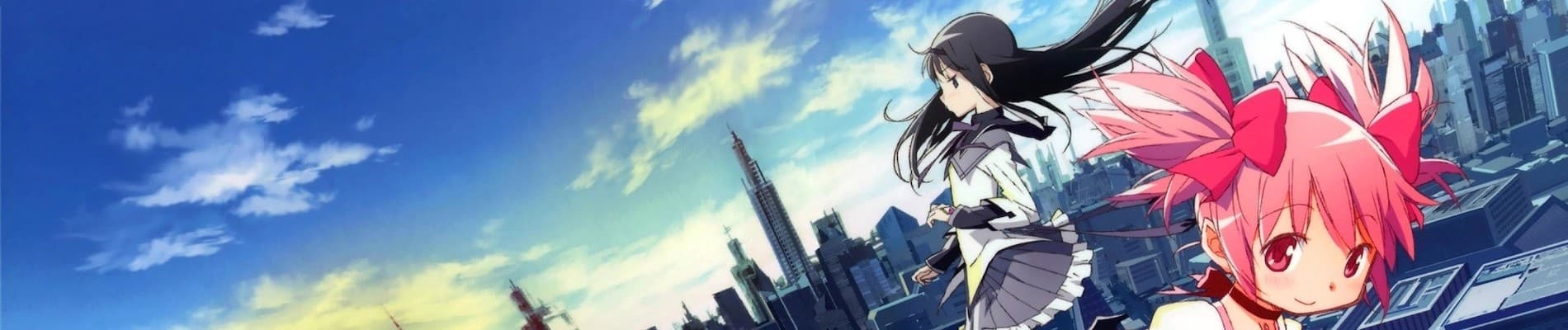
Where that lack of specificity, the evocative broad-strokes portraits of characters that let the viewer fill in the gaps herself, really shines is in the last three episodes of the series. Madoka Magica would've been consigned to the seasonal anime memory hole long ago in their absence; I can say without exaggeration that the show is MadoHomu and MadoHomu is the show. It's an aspect of the show that relies on a lot of the series' best qualities: good voice performances, in particular that of Yuki Aoi, supported by really expressive character animation, and aokiume's strongest character designs, which themselves account for so much of why these two have been fanart staples for more than a decade now.
The quality that really distinguishes them from the usual shonen-seinen yuribait couple, though, is the recognition that making these characters too individual, too grounded in the premise of the show or the details of their own lives, would only limit their appeal. We don't actually see much of what a relationship between these two would look like. Homura's backstory is all compressed to a twenty-minute sequence mostly focused on high intensity scenes of loss and need. What's shown in its place is a volume and depth of feeling, a more abstract sense of the purity and emotion that forms its foundation. Anything else can be filled in, and people eagerly do; spend ten minutes on the Pixiv tag and you'll see fluffy, idealized young love alongside the agony of unrequited adolescent pining, alongside Homura consigning herself to a life apart from her and the world, and the two of them as young mothers, and Homura as Madoka's captor. All of these are basically supported by the show, and this goes a long way to explaining its afterlife as a lesbian cult series despite its demographic target.
In a less fannish sense, though, the best part of the show is Junko and Madoka's relationship. It's so rare in this medium to see familial relationships not built on the performance of a role. Junko's doing her best to communicate with a girl in a very alien position, and Madoka's doing her best to convey what she's experiencing in her own limited capacity. Junko's the model that Madoka's following in becoming an adult, in taking on a role in which she's relied upon by others, but there's only so much guidance she can give her, and they both feel that limitation acutely. All the best individual scenes in the show are between them, those which have the most purpose without being didactic, and ending the show on a scene between Junko and Homura's probably the best call it could've made.
32.5 out of 34 users liked this review