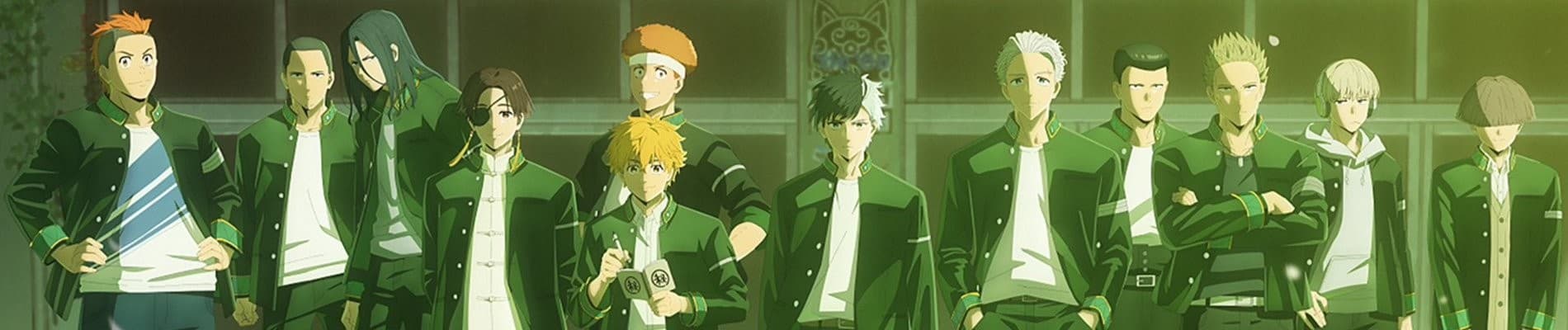
WIND BREAKER
a review by juleseverworth
a review by juleseverworth
Do you ever encounter a story that feels like it was almost written specifically for you? Dumb high school shounen-type humour, plenty of creative and fluidly animated fight scenes, and enough character depth to provoke emotional investment – Wind Breaker really has everything I’m looking for in a shounen. I understand why not everyone loves it, but I just happen to disagree. It’s not perfect and I still love this show (and its manga) so much. Now, I’m sure people who are smarter and more well-spoken than I have long reviewed (and criticized) every aspect of this show, so I want to only focus on two parts that I love with all my heart: Sakura and the final fights of the Shishitoren arc.
This review will contain spoilers for season 1.
Sakura starts off as your basic male lead, he wants to fight, he’s good at it, and he’s really quite loud about it. But right off the bat, I love how Sakura’s backstory isn’t given a lengthy expository dump; we know everything we need to know already. Sakura is a boy who has been scorned for his appearance, to the point where not only has he internalized the fact that he is “disgusting”, he anticipates nothing but malevolence from everyone that interacts with him (throughout the season, it is very obvious that Sakura’s first reaction to an unknown person greeting him is to prepare for a fight) and his entire self-worth is tied to his ability to win fights. He basically states this after the tournament arc. And this backstory defines everything Sakura does.
To put it simply: Sakura is someone who doesn’t know what it is to be loved, and someone who doesn’t know how to care for other people, and this forms the beating heart of Wind Breaker, even long into the manga. Because, to me, that’s what Wind Breaker is really about: community.
I love the way that Sakura’s upbringing defines everything he does at the beginning of the show. He’s violent. He’s useless in anything other than a fight. But, even from the beginning, you can see Sakura’s heart of gold, even if he himself doesn’t. It’s easier for him, to just go along with what he’s used to, but Furin won’t let him do that – and that ties into a major theme of the season. Having friends and a community is hard. Sometimes it’s easier to be on your own. But your friends will challenge you. It will hurt. You will have to unlearn a lot of things about yourself, but if you surround yourself with the right people, you will come out a better person.
That brings me to my next point: it’s easy to tie character development to strength. Main characters learn grit and resilience, and persevere through challenges with all the new skills they’ve learned from their training. And there’s nothing wrong with that, don’t get me wrong. But I do love that Sakura’s character development is not about his strength. He is strong from the very beginning. Sakura’s development is almost entirely emotional and psychological. He learns how to accept other people and he learns what it is to be accepted himself. He learns that he is dependable (despite the fact that he consistently sees himself in the worst way possible) and that he is not the problem. But all of this is only possible because Sakura is willing to learn, and to unlearn the harmful habits that have led him down this lonely path. He, despite being visibly uncomfortable, asks people for help. He studies Umemiya and Kaji, with the simple logic that he uses to deal with the fact that he doesn’t understand social norms, and tries to figure out what they have that he doesn’t. I think that is a message that is more relevant than ever: you not only need a willingness to learn the hard skills and technique: you have to be willing to learn about yourself and your own flaws from the people around you, and sometimes, that will be even harder.
I haven’t even begun really talking about why I love Sakura so much, so I’ll just say one final point and leave it at that (for now). Sakura is a loud character, there’s no denying it. He’s constantly screaming about one thing or another. So I really love how, when Sakura is truly struggling with something, he is really, really quiet. In fact, a lot of the saddest parts of Sakura’s character (for me) get played off as comedy. Sakura doesn’t have friends. He doesn’t know how to use a phone and has no apps for socialization. He doesn’t even have anyone in his contacts other than the weather, not even his parents, but he never says any of this. It’s quiet, but you can see the toll it’s taken on him through everything he does, every time he freaks the hell out from someone showing basic human decency (that he isn’t convinced he deserves) to him. There’s a scene in the manga later on, of Sakura sitting alone in his barren house, that completely breaks my heart, and I feel like it encapsulates a lot of his character.
Sakura is loud, chaotic and kind of dumb sometimes; strong physically and strong at heart. But he is also selfless and self-sacrificing, humble to a fault, willing to face difficult situations in which he is out of his depth, honest, honourable, dependable, and so profoundly sad in some moments. And, most importantly, it is so easy to understand why he comes to be loved at Furin.
First off, the first choreography, animation and overall direction are stunning, and the music during Choji vs. Umemiya is top tier. Incredible stuff, topped off by some great performances from all four voice actors (Uchida Yuuma as Sakura, Nakamura Yuuichi as Umemiya, Umehara Yuuichirou as Togame and Toya Kikunosuke as Choji – hats off to them). I love that each character has their own distinct fighting style, and that each fight had a vastly different tone: understanding, from Sakura and Togame, and rock bottom, from Choji and Umemiya.
There are two main things I want to talk about: the relationship between Togame and Choji, and the parallels to Sakura drawn by Umemiya vs. Choji. I really like Choji, you can probably tell.
Togame and Choji have such a beautifully imperfect relationship. They really care about each other, intensely so, but they haven’t gone about it the right way in the past. Remember how, with Sakura, I talked about how surrounding yourself with the right people means that they will challenge you and it will hurt? That is precisely what Togame and Choji didn’t do. Togame didn’t do what Umemiya and the rest of Furin did for Sakura. He stood by, told himself that he would do what he had to in order to make Choji happy, and let something he knew was wrong happen – ironically, fueling Choji’s descent onto a darker path. And this is such an easy thing to fall into! It’s easier, in a way. It’s so easy, to put it off, to internalize the issue, and to stand by, but Sakura’s bold straight-forwardness and steadfastness in what he believes in shakes Togame to his core, and he realizes what he’s done. I’m not saying that Wind Breaker teaches us to punch people when we disagree with them, but I love the message that some types of conflict are healthy. If you don’t fight with people in your life, ever, you probably aren’t close enough with them. Healthy conflict, between two people who mutually respect and care for each other, helps them both learn and grow as people. Hiding their grievances against each other does nothing but hurt both of them and that’s a valuable lesson to take away. It hurts. It will hurt. But it’s how you hold each other accountable, as friends and as equals.
One other thing I love about them, particularly Choji’s reaction to the aftermath of his epiphany, he doesn’t blame Togame. It would have been so easy turn around and say “I trusted you, why didn’t you have my back?”. But Choji didn’t do that. He accepted that while yes, Togame should have stopped him, the responsibility is ultimately on him. He accepted accountability. He accepted the consequences of his actions, and fully intended to honour them (even though Umemiya turned him down). And not only is this huge for his character, it fits in perfectly with the overall message of community and growth that Wind Breaker tells so well.
I talked a lot about Togame’s story, but I like Choji’s story as well. Just very quickly, it’s so easy to get so wrapped up in chasing something that you lose sight of everything else. As someone who has constantly been pushed to excel academically, I really relate to Choji talking about how he doesn’t feel anything anymore. I don’t feel joy when I get good marks anymore. I just move on, because it’s what I am expected to do, and continue down a self-destructive road where my entire self-worth is pinned on my grades. I feel like his story is relatable at its core, and the flaws that turn him into who he is are believably human (projecting his own emotional turmoil onto those around him, and taking his pain out on other people).
Now onto the second matter: I love how Umemiya vs. Choji parallels Sakura’s own development. Sakura is strong, and Shishitoren are the devotees of power, basing their entire hierarchy on individual strength and Choji is the exemplification of his mindset. Choji thinks of nothing but fighting strong opponents and he doesn’t particularly care about anything other than that. In other words, Choji is a mirror image of who Sakura could have been, if he never came to Furin. Choji is the epitome of the strength-above-all mindset. Sakura himself even admits this later on, after the Shishitoren arc shakes his confidence in who he is. But the key is this: Choji loses. Choji, a parallel to who Sakura could have been on his own, loses to Umemiya, who is clearly holding back because he misses who Choji once was. Choji loses, and Umemiya says that his punches are “light”, because there’s “nothing behind them”, whereas Umemiya has a community to protect behind his back. In order words, the outcome of Umemiya vs. Choji is basically a statement of Furin’s community-centric ideology triumphing over Sakura’s initial “lone wolf” mindset. Sure, Sakura’s learning how to be a part of a community, and Tachibana told him that he’ll never ascend to the top on his own, but here’s the proof. Here’s the proof that Furin and Umemiya aren’t empty words, that Tachibana is right, and Sakura knows this.
Not only is this fight a triumph for Umemiya and proof that Umemiya more than deserves his title as the number one in Furin, not only does this fight serve as the breaking point for Choji’s mindset, inspiring him to do better and atone for his mistakes, this fight also serves as the final breaking point for Sakura’s mindset too, albeit in a much quieter way. It’s a beautifully packaged fight scene that develops four characters at once, which is no small feat.
If you’re still reading this, well…my condolences. This is barely even a proper review, just an excited spiel about why I love this show. I’m also sorry to say that this is not even close to everything I have to say about this season. People will probably disagree with me and say that I’m reading too much into a simple story and projecting my own experiences onto it, but hey, this is just my opinion on why I loved this show so much.
To wrap up, Wind Breaker gets a lot of comparisons to Tokyo Revengers and on the surface, they seem similar enough: children fighting children with no competent adults to be found (a classic). However, Wind Breaker is completely different, for better or for worse. Wind Breaker is not a story about fighting. Wind Breaker is a story about a bunch of otherwise violent thugs, dismissed from polite society, and how they come together to challenge each other to be better. Wind Breaker is a story about a bunch of children that otherwise may have ended up in jail finding each other and becoming a force for good. Wind Breaker is a story about overcoming prejudice, about overcoming walls that you build for yourself, about loving and being loved in return, about growth and finding your place in a society that doesn’t want you, and about, ultimately, love and community, told through the language you would least expect a story about love to be told through: violence.
13.5 out of 16 users liked this review
