One Outs
a review by Turcobandido
a review by Turcobandido
One Outs is a sports manga focusing completely on psychological battles. In it, the main character, Tokuchi Toa, has almost no true athletic ability but stands out as a “gambler”, a person that has full confidence in his abilities to read the opponent’s intentions and uses this skill to win entire games either as a pitcher or as a coach for the entire team.
Early on, these abilities are used in very entertaining ways. We get entire matches where Tokuchi shows off and messes with people’s heads and their entire perception of how Tokuchi pitches in the first place. Tokuchi’s personality shines through here, showcasing how he’s a master at planning and cunning.
Every single game, Tokuchi has a plan to mess not only with his immediate opponents on the pitch, but also with his greedy boss. Tokuchi has entered a special contract that will boost his own salary with each added great performance, while he will lose part of his salary if his performance tanks.
One Outs distinguishes itself from other sports manga in that it’s not really about the thrill of checking someone’s athletic skills. There isn’t a new technique, nor does a player understand the flow of a match better in each match. There isn’t a training arc. Tokuchi is overly strong, and this manga is all about how he can demolish all of his opposition. Honestly? I don’t think I mind that. This manga is not about a team focusing on physical challenges, but more so, trying to figure out surefire ways to win without necessarily working that hard.
This is exemplified early on through some outright brilliant matches. One Outs shines in moments in which Tokuchi wins through unexpected rules, has to deal with an incredibly freakish athletic player, or has to deal with other cheating players and has to outwit them without necessarily ever breaking the rules. It’s entertaining!
Sadly, the manga kinda falters on this end later on. After the equator, we shift the focus onto building up the overall shape of the team rather than Tokuchi outwitting his opponents. Parts of this are entertaining, I like how Tokuchi makes use of some inexperienced players or how he builds up camaraderie amongst his teammates through a new “MVP” system.
However, the matches themselves feel rather underwhelming as time goes on. The last couple of matches are an egregious example of this. We see the opposing team preparing to battle against Tokuchi by adjusting to his pitches… yet the final game is decided in the span of 20 pages, where the solution is way too simple for what the beginning of this story prepped us for. Which is a shame, because those first 10-13 volumes are amazing, but the landing didn’t stick the landing at all.
It’s not like One Outs is full of deep characters either. Tokuchi is an incredibly interesting character who catches the spotlight at all times, sure, but the secondary cast? Kojima is a bit interesting as the “veteran star,” and Ideguchi serves a good role as the “intelligent backup” that acts as the team’s core but the rest of the baseball team is rather flat. This is disappointing to me since I read Rookies not long ago, and in that manga, the entire team was beautifully characterized. That manga was a Shonen fully focused on personal dynamics, and One Outs is much more brainy, sure, but seeing how the last quarter didn’t live up to the hype on that front, I would have appreciated a bit more passion put into the team’s overall roster of players.
The rivals don’t fare that much better. There are some recurring characters, but the overall roster of foes is not really that memorable. Some have striking designs, such as Brooklyn from the Mariners and his imposing muscles or the striking dasher from the Buckaboos, but their gimmicks and their looks are what I remember, not their overall character or disposition.
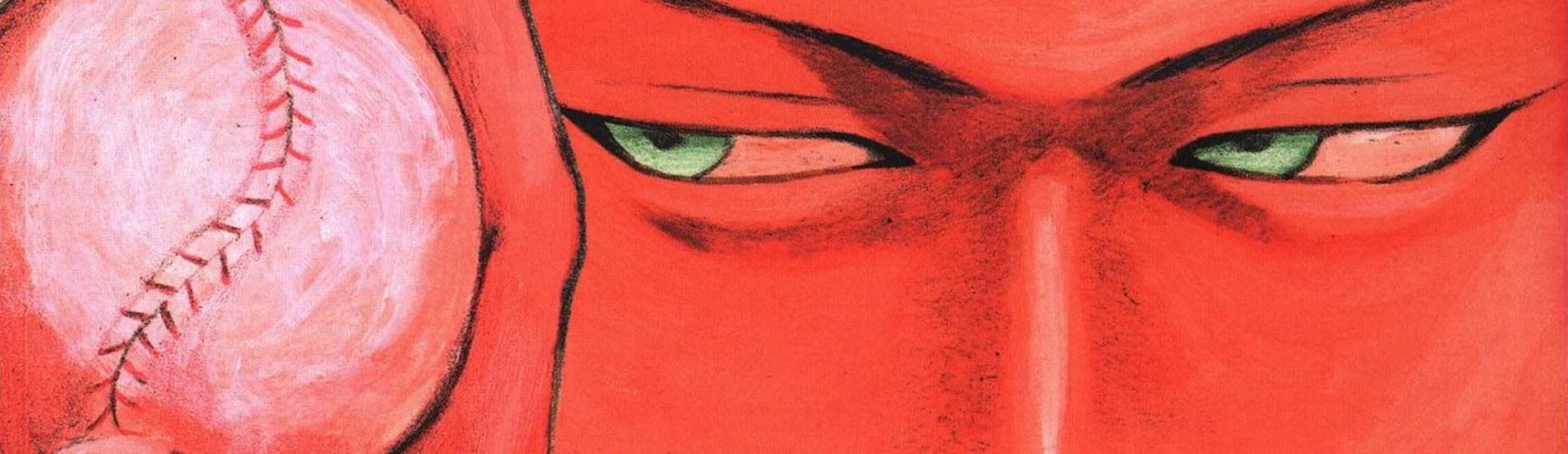
Kaitani’s art is a marvel to look at, though. It’s soft and stylish, with characters breaking into exaggerated but realistic outbursts that showcase their current emotion beautifully. Kaitani can infuse tension and threat into his panels through lights and shadows to great effect. It’s still nothing groundbreaking, and his “sports metaphor” game and visual variety when depicting sporting acts (like the ever-present pitches and battings) are both dull, but he’s still able to characterize the cunning and emotion of his characters with great precision.
All in all, it has a great start but falters towards the end. I like when it’s really brainy at the start through long matches where they show Tokuchi’s cunning throughout, but as time goes on and matches get shorter and shorter, the manga begins to lose my attention and ends in a bit of a whimper. It’s not the worst end to a manga, not at all (it’s not as alarming as Promised Neverland or Oshi no Ko), but it leaves me a sour taste that dampens my overall outlook towards this manga.
9 out of 9 users liked this review
