Mobile Suit Gundam ZZ is a direct sequel to Mobile Suit Zeta Gundam, but is fairly unlike its predecessor. Consequently, your experience with Zeta is likely to have a strong influence on your reaction to ZZ. If you really enjoyed Zeta's fairly bleak tone and ambiguous, heavy character drama, the first half of ZZ's hard commitment to farcical comedy is probably not going to go over well. Neither is the fact that ZZ is not as well animated as Zeta. However if you found Zeta a bit of a slog (as I did), I think ZZ does a lot of things to course correct that will make it worthwhile viewing.
One key thing I think ZZ has over Zeta is that it's consistently more exciting, even in the more slapstick-heavy early portion. Zeta's action was often dominated by mobile suits engaging in slap fights in space with little to differentiate one engagement from the next. ZZ, on the other hand, tries to give most of its fights something interesting - a handicap, interesting battlefield conditions, unique mobile suit capabilities, or heightened stakes. Also, while it is less pretty to look at (and there is a distracting amount of reused animation), I'd argue it is better directed than Zeta. It's much easier to follow the position of mobile suits and the fights feel more frenetic and intense, even if they have fewer and less detailed frames of animation.
The central cast for this season are more straightforward and easy to like than the Zeta crew, and their overall dynamic feels closer to the White Base crew from the original series. Another key thing I liked about ZZ over Zeta is that it remembers that poverty exists and will be a significant motivator for people. The central protagonist Judau and his friends - the cool headed Elle, serious Lino, and lackadaisical Beecha and Mondo - do not start out caring about the Neo Zeon conflict. All they want is financial security. They are made to care as they are confronted by the consequences of the war, and slowly grow into a determined and coherent fighting force. It's a simpler character dynamic than Zeta attempted but I found it considerably more believable and endearing. ZZ rotates through a couple of recurring comedic antagonists before settling back on Haman Karn as a central bad guy. (Fortunately Haman, who I think was one of the good things in Zeta, survives the transition between series intact) I preferred the first one, Mashmyre, whose endearing romantic himbo antics were generally quite funny. The second is Chara Soon, an unstable cougar who appears to be sexually aroused by mobile suits, and I think this works less well. I don't dislike the more comedic arcs purely for being comedic, although they are only sporadically funny, but I do dislike how much of it feels like its filling time. That's not to say that they're hugely boring to watch, and they're less of a dirge than Zeta's middle part, but I could really feel the wheels of the plot spinning in place which was frustrating. There is a fairly natural transition from the campiness of the early episodes into something darker and more recognisably of a piece with the prior two series in the back half, although the comedy still does make some unwelcome intrusions into places it doesn't belong. There is a particular episode in the second half that has some really striking images of large scale destruction that I think stands out as the single best episode of the first three series outright. Tomino still hasn't quite worked out how to pace a 47 episode series of television so apart from the slow pace of the early section there are a few wonky transitions between arcs, and the concluding part feels like it perhaps should have started a few episodes earlier to give the final conflict the depth it deserves.
Beyond the central crew and the antagonists, the main addition to the cast I think warrants a specific mention is Elpeo Ple. Ple is Tomino's fifth or so attempt at the same archetype of "young female Newtype wielded by the antagonists but who forms a connection with the protagonist" and this is the one that finally really works. Largely this is because she's a much more prominent character than previous versions of the archetype so you actually get to see the bond between her and Judau form in a more organic way, but also partly it's because she's visibly younger which makes her behaviour come off as less weird. In general, people act less strangely in ZZ than in Zeta, except for comedic purposes. Characters make choices that are more easily fathomable, people express their emotions through physical assault far less often, and the women and girls by and large act like women and girls instead of aliens from another dimension trying to imitate human behaviour.
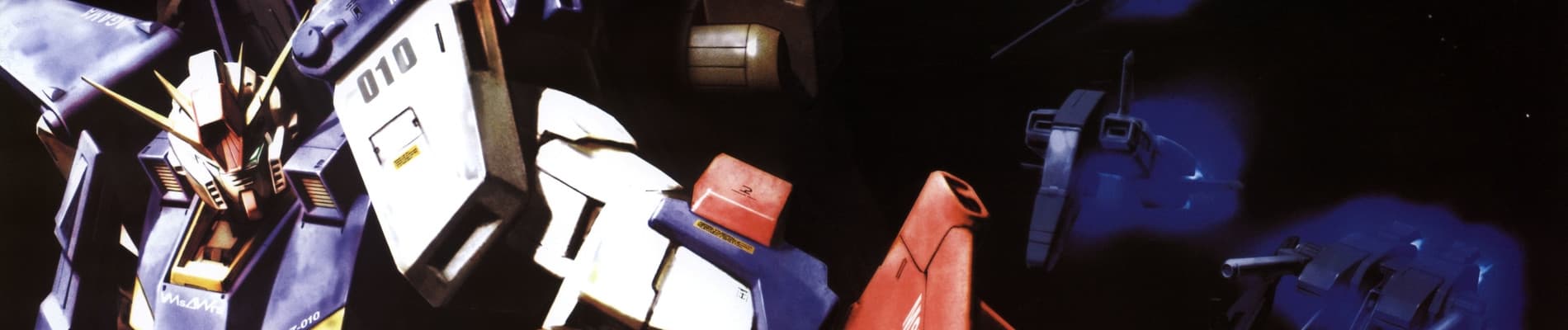
A lot of the technical design from this series is carried over directly from Zeta, as you'd expect for a direct sequel. The new additions are a mixed bag. I wasn't especially taken with the design of the ZZ Gundam itself, it sort of looking like the Zeta with a lot of extra bits bolted to it. Its ability to be split into three parts like the original Gundam also seems wildly impractical in the context of the existence of the Zeta, particularly since the Zeta sees heavy use in this series so you're constantly reminded of it. However, I have to admit that there's a lot of good use of this gimmick in the creation of exciting set pieces. There's plenty of good looking, interesting enemy mobile suits introduced for it to face off against.
Overall, while ZZ has some strange idiosyncrasies and essentially changes its whole identity over the course of the series, I think it's fundamentally actually a good, solid, down the middle bit of Gundam that makes some notable refinements to the formula. It might disappoint viewers hoping for something more ambitious, but there's certainly enough quality content in it to warrant watching it if you've made it this far through the Universal Century already.
16 out of 29 users liked this review