The first and most important thing to say about Mobile Suit Gundam is that there are a great many sequences that use flashing images that could induce seizures in people who have photosensitive epilepsy. This is a series from a time when using strobe effects to represent explosions was still considered acceptable, and it is used liberally. The sequences that use this effect were unpleasant to watch for me, and it therefore seems likely they could have much worse effects on people with a sensitivity to such things.
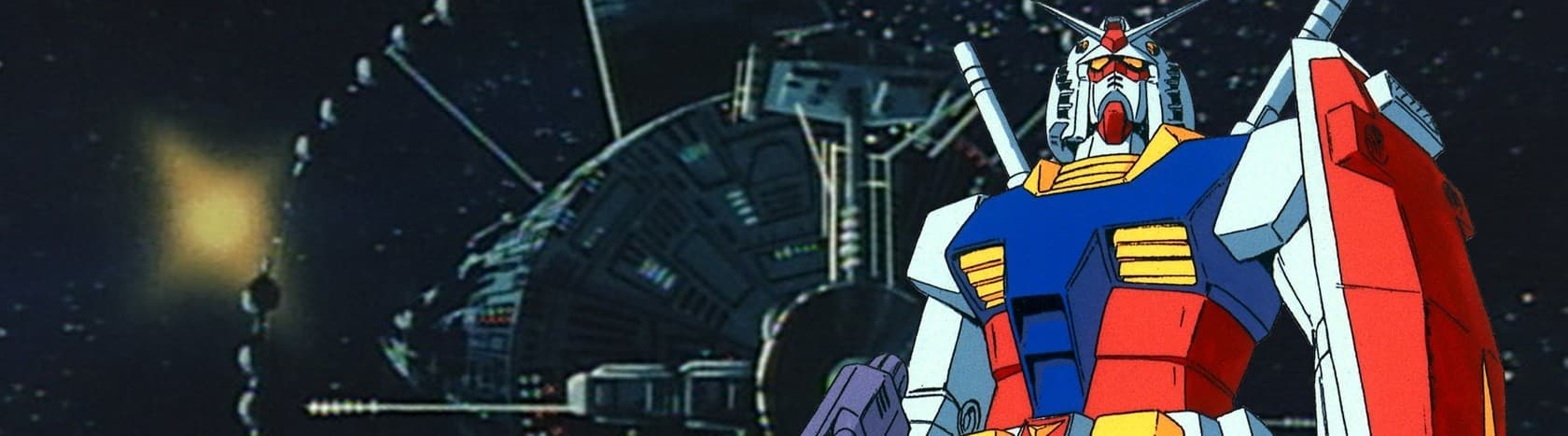
Despite showing its age in many ways, Mobile Suit Gundam’s better qualities shine through consistently. TV anime in 1979 was primitive, to say the least. Every episode looks like it had a budget of about ¥23, but you can the direction pulling hard against those limitations to get the maximum possible value up on screen. Detailed mechanical design is a pipe dream, objects on screen often don’t rotate wherever possible, and the Gundam itself feels like it’s slightly off model a lot of the time. Despite that, there is a lot of striking shot composition, and careful use of the fairly limited score to build tension and excitement even though very often what you are watching is clearly a static animation cel being moved across a background. The depiction of the grim realities of warfare, and the ultimate inhumanity of death and destruction on such a scale are evoked very effectively despite the limitations of the animation, helped along by some excellent sound design. The technical design is also constantly wonderful to look at, there’s a very distinct and interesting aesthetic not just to the mobile suits but also all the technology, ships, and uniforms have a great look to them. A lot of it is a very 1970s vision of future aesthetics that doesn’t quite line up with modern sensibilities, but the Gundam itself is a design classic that has endured in our collective consciousness for a reason.
The writing side is a similar story in how it is in many obvious ways very flawed and yet clearly has something special about it at the same time. The central character, Amuro, has a mixture of neuroticism, fear, vanity, drive, and antisociality that feel right for a teenager thrust into a key position in a war, although it doesn’t always feel like those traits come to the fore organically or in the right order. The central antagonist Char Aznable, as an experienced and cunning soldier, is an ideal foil for him, and the scenes where the power of the Gundam is pitted against the experience and skills of Char are always exciting. They are surrounded by a good supporting cast, with the crew of the White Base believably developing from a rag-tag group of children armed with advanced military technology to a hardened fighting force. The series greatest flaw which drags it down more than anything else is that the plot is all over the place. The opening arc where the White Base is trying to escape to Earth is great, full of constant tension as they are pursued by Zeon’s forces. Once they get to Earth things start to get a bit wobbly. Char isn’t present for large stretches and none of the secondary antagonists introduced in the meantime can really fill the hole he leaves, and there are multiple short arcs that are a bit of a drag to sit through. Characters also repeatedly seem to change their motivations or relationships at random which leads to a lot of scenes feeling jarring. It might also just have been a deficiency of the subtitles I was using, but the motives of certain characters occasionally seemed opaque in a way that I don’t think was intentional. For example, I have no idea what Char was actually hoping to achieve in the last arc, which incidentally also takes a lurching left turn into being concerned with dealing with the implications of the emergence of Newtypes, humans with extrasensory perception. While the plotting is shambolic, the vibes do generally shine through; this is a crushing war of attrition, where characters can and will die, with moral compromise on both sides. Zeon’s nationalism and authoritarianism are the greater folly that initiated the war in the first place, but the Federation are not innocent of carrying out many of the same crimes. Likewise, although many combatants are dragged into the war against their will, they are not any less complicit in propagating it.
The practical upshot is that Mobile Suit Gundam is deeply messy and imperfect, but it is an imperfect mess that I have a lot of respect for, and contains much that is enjoyable. I wouldn’t recommend it on its own merits, but it’s Mobile Suit Gundam; we live in its world, and it doesn’t need to be brilliant to be worth watching. An enduring legacy of mecha anime started here, in the Universal Century continuity, the wider Gundam franchise itself, and beyond, and if you care about the history of the medium it's worth it for that reason alone.
20.5 out of 37 users liked this review