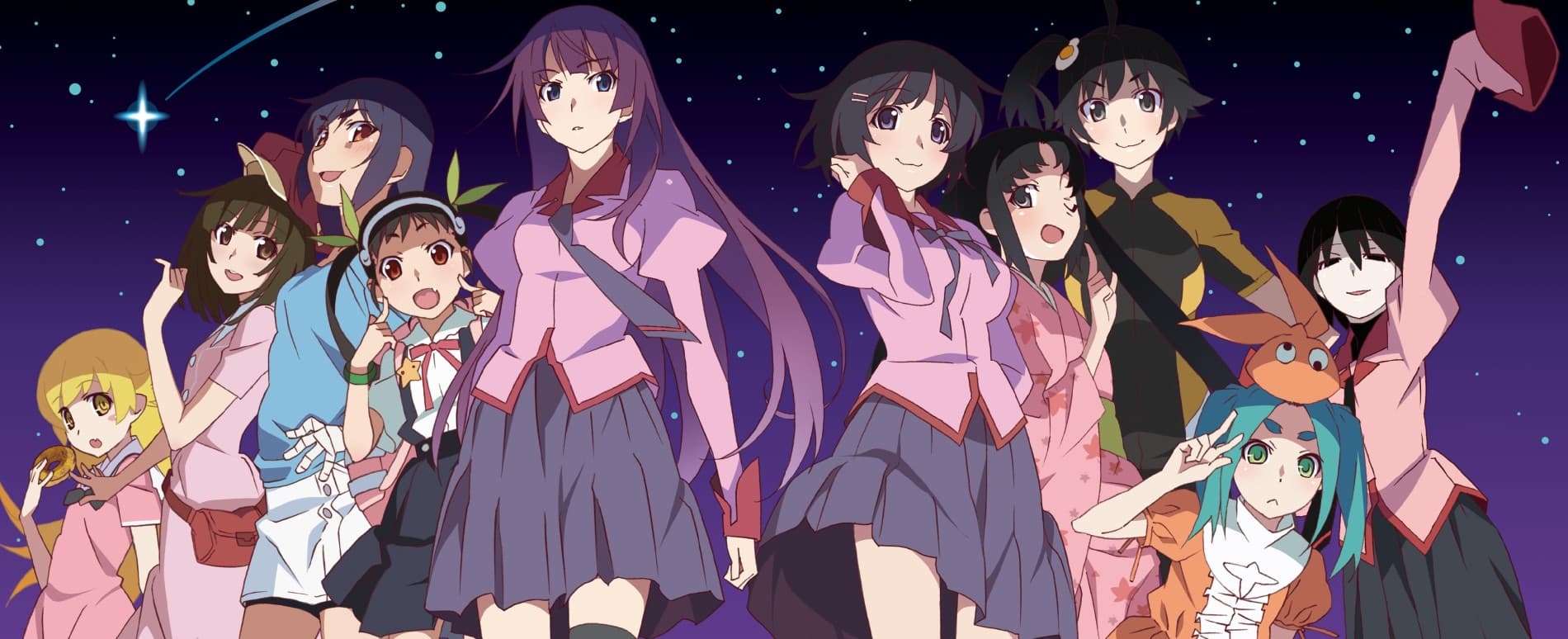
"It's important to look back on the road you've been walking on to see how far you've come every once in a while, Arasuji-san."
``
-- Mayoi Hachikuji, Koyomi History
Due to being a series of twelve short little mini-sodes spread across the calendar, first released on a mobile app lost to time, Koyomi is an oft overlooked chapter in the series of stories known as Monogatari. It's very easy to think little of it due to its very nature, as I've seen countless viewers do over the years, but I need to make this very clear: This collection of side-stories is just as relevant and meaningful as any of the much more beloved parts of the Monogatari Series.
It's just as laden with themes, foreshadowing, and deceptively meaningful storytelling. And most of all, I'd consider it one of the best executions of a "series recap" I've encountered in my years as an anime watcher. So as much as this is a review, it's also my attempt to persuade you to see it how I do, even if only for a moment.
One that cleaves a path across the Calendar, building a bridge to the "End" of Araragi Koyomi. When you consider the Final Season as a whole narrative, Koyomi serves as the intermission right before the main course (Owari). In other words, It's a reminder of the path which Araragi has tread throughout his final year of adolescence, and also highlights the next step. Consequently, the overarching purpose of every mini-arc is to remind the reader of this "path". That's why they all take place somewhere along the path to, from, between, or during all the past stories we've been told throughout the proverbial calendar.
Despite functioning as a recap Koyomi is no clip show. Every arc explicitly references different Stories we've already been told in such a way that helps build a clear mental image of the timeline, and it does so without ever feeling as if it wastes your time by rehashing scenes we've seen before. Part of this "reminding the audience" is also accomplished through context clues. Reusing various landscapes and backgrounds of a particular arc builds that bridge in the reader's mind to whichever arc it's calling back to.
Another aspect of Koyomi that is often overlooked, yet easy to appreciate once you notice it, is how comfortably it comes off the heels of Tsukimonogatari, the previous installment. Immediately prior to Koyomimonogatari, Araragi's tale about Yotsugi was one that showed "the beginning of the end", and involved Araragi making a vow not to involve himself in oddities once more due to his encroaching vampirism.
So it's only fitting that such a turn of events would then be followed up thematically with a installment where nothing particularly supernatural happens. Koyomimono's arcs begin as minor tales where something seemingly odd is discovered to be the work of humans or nature, not the supernatural.
Naturally this mundanity very quickly dissolves near the end as the arcs encroach onto a part of the calendar past Tsuki, culminating in one of the most jaw-dropping and exciting cliffhangers I've ever experienced. In case you've yet to see Koyomimonogatari for yourself, I'll leave it at that! I'll also leave most of the deeper analysis and meaning of its bite-sized sidestories for you to discover, assuming you've yet to watch it. Just know that every episode has some depth to offer, despite how it may seem (probably just better to read the novel for that though, i'll admit).
I do want to touch on some criticisms I have of this adaptation. Firstly I have to mention the lacking production value in comparison to most of the series. It's understandble for the most part, considering its origins as an ONA for a phone app, but even so I feel much more could have been done for the blu-ray release to bring it to a similar level as most of the series. It still has interesting visuals and a distinct aesthetic that sets it apart from most anime due to its Shaft pedigree, but that only goes so far when the format is as restrained as it was for this work.
That being said, one aspect of this "cheapness" I do give more leeway towards is the reuse of shots, cuts, and entire OPs from previous installments. Though it was likely done with the intention saving time/resources for more important projects; I actually feel that these instances of "recycled assets" actually compliment the core purpose of Koyomi's narrative as a recap. It only serves to make the callbacks more clear through the sense of deja vu. And I'll never turn my nose up (or should I say ears) to the distinctly iconic musical score this series has, even if no new tunes came out of this one besides the Ending theme.
By the way, for those watching for the first time, I suggest skipping the OPs for episode 8 and 9, since they're from Owarimonogatari. (This is due to this adaptation being made after Owari was adapted in 2015, despite Koyomimonogatari's anime being an adaptation of the novel that was written directly before the _Owari novels).
Leaving aside talk of the technical, I also want to address what I consider to be the place where Koyomimonogatari is most lacking. As a source reader very familiar with the novels, I feel that the narrative's purpose would've come across far more clearly in the anime adaptation had it taken the time to include the contents of the first chapter in each sidestory. This is because it's within those chapters that the bulk of Koyomi's thematic cohesion is most apparent. Araragi is a guy who is infamously very quick to spend entire paragraphs of text contemplating his own existence, as is the case here. Each arc of Koyomi begins with him reflecting on his own life, his choices, and the "road" he has tread on; always punctuated at the end with him asking for the perspective of a different heroine about this concept of "paths" or "roads" through life. I began as an anime-only fan of Monogatari, but after watching the show seven times and reading and rereading the novels, these contemplative chapters have ultimately became my favorite part of Koyomimonogatari. They are what completes the work in my mind, and you could say that after I had that shift in perspective, the adaptation feels incomplete without them.
Of course it's great. This series is never anything less than a 9/10 if you want me to put it in base terms. Despite admittedly being one of the weaker installments in the series; Koyomimonogatari itself is still a far more narratively cohesive, meaningful, and just plain ol' fun show to watch compared to most anime. Even at its weakest, the Monogatari Series still reliably proves itself to be more fascinating than most anime out there. That's what makes it so underrated for me. Don't listen to anyone who tells you it's okay to skip most of this installment, they have no idea what they're talking about!
57 out of 61 users liked this review