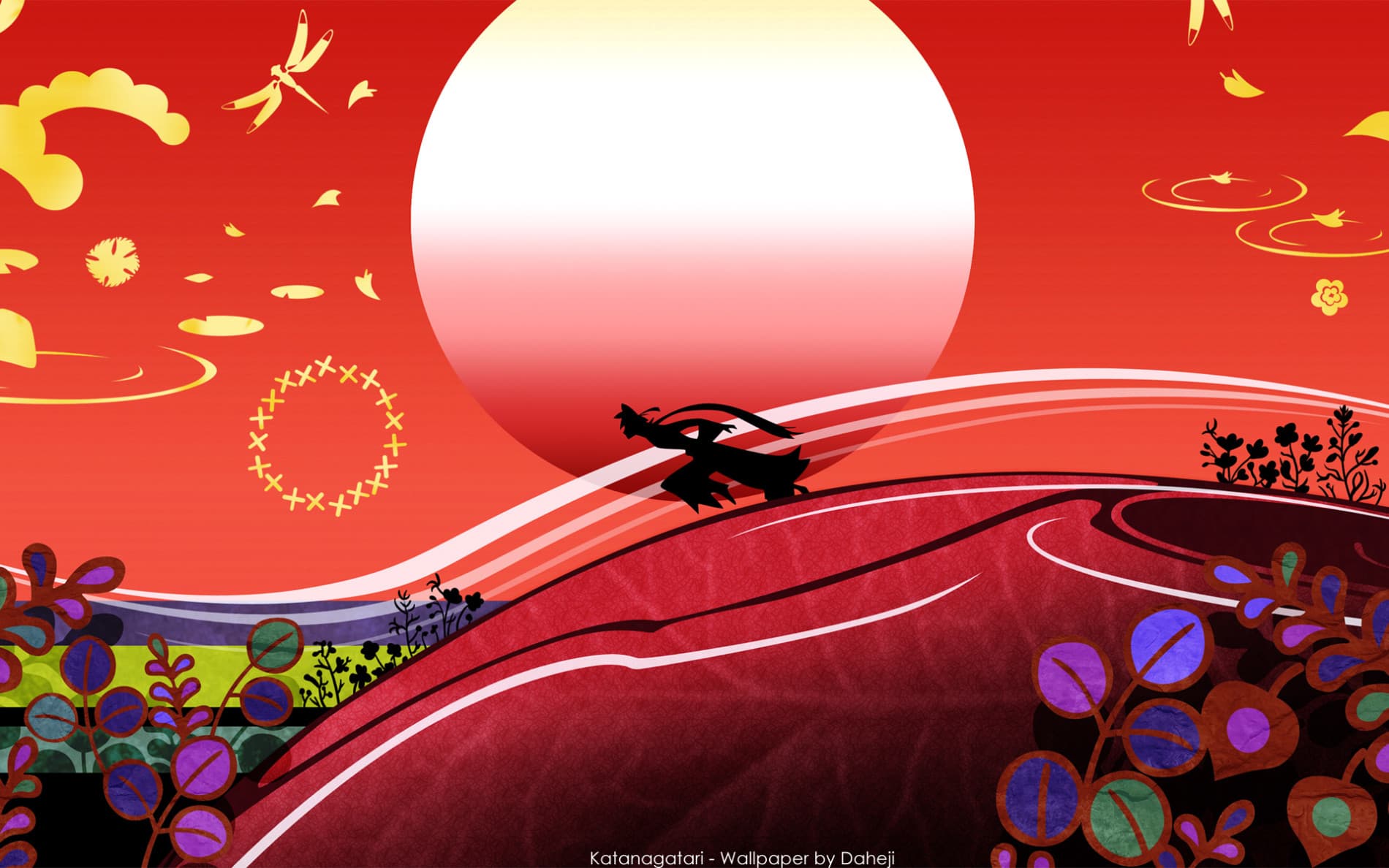
Katanagatari
a review by diavolo
a review by diavolo
Let me preface this by stating that this is more of an interpretation of the series' ending filtered through its philosophical and narrative themes rather than a review in the classical sense, meaning that I won’t be diving into its aesthetic (beautiful!), its soundtrack (very good!), its style (quirky!), its rhetorical devices (unorthodox!), nor any technical aspects of the plot/story execution (not without flaws!). As such, this will be full of spoilers, and I won’t be providing a synopsis here, so really, make sure you’ve seen the anime before reading this.
Also, I don't know the source light novel, nor have I read up any further about the series or any other interpretations of it, so this is really just me thinking out loud a day after finishing the anime.

I'd like to unpack this beginning with the ending, namely the revelation of the history revision plot, as it defines the series’ overarching theme. Following the series’ premise, the deliberate expectation that this is going to be a heroic quest, culminating in a victorious conclusion for our heroes, is ultimately shattered here. As the show has reminded us time and time again, it’s the victors who write history and carve up their space in it, and at last we understand that this story is not about victors. But then again, none of the stories told across the twelve episodes ever were. At its end, Katanagatari finally reveals itself as a tale not of triumph, but of failure. The narrator plainly states that these were the stories of those who failed—not just in their missions, but in their attempts to find meaning, to realize their identities, to make history remember them. It is the tale of those who dedicated their lives to a single purpose, and who failed to fulfill their purpose as much as that purpose failed to fulfill them.
This sets the philosophical tone: Katanagatari is about those forgotten by history, yet vividly remembered by us. But it also raises an important question: Did your life ever matter if you fail to leave behind a legacy to be remembered by? What does it mean to have lived a meaningless life? What gives life meaning?

The characters we follow—Shichika, Togame, Nanami, the sword wielders, the Maniwa—all dedicated themselves to purposes that ultimately consumed them without fulfilling them. In conventional terms, they "wasted" their lives. Yet Katanagatari doesn't simply present this as tragic; it presents it as fundamentally human. The series takes special care to show us not just their failures, but the vivid entirety of their existence—their passions, their contradictions, their moments of connection and alienation alike. What emerges isn't a consolation that "their lives mattered anyway," but rather a more complex suggestion: perhaps the meaning of life isn't found in accomplishment or historical legacy at all. Perhaps it's found simply in the experience of being alive, with all its richness and absurdity. And perhaps, there’s also something to note about agency here, but I will be coming back to that later.
Consider Nanami, who possessed the power to change history yet chose isolation and observation, trapped by the confines of a paradoxical existence—too weak to realize her potential, yet too strong to die from it. Consider the sword wielders, each so consumed by their singular identities that they became prisoners of their own specialization. Consider the Maniwa, with their elaborate personas and rigid objectives, who substituted a fantasy of importance for genuine autonomy. These aren't just stories of failure; they're stories of lives that mistook purpose for meaning, achievement for fulfillment.

Let me illustrate this further using our heroine Togame as an example, who was entirely entrapped in the self-made confines of both her persona and her sword hunting quest, meant to shape history in a way she hoped would give her life meaning. A quest that would have been entirely futile had it not been for Shichika, but that implied imminent danger surrounding it regardless—revenge always does, but even more so when it’s aimed at the shogunate. And while she initially never meant for Shichika to be more than her sword, he ended up becoming much more than that. Actions speak louder than words; regardless of what Togame pretended to be or feel, her countless attempts to draw reassurances from Shichika regarding the sincerity (and mere existence) of his feelings and loyalty towards her paint the picture of someone who so obviously wants to be vulnerable, yet fails to even admit that to herself.
Now, in theory, at any given point, and especially so later on, she could have decided to no longer be a part of all of that—her revenge, her plans, her pretense—and just run off into the night with Shichika by her side. In theory. Because of course, someone so attached to the persona and meaning she had created for herself to the point of actively even lying to herself, the Togame we’ve come to know would have never done that, and so she didn’t, and so she died. Not only died, but in a way history will punish as having been meaningless; as no more than a pawn to Hitei, who had really been pulling the strings all along. And through the incredibly zoomed out lens of history, Togame’s death might just be as insignificant as that makes it seem. But that is precisely why we followed her along for eleven episodes. It’s also why we followed along Nanami, the sword wielders, the Maniwas—everyone who would be sure to be forgotten with time, but whose lives were still saturated with ambition, love, vengeance, and connection; even if all of it faded into obscurity.
Togame was certainly riddled with complexes and insecurities, but we experienced how temperamental, how dramatic, how sad, how jealous, how joyful, how content she could be, and could have been. It leaves us with the bittersweet experience of having known not only her, but of the potential she could have had. This might explain why the series presents these tales of failure not through a lens of unrelenting tragedy, but through vibrant aesthetics and moments of genuine humor and warmth. Katanagatari is colorful, stylish, vibrant—it’s meta. It’s one of many ways in which it plays around with the subversion of tropes and expectations, but for a series that makes it its point to showcase the lives of those who failed, I think it’s quite befitting to do so in a way that focuses on that life, and the nuance it entailed, rather than just its legacy.
Speaking of legacies—let’s dive deeper into Togame’s death and Shichika’s life.

Togame was afraid not only of betrayal, but of the sheer emotional vulnerability required to trust someone. Despite this, she shares some incredibly significant, vulnerable moments with Shichika. These moments themselves are a testament to how much he means to her (and how much she ultimately wants to trust him). But in the end, she is who she is—the person that stuck to her path and to the meaning she saw in it—and as such, when she dies, we don’t get to hear her openly admitting her true feelings. I think that her claim that she would have killed Shichika after completing their mission is likely what the idealized version Togame had of herself—the cold and calculating mastermind—would have wanted to do, but the Togame we knew would likely have found a way to justify not doing it, as to then be able to ignore the dissonance between her self-conception and actual (vulnerable) emotions, while keeping Shichika by her side, hoping he'd stay by hers, too. Either way, the Togame we knew said farewell to Shichika in the only way she could—dramatically, and true to her carefully crafted persona. I also like to think that her trying to deny the sincerity of her feelings was what she would consider to be a noble attempt at setting Shichika free from the grip of being her sword. After all, she was dying a meaningless death following an ultimately failed quest; Shichika had the potential to do and be more than that. The potential to truly live, rather than waste his life chasing an unfulfilling purpose. ...but that’s really just me speculating.
Shichika's path, in this context, is quite interesting. He starts out as a sword, yet paradoxically, the more opponents he cuts through, the more it humanizes him. Giving in to his grief right after Togame’s death, he ends up doing quite the human thing and tries to follow her, which ends up being precisely what Hitei had wanted him to do to complete her history revision plan. It might seem random at first how he ends up (begrudgingly) travelling with Hitei, of all people, after all of that is done and over with, but there's a certain irony in it that I appreciate. They are, after all, the only people to have technically affected history—one unknowingly strung along by the other—amidst all of the characters unable to do so. Yet it ultimately results in nothing, as history goes on to take its seemingly predetermined course regardless. What does matter, though, is that this history will unfold with a Shichika who has chosen to no longer be the 7th Head of the Koytouryuu, nor to continue Kiki’s sword line, and to instead simply live his life. While this might be of no further significance to history, this is the story’s quiet, final truth: the reclamation of one’s own will.

In order to expand on this additionally emerging theme of agency and living life self-determined, rather than predetermined by history, lineage or even fate itself, let’s take this back to the history revision theme one last time.
Taken at face-value, Kiki claims to have already succeeded in altering history previously—with the outcome being the additional existence of Togame, the Itezora clan, and other characters that wouldn’t have been supposed to be there—but I wonder if this is about actual time manipulation as much as it is about going up against what is perceived as fate, and trying to become an active participant in it by changing its course. Regardless of how it’s meant to be taken, it ironically achieves nothing either way, as both times the course of history was supposedly altered, key events still took place as they should have, rendering the revisions futile. The series almost even suggests that these attempts at revision seem to have further reinforced the history meant to be. Does this mean, then, that trying to determine one’s own fate is futile or meaningless, too?
Maybe it’s true that things don’t happen around us, but that we unfold within history’s contours—woven into a narrative we didn’t author, born into a momentum we cannot fully redirect. Most of us will never leave a mark on history’s pages. Katanagatari reminds us that this does not render a life meaningless. Even those who failed to shape the world around them were shaped by the world—and in their fleeting choices, contradictions, and connections, they lived.
The irony, of course, is that the more the characters try to revise history—to rebel against their roles, to impose their will on fate—the more the old patterns reinforce themselves. Hitei’s manipulation, Togame’s quest, Kiki’s forbidden blades; each a challenge to destiny that ultimately affirms it. The story suggests a kind of tragic symmetry, where resistance itself becomes part of what history was “meant” to be. But that doesn’t make it futile. Because to live, in this context, is not to rewrite the story, but to become a story worth telling—even if only for a moment, even if only to those who remember.
Maybe, then, this story is meant to add comfort to the thought that even those who failed to write history still had their place in it. Maybe, to live is simply to live, to experience existence in all its intensity, regardless of what one accomplishes within that life.
Or maybe, whatever that means is up for you to decide.

With a joyful cheerio followed by the dull pain of failing to punch the air out of your lungs, I’ll see myself out!
23 out of 23 users liked this review
