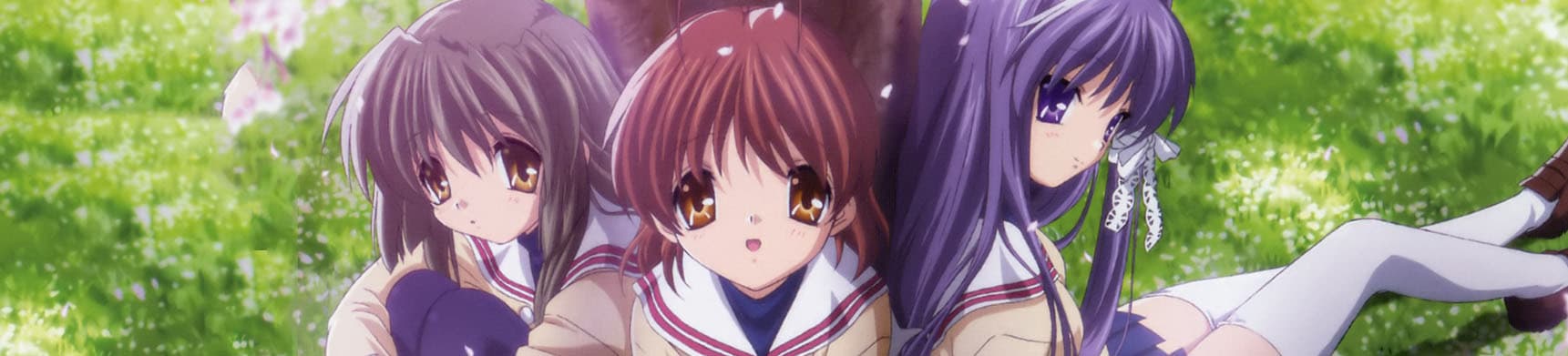
Look, I get it: it's hard not to let Clannad's first impression turn you away. The famously fish-eyed characters that look more invertebrate than human. The opening that screams 2000s visual novel adaptation by showing you still PNGs of each female character with their names spinning around in a PowerPoint slide.
It's easy to find what you're looking for in any piece of entertainment. If you come into this expecting a trashy harem, you will probably come away thinking you were right and that this didn't explore the other characters' routes enough. If you come into this expecting a comedy, you might say that the jokes were too sparse compared to the emotional scenes and that they never deepened past the level of slapstick comedy or running gags. If you're expecting a tearjerker, you might say, as everyone (including myself at one point) seems to have said, "It's just the setup for Afterstory."
My point is that your expectations for an anime are likely to become your opinion of that anime if you believe it strongly enough. So I urge you, whether as a potential first-time viewer or as a rewatcher, to approach Clannad with an open mind. I'm writing this review after binging it in two days for the second time.
On my first watch, I was expecting most, if not all of the above, and honestly just rushed through it to get to Afterstory. I came away with a mixed opinion. Now, I decided to rewatch it with a more open mind knowing what's ahead in the story, and I was pleasantly surprised to find Clannad to be much more enjoyable than I see it get credit for, so I'd like to offer my defense for some common criticisms.
____
The characters are ugly. / The artstyle is dated.
Just because their eyes are huge doesn't mean that there's not also a lot of other great stuff going on here art-wise. The camera work is varied, the characters and backgrounds can be drawn in great detail and have this pleasant pastel look to them. The animation is really fluid as well for the surprising number of action shots in here. Overall still a great-looking anime even in 2025.
The girls all throw themselves at him. / The harem choices are terrible.
I agree with this one, but it's by design. The main plot of the series is driven by the progressing relationship between the male and female leads. Clannad is a harem show in tag only, there is never any real competition from any character aside from
There is too much/little comedy/romance/drama/mystery/slice of life.
The best way that I can describe this show is that it is a slice of life in the truest sense. When we think of a typical show with that description, we may think of characters doing mundane, everyday activities. Don't get me wrong, sometimes the grocery shopping arc does hit different: but a recurring theme of Clannad that quickly becomes clear is that the life we are slicing from isn't all fun and games: it can lift you up and let you experience unbelievable joy and prosperity, then it can hit you with a ton of bricks while you're down, which brings me to the next point:
It's just the setup for Afterstory!
While it's true that this first season is necessary to introduce our cast and let viewers get emotionally attached to the main duo, I think you could probably pick up Afterstory episode 1 having never seen Clannad and put the pieces together yourself (not that I would ever recommend doing that).
My point is that this show does stand strongly on its own. There is laughter, there are tears, there are moments of triumph and moments of despair. The ending is quite satisfying and leaves us on perhaps the happiest note possible for the main duo. Every major character gets at least an episode or two's worth of content and they manage to remain unique and relevant throughout most of the show, although it's probably for the best that they are largely forgotten in Afterstory.
Kyou wants him for the bad-boy delinquent act, Tomoyo sees him as some kind of pet project to see if she can straighten out his grades and relationship with his father and turn Okazaki into an upright citizen. The rest aren't really relevant, Kotomi and Fuko are more like younger sisters to him than anything, and Ryou is... a character, I guess.
Okazaki's future is teetering on a knife edge and he knows it. One more year of school before he is thrust into the world with essentially no family, no money, and no goals, seemingly destined to a bleak life full of failure. But then along comes Nagisa, who, with her medical condition and past struggles with attending school, could easily imagine the same for herself and become similarly apathetic. But instead, she's standing at the front gates of the school, shouting something about sweet bean bread to get her cheered up to do her best.
Nagisa is clearly the best option for him and I think that it’s intentional that she tells him multiple times that she doesn’t want him to change at all. All the other characters see Okazaki as this burnout who is destined to go nowhere in life, so they try to change him. Nagisa sees him for the kindhearted and optimistic person that he truly is, that’s why she asks him not to change.
Ironically, this is probably the response that would cause Okazaki Tomoya to change the most: because he’s not trying to better himself for Tomoyo or Kyou, he’s trying to better himself for his own sake, because he wants to become the best version of himself for Nagisa. Several characters joke that "I can’t believe that Okazaki was finally tamed by a girl!" and I think those comments are deserved. Okazaki respects the fact that she is living her best life at school despite her condition and setbacks, and seeing that transformation in her makes him think that maybe he can induce it in himself.
I'm glad that I rewatched this and didn't try to skip straight into Afterstory. This has been both genuinely heartwarming and heartbreaking. Yes, there are some gags that overstay their welcome. Yes, the repeated appearances of the harem side characters can be unnecessary. Yes, Afterstory will undoubtedly be better, although I maintain that this still impresses as a standalone work.
At the end of the day, Clannad’s strength lies in its characters. Although they may initially seem like caricatures of characters from this era, deep down they all want the best for Okazaki and each other. When all the female leads get into a room together, there are these looks, nods, and silent exchanges to each other like they are working towards the same goal. Each one of them believes that they can change Okazaki for the better, but over the course of the show, they realize that only Nagisa can make him change himself. So they accept defeat graciously and step back in time for the real story to unfold in the second half. I can’t wait to rewatch it.
23 out of 24 users liked this review
