A Bride's Story
a review by Kishbokai
a review by Kishbokai
What I love about reading historic media is it's the closet thing we can have to experiencing what life was like back then. Photographs, personal diaries, etc., they can shape and explain much of history. But something about how art depicts feels so personal. As any modern art piece can touch someone's heart, like the person is reaching out to connect them to the piece, so does historic media. Except, the artist isn't connecting you solely to the piece, but to an entire time of culture and its people.
So it's not a surprise to me that most of my favorite manga take place in different time periods and settings. When I read a story, I want to go somewhere, see a place I've never seen before. Feel as if I'm there with the characters and understand this culture.
And I can proudly say that Otoyomegatari does this and excels further than I expected.
The manga is about a region I've heard from my friend, who is Turkish. She's explained a few things about her home as best as she could, but I knew that I could learn more and understand it when I visited that place. To me, she created that region in my eyes. And that's where this manga came in. A beautiful depiction of her culture that allowed me to connect to my friend on an even deeper level. For that, I am forever thankful.
But onwards to the manga, it is the story about different brides across central Asia. Each bride offers a different look into the culture of these regions, with amazing stories that can become their own fairytales. Each story has this silly start. Perhaps it's two twins trying to get husbands with funny plans like throwing a fish at a guy's head, and then saving him. Perhaps it's a somber tale of a bride who has lost many of her husbands to the chains of death, and has met a foreigner who seems like a gift of God. Or, where the story begins, an 8 year age gap between a twelve year old boy and a twenty year old women.
What helps about the story starting here is that we get to ease ourselves into the culture with a big culture shock. An age difference, and a big one at that.
Of course, you start to understand why this is the case: In an era where people could die as early as a baby, and before a proper marriage age, situations like this obviously have to occur. But another great reason we can start from here is we get to see the process of what a married couple is like. The type of things they do in this region with one another and seeing what being in a community like this feels like. When you read these early starts, you feels like a researcher, discovering an entire world unknown to you. I've lost count of the amount of times I would sit and stare at the pages, trying to grasp how these people created these things, knowing in the back of my mind all of this is real.
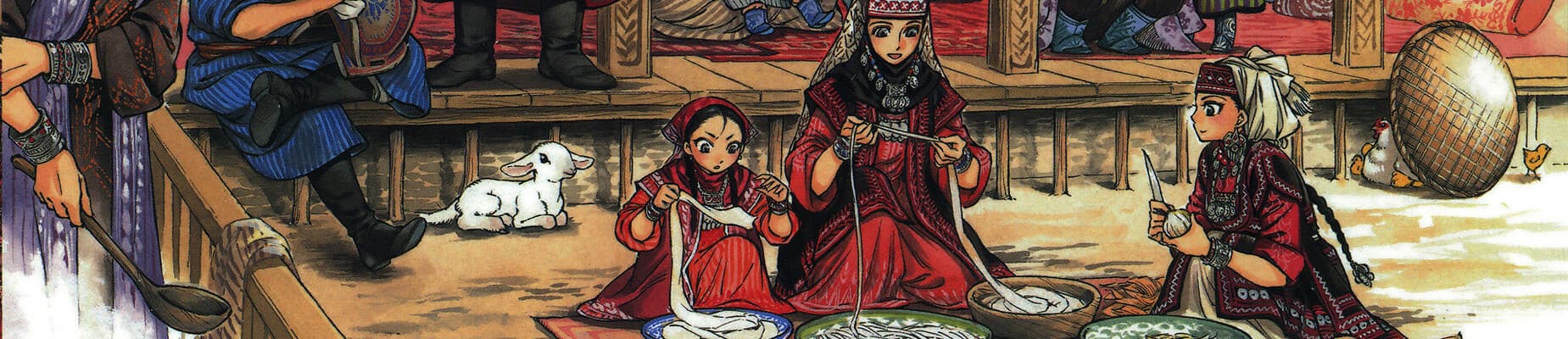
Now I have to talk about the art, because it is stellar. The mangaka talks a bit in her afterword's about the research she does for the art, but she is very humble about it. The fine details of her artwork are incredible. Nothing is without detail, nothing is without passion, and all of it was done by ink. I'm flabbergasted whenever she shows off the carpets or clothing in the manga. It's the work of a craftsmanship at its finest. That's not even getting to how handsome and beautiful these characters are. They are brimming with personality in the tiniest of ways, especially in their clothing. I can't stress how good it is. You are seeing her take a real life object and implant inside the manga. I now want a carpet, I want lots of carpets and rugs like the ones in the manga because of this mangaka. I think how this culture decides to sew history and the lives of so many different women into a carpet is touching beyond what I'm sadly capable of describing. It becomes more than a simple decoration but an imprint of us.


Most likely, as a reader and if you're not from Central Asia, the character you can relate to the most would be Henry Smith. A researcher from England, he has travelled all the way here to study the language and culture of these tribes. He is a very polite and honest man, whose tales could fit into their own manga. He is absent minded but there's something charming about that. He takes cautions, yes, but nothing will stop his curious nature from traveling the world. Probably what is so relatable about him is how he approaches the culture. He has culture shocks every then and now, but he always respects it and takes a step back. Some might mistake as it being cowardly, but I see it as admirable.

There's a lot of romance tales in this manga, but my favorite has to be with Pariya. She is someone who has this tomboyish energy, very nervous but it's so cute. She can be blunt and riled up which causes a lot of trouble in getting suitors for her. But when she does meet a potential one, my heart melts when reading it. So much of the romance is so pure, so delightful. No bride's tale is without its shares of love and joy. Likewise, each tale offers new pieces of culture that are exciting to learn about. These tribespeople share so much in common yet so many small aspects are different. The way women dress, the recipes they make, how they travel. All so different yet similar.


Because what this manga does best is display the natural life of humanity. We are but a race of animals that have managed to survive and learn through generations of people before us, and with people around us. We fight, we struggle, but in these peaceful moments, we create beautiful pieces of culture, a way of living that we can explore the world we live and discover it. What Mori Kaoru does is take her passion and spill it into a story of humanity so touching that I want to travel back in time to experience it. But she also makes you realize that these places aren't a wise tales, they exist! You can go and see them! That's the most wonderful thing that a story could give you. A time to reflect and take action in your own life, and meet people, laugh and travel with them on this grand journey of life.


19 out of 19 users liked this review
