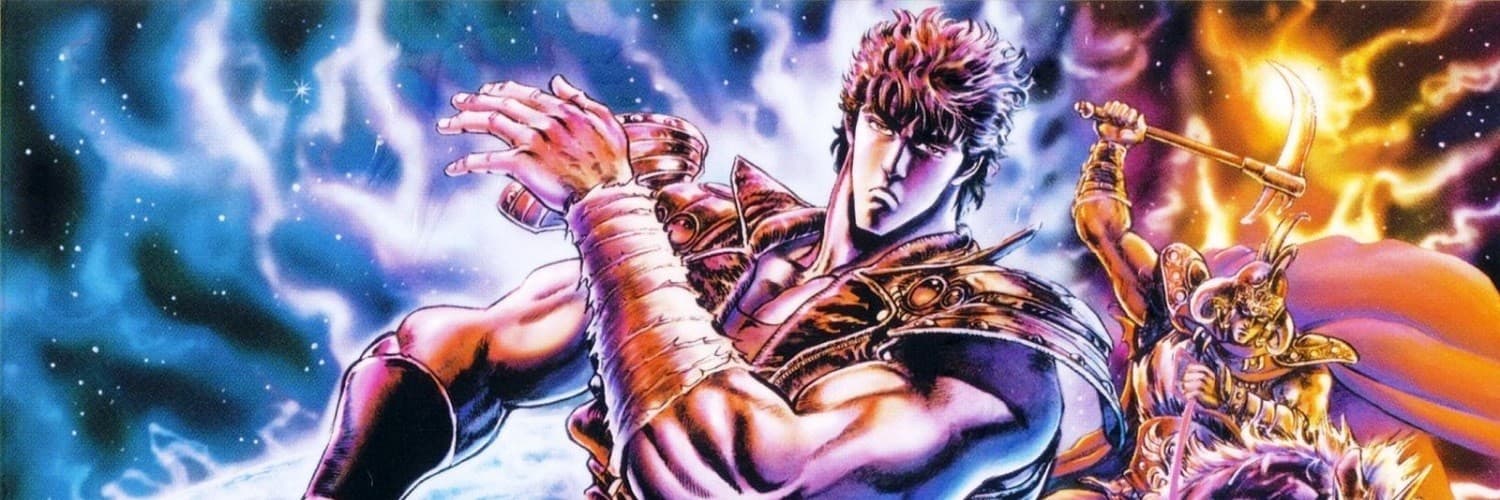
Spoilers for Fist of the North Star: You've probably already got the important bits though.
TL:DR: The Fist of the North Star film is quite reflective of the time period it was made in. It's certainly influential, and worth a watch if you like bloody, fighting films or are already dead.
The other day I watched the Hokuto no Ken, better known as Fist of the North Star, film from 1986 as part of a personal endeavor to look into anime I've missed over the years, especially influential ones. I think the reputation of Fist of the North Star ended up preceding itself for me a bit; I approached the film as a notable historic anime and thus I ended up viewing it less as an independent piece of media and more as a reflection of the time period in which it was made. I ended up observing things about the film that felt emblematic of the 1980's as a whole, rather than taking note of some of the film's more iconic scenes and moments which would pioneer tropes in the anime space which persist to this day. So I suppose this analysis/review is less about the film as a whole and more about what it made me think about from a historical context.
The first and most apparent thing that stands out about the film, and by extension the series as a whole is the influence it takes from other contemporary media at the time. The premise is unapologetically inspired by the Mad Max franchise, in particular The Road Warrior, with its post-apocalyptic setting, bands of punk-like brigands and motorcycle gangs who must be stopped by a lone hero who holds onto morals in a time of might makes right. The other big mark on the series comes from martial arts films; protagonist Kenshiro is effectively a much larger and more muscular Bruce Lee, even down to the high-pitched vocalizations he makes when delivering blows. There's also that whole "fighting over the inheritance of the fighting style" and the "rivalry between different fighting styles" thing going on as well.
Most interesting to me about the film is the way it reflects Cold War era political values and ideas, whether intentionally or no. The fear over impending nuclear war is shown in the film from the get go as the catalyst for the apocalyptic setting of course, but is also displayed in the climax. Roah and Kenshiro fight in in an epic battle, ostensibly over ideological positions, as their big anime energy is outlined in opposing in red and blue colors, all the while their conflict destroys the city around them. Two great and equally matched powers duke it out with the only result being the destruction of the world around them, only to be stopped by a girl, our vector for innocence in this narrative, begging for peace. It is not difficult to read the parallels to real world concerns about geopolitics at the time.
Like many action films at the time this messaging is a bit contradictory and messy; Kenshiro is our messenger for a world of peace and love and where the trees can go again but delivers this through exploding peoples heads into viscera piles through violence. Of course the idea is that what separates Kenshiro's violence from that of the villains is that his is done in defense of the innocent and for noble purposes but given how comically violent the film is such a notion can be difficult to take seriously. It reminded me a lot of Rocky IV, where Rocky Balboa gives a rousing speech about changing the world and achieving peace after beating the absolute hell out of a Russian dude.
Perhaps however, this is again, emblematic of the times. Not dissimilar to the values of the western world was easing tensions with the Soviet Union while also keeping a firm stance of bravado to appear strong and willing to fight at a moments notice. Did I mention this anime is SUPER buff and manly? We lost everything in the apocalypse except for steroids and hair dye it seems.
Some other minor historical tidbits worth mentioning are the subplot surrounding the growth of a flower on the dead earths soil and the presentation of the baddies. The focus on getting a flower to grow in the dead, irradiated soil of the earth, seems to exemplify at the time growing concerns and support for environmentalism, not only in response to potential nuclear events but as a result of rapid modernization and data showing the harm it was doing to the planet. The villains of the show, especially the more generic ones are heavily characterized by eccentric hairstyles and colors and flashy clothing, This is an interesting way to present villains in my opinon; these fashion choices were often worn by "punk" or counter-cultural elements in the 80's who did not jive with the era of Thatcher or Regan's neo-liberalism for one reason or another. The 80's was marked by a rise in criminal activity, and many pieces of media depict criminals in a similar way; think Bebop and Rockstead from Teenage Mutant Ninja Turtles or Birdie from Final Fight. It seems there was a desire to depict opposition to current cultural trends to criminality and violence...even if it wasn't true. In retrospect, we know that while there was a rise in crime in the 80's, some of it was the direct result of things like the War on Drugs, which manufactured crimes that did not exist previously or created harsher sentences for those that did.
A bit of meta-history here, the particular copy of the film I watched had an issue where during some shots of particular ultra-violence the video quality would mysteriously dip in quality. As it would turn out, this is not a form of censorship (as there are plenty of other violent scenes in the film that look fine) but rather an issue with the original release from Manga Entertainment for English distribution in 1994, which wasn't working with a complete master, so some of the shots (particularly complex, gory ones) revert to their original, shoddy VHS quality during these scenes. It was a bit annoying to deal with, but most of these instances only lasted a few seconds. I'm sure there's a full version out there, I just didn't use it.
To cut to the chase, did I like Fist of the North Star? I think so. I think I mostly liked it in a campy over-the-top violent kind of way where it was fun to watch people explode from martial arts moves and big muscular guys say cool lines. It probably goes super hard if you're a teenager or young kid in Japan, the same way Dragon Ball does, so I can see why it had a lot of influence. I also did rather enjoy thinking about it from a historical perspective...it was a viewpoint I didn't really consider going into it, but now that I have I feel like going forward I'll be able to look at shows and films with a more critical eye and analyze how the time period they were made in affects their narratives.
It's a fun romp. Go ahead and see it if you like action, martial arts, or buff dudes. Maybe avoid if you're squeamish...it is a bloodbath.
6 out of 7 users liked this review