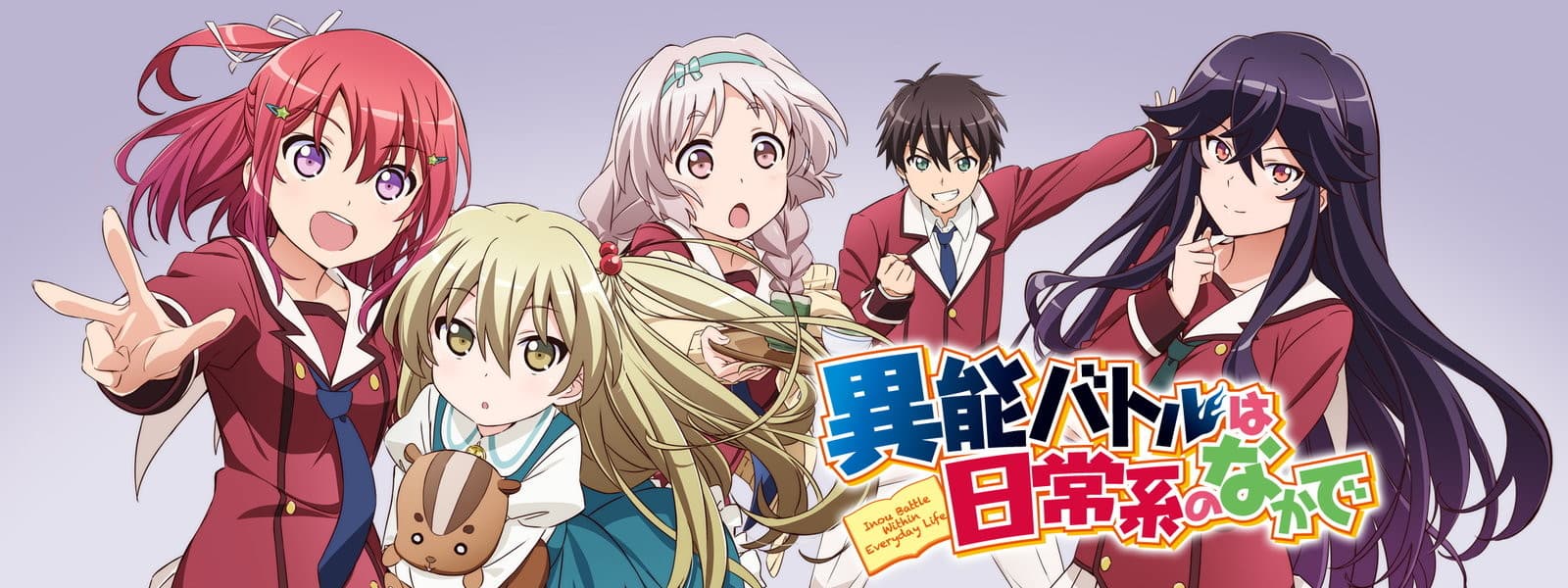
Verdict: InoBato is held back a bit by fanservice and some occasional confusion, but the great character writing and voice acting performances make it a delight to watch. The premise doesn’t really do it justice.
InoBato was an interesting watch in more ways than one. Like how I assume most people hear of the show, I was exposed to Saori Hayami’s infamous “I don’t understand” rant, which I maintain as the best bit of voice acting I’ve heard. So I finally decided I wanted to watch the show and understand the context.
The show spends the first 10 minutes convincing you that Jurai Andou is an insufferable person. His chuuni act isn’t even genuine; he knows that it isn’t real. I was deadest on hating this show based solely on the first 10 minutes, but I was wrong. I think if you take Anilist at face value, that this is a fantasy/comedy/romance/sol/supernatural anime, that you’re missing out on what I think the best part is.
InoBato is very quick to let you know of the harem elements, and there’s no immediate clear answer to why everyone would catch romantic feelings for Andou. That ends up being a recurring theme throughout the show, that they’ll give you the information before the context, which does make for some awkward moments. However, the shoe drops in the second episode and things begin making sense. Andou is far from being defined by his chuuni traits and instead proves himself to be emotionally mature beyond what you would expect from a typical high schooler. He is a great friend who knows what to say and when to say it, often disguising a mature attempt at resolving an emotional dilemma with chuuni nonsense. He also knows how to take responsibility for his own actions, and is quick to try and resolve the issues through communication.
These positives extend to the rest of the main cast as well. The literature club in InoBato includes Tomoyo Kanzaki, Hatoko Kushikawa and Sayumi Takanashi, as well as elementary schooler Chifuyu Himeki. All of them are demonstrated to be great friends with one another, and despite the inherent love rivalry over Andou, have no issues going to each other with their own problems. The ability to communicate their issues and move past them together puts InoBato ahead of a lot of RomComs that are far more popular. If anything, it feels more like a coming-of-age story than any of the designations it has. The dialogue is well-written and makes it clear that each character is trying to move forward in their own way.
The ”fairy war” subplot that tries to get the main cast involved isn’t particularly interesting, though it does provide a means to progress the character relationships. This does bring me to probably my only real issue with the show, which is that the show seems more focused on impactful, emotional scenes than how they should be laid out. Take the aforementioned “I don’t understand” scene, which in isolation is a phenomenal scene where Hatoko is calling out Andou’s chuuni nonsense for what it is. But there was no tension regarding his chuuni habits leading up to this point, and the entire “I don’t understand” moniker was based in him trying to hide a friend’s secret. By the end of the episode, you understand where it came from, but if I didn’t know it was coming at the time, it would have felt out of place entirely. But at the same time, the ordering of events in the episode couldn’t really have been switched for plot purposes. It’s a dilemma where the author opted for the more impactful scene, which I can’t say I 100% disagree with.
Aside from that issue and a good bit of unnecessary fanservice, InoBato is a heartwarming watch that I could have seen myself truly falling in love with if I was younger.
6 out of 7 users liked this review
