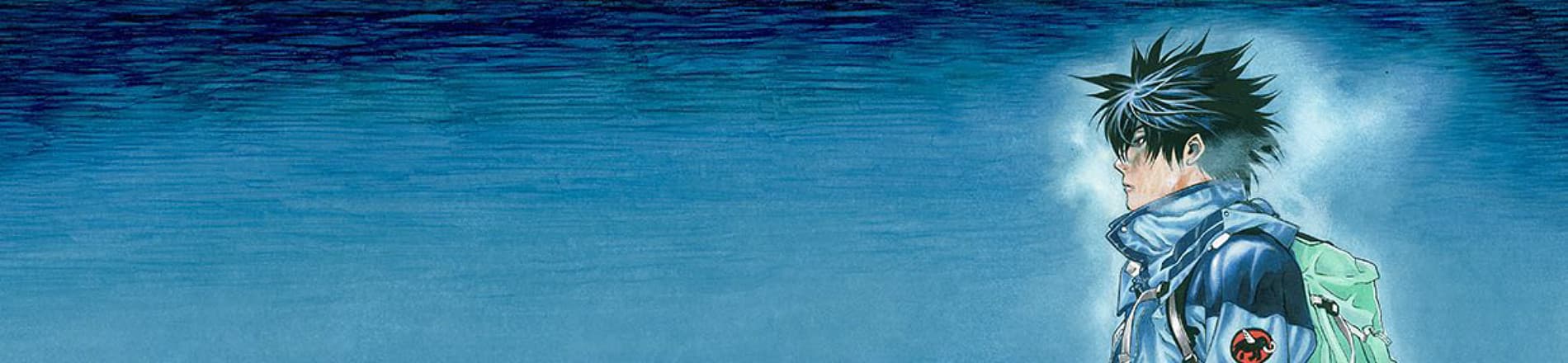
The Climber
a review by atomx
a review by atomx
What if I told you that “The Climber” is not about climbing… well at least not in a broader sense. Of course Kokou No Hito follows a climber and his journey against loneliness but below his journey is an even bigger picture that lies hidden in the snow.
“One cold winter's day, a number of porcupines huddled together quite closely in order through their mutual warmth to prevent themselves from being frozen. But they soon felt the effect of their quills on one another, which made them again move apart. Now when the need for warmth once more brought them together, the drawback of the quills was repeated so that they were tossed between two evils, until they had discovered the proper distance from which they could best tolerate one another. Thus the need for society which springs from the emptiness and monotony of men's lives, drives them together; but their many unpleasant and repulsive qualities and insufferable drawbacks once more drive them apart. The mean distance which they finally discover, and which enables them to endure being together, is politeness and good manners. Whoever does not keep to this, is told in England to ‘keep his distance’. By virtue thereof, it is true that the need for mutual warmth will be only imperfectly satisfied, but on the other hand, the prick of the quills will not be felt. Yet whoever has a great deal of internal warmth of his own will prefer to keep away from society in order to avoid giving or receiving trouble or annoyance.” (Arthur Schopenhauer)
Loneliness is not the same as solitude. Whereas solitude is a state often chosen by a person themselves, loneliness is forced upon one by others, or more by the absence of others. The difference becomes clear in the common usage of both terms. Solitude is often seen as valuable, a great virtue and a necessary ability to navigate through life. Conversely loneliness, the feeling of social isolation, is something to be avoided and often seen as a problem that society has to fix.
Another important distinction is “lonely” and “alone”. Lonely simply describing the emotion of loneliness and alone describing both the physical and mental state of not being surrounded by others.
Mori is not alone, he is lonely and this loneliness arises from his way of dealing with his trauma. Mori is introduced as a character that does not try to socialize. He rejects initial attempts from Miyamoto, who tries to befriend him, and tells him that he does not need friends (“It’s cause I don’t need things like friends” - Chapter 2). Although Miyamoto is depicted as a bully, and later turns out to be worse, his attempts at befriending Mori are genuine and not just playful bullying tactics.
The first to recognize Mori’s trauma and his problematic attempts at coping with it is Oonishi. Early on he realizes that Mori has shut himself off from others but has also found a new passion. Even more impressive is that he not only supports Mori’s passion for climbing but he also sees that it is leading him to become even more isolated and tries to counteract it. After the climbing tournament, where Mori meets a mysterious climber who tells him that he is a solo climber, Oonishi goes on a hiking trip with Mori, Miyamoto and Yumi. The trip turns out to be a good experience. Even though Yumi ends up almost dying, Mori has a chance to prove himself and rescues her. The problem arises afterwards when a local newspaper reports on the story and Oonishi has to take the blame. Mori returns to his dismissive state and blames himself for everything that happened (“When I’m involved things always go wrong. It’s been like that since a long time ago…” - Chapter 19).
It’s a pivotal moment for Mori’s degrading mental-state. Afterwards he gets baited into climbing another mountain by the same reporters that caused the drama in the first place. They lure him by explicitly telling him that the mountain is an escape from society, that Mori now has become to despise even more (“All of the dirty and unpleasant things of the world below get washed away in the pure whiteness” - Chapter 19) . During the climb Mori is shown to still long for society but ultimately he decides to turn away from the view of shining lights and continue climbing up the mountain (Chapter 25). The journalist also notes how it may already be too late for Mori to change back into a “normal” person (“You may not understand it, but not all humans would think the night view behind us is beautiful. People who choke being in the world below, and want to run away from annoying connections with humans. There are many humans who think that way… Oonishi, we may not be able to catch up to that boy anymore” - Chapter 27). Not being able to catch up is both meant in a literal and figurative sense.
What marks the end of the first few arcs is Oonishi’s death and simultaneously the end of Mori and Miyamoto’s school life. Oonishi, having been the only person watching over Mori and caring for him, leaves Mori only with the desire to climb. Mori visits Mizuki, the boy who tried to commit suicide, and apologizes to him while telling him that he has found something he wants to do. It’s an admission of excessive guilt - Mori still blames himself for something that he was not at fault for.
Few years later Mori has taken on a job to earn money and has made his goal clear - to climb the number one mountain. What remains is his social isolation. He doesn’t talk to his coworkers and when a female coworker tries to ask him out on a date he rejects her. The rejection is pictured by Sakamoto as a sudden glimpse of the mountain, which has become a symbol of Mori’s rejection of all connections to other humans, and although he says that he is contempt (“I like how things are now” - Chapter 33) his issues are still unresolved and he is only running away from everything. He also feels indebted to Oonishi, especially because he is still alone (Chapter 36) but is unable to find a way to escape it.
As already mentioned, the mountain becomes a way for Sakamoto to express Mori’s overwhelming feelings. When he first meets Yumi again and she tries to seduce him in his room he is pictured in a giant blizzard that won’t let him go. His view on reality is warped and Yumi blaming him for how she has turned out certainly doesn’t help him. On his next climb she even becomes a parasite that sits on Mori’s back and slows him down.
Sakamoto’s metaphors and symbolism continue to grow as the story goes on. On the first meeting with the 14th-Mountains team Mori is suddenly transported in the middle of Shibuya-crossing (Chapter 47) or his sleeping-bag transforms into a shell of a snail (Chapter 48). Although he has found people with similar aspirations and goals he is still lonely and only able to find a glimpse of happiness when escaping the group (Riding the horse through the sky - Chapter 49).
The Northern Alps All-Mountains Ridge Traversal Arc (Chapter 52-87) shows a significant turning point for Mori. Stuck in a snowstorm with Nimi he, for the first time, tells his own opinion instead of staying silent and following orders (“I don’t want to go back there” - Chapter 61). Before he had always compromised and acted upon the orders of others. Not because he felt that they had a better view on a problem but simply because his social anxiety did not allow him to speak. Chapter 59 even depicts Mori scribbling on hundreds of papers just to find the right sentence to say. Even if his decision might have been selfish it is an improvement of his anxiety and Sakamoto beautifully depicts this as an orchestra performance.
After Kase’s accident and subsequent death comes one of the most painful moments in the first half of the story. Unable to decide what to do and how to communicate it Mori is left alone as the rest marches onward. He has been wronged his whole life and the team wasn’t exactly friendly to him either but still he has attached himself to them and fears being left alone (“Please, don’t leave me alone…” - Chapter 72).
What ends up happening on the rest of the traverse turns out to be much worse than Kase’s accident. In the end everyone except Mori dies and he is once again left alone without any friends. Nimi's death is especially tragic as he resembles Mori and his fear of being left out. As a kid he was bullied and wasn’t allowed to play football with the other kids. He regrets never having stood up and, in his final moments, realizes that mountain climbing was just an excuse for him to feel some sort of self worth. Mori emphasizes with him and even risks his own life to stay in the tent and support Nimi.
Four years later Mori has found a job working at a weather station on Mount Fuji. Even though he has no qualifications other than climbing and is seen as worthless by the government, Adachi, a university professor, recognizes Mori’s ability and helps him find a job. His longing for the mountains has not stopped but he also gains a greater understanding of what it’s like to live as a “normal” citizen.
What throws him off-rails is the reunion with Miyamoto and Yumi. Both of them have turned out for the worse and you can only help but feel bad for them. Yumi is still working as a prostitute and Miyamoto has not accomplished any of his goals, as he is plagued by visions of teachers or bosses that tell him how he has to act. It’s quite a sad moment for Mori. His image of Miyamoto was that of a friendly rival and he was excited to see him only for him to turn out to be a parasite (depicted as an insect by Sakamoto).
Mori’s first real encounter with Hana is on a mountain where he rescues her. Their similarities are instantly introduced as Hana, like Mori, has difficulties fitting in and talking to other people. What is also important is the conflict between her and the mountain that is established in Chapter 110. When Mori strips her to put on warmer clothing and touches her breasts it’s as if the mountain is suddenly watching and judging him. Furthermore when he carries her, he is depicted as Jesus carrying a cross. The mountain rejects Hana and her body becomes as heavy as the sins of humanity. Her being the central figure to his return to humanity has also been hinted at before. “Hana” meaning flower in japanese is symbolised early on where Mori avoids stepping on a flower or when a little kid gives Mori a flower after he helps her put on her shoe.
This idea that Hana is slowing Mori down and hindering him from reaching his goal of climbing K2 becomes even more obvious when he is climbing Nanga Parbat. In Chapter 113, although he is climbing alone, Hana is still attached to him by rope (“Because no matter how far we are apart, we’re tied together by a strong climbing rope”). Mori struggles extremely between mountain climbing and his social connections. As he prepares Hana questions his extreme training methods and his emails to Adachi get shorter and drier. The whole of Chapter 115 is a showcase of how his life could have been: college life, his first relationship, parties with friends etc. He cries alone, split between two lives, unable to find a certain decision.
Probably the biggest question about the manga is why Mori leaves his family and decides to climb K2. After marrying Hana and having a child it seems like he has finally reached a fulfilling life. “He just loves climbing there is no deeper message”, “He ultimately chose his passion over his family” these are just two examples of what I would consider misinterpretations of the last arc and ending of Kokou No Hito.
What makes Mori leave is his unresolved conflict. KnH is a manga about overcoming our trauma/past and growing into a better person and this is represented in every character. Miyamoto, Yumi, Nimi, Hana, Oonishi, Kase, Murata, Komatsu, Takemura - all of them are plagued by troubled pasts and are unable to overcome them (except Hana). Some of them simply turn out to become bad people (namely Miyamoto and Yumi) while others die on the mountain. Problems are not easy to overcome and we cannot simply change within a day. The mountain is a representation of this. Just like a problem, it takes a long time to climb the mountain and you have to reach its peak. Takemura even tells Mori this - What is the point of mountain climbing if you do not reach the top. Translated to the message it means that there is no point in changing if you stop midway through, when there are still unresolved things you are ignoring. This is exactly why Mori climbs K2. His past is still unresolved and Sakamoto constantly hints at this. He constantly has flashbacks to climbing and imagines himself in snowy terrain while daydreaming, he is shown split into two versions of himself: One that symbolizes his current life (Katou) and one that symbolizes his unsettled trauma (The Immortal Climber Mori).
However it’s quite hypocritical that Takemura is the one to tell Mori this. On the K2 climb it becomes apparent that he is the one who has not let go of his problems. He is still mad at Yumi for using him and only wants to prove himself by climbing mountains, similar to Miyamoto. The usage of drugs like viagra or anti-sickness is also a symbol of shortcutting one's problems. Instead of actually overcoming them (climbing the mountain) we look for cheap solutions (drugs).
So how does Mori manage to climb K2 and why does he die or does he even die? The person that dies on the mountain is The Immortal Climber/Mori not Katou. The difference between both should be clear by now but I’ll explain the last few chapters since they can be complicated to understand.
After Takemura’s death Mori (I’m using Mori as a description for him as a person and not his identity) decides to keep climbing and try to reach the top. The climb becomes increasingly harder and he battles between descending and returning to his family or reaching the top. His internal conflict reaches a climax and he even splits into two people (Mitosis). As he is about to descend he passes out and returns to a childlike state where he semi-unconsciously climbs to the top of K2. This is the point where Katou Buntarou “dies”. In Chapter 168/169 Hana, who is waiting at home, sees a butterfly landing on their window and flying towards the moon - an allusion to Mori's final transformation. He has finally managed to overcome his challenges and “transformed” into Katou Buntarou.
“Whenever you hear anyone talking about a cultural or even about a human problem, you should never forget to inquire who the speaker really is. The more general the problem, the more he will smuggle his own, most personal psychology into the account he gives of it. This can, without a doubt, lead to intolerable distortions and false conclusions which may have very serious consequences. On the other hand, the very fact that a general problem has gripped and assimilated the whole of a person is a guarantee that the speaker has really experienced it, and perhaps gained something from his sufferings. He will then reflect the problem for us in his personal life and thereby show us a truth.But if he projects his own psychology into the problem, he falsifies it by his personal bias, and on the pretense of presenting it objectively so distorts it that no truth emerges but merely a deceptive fiction.” (C. G. Jung - The Spiritual Problem Of Modern Man)
Before going more in-depth into KnH’s message I want to talk about why I think that my interpretation is “correct” and where common misunderstandings may occur. One could certainly say that I am the one who is misinterpreting the manga and overanalyzing it but I atleast want to show some “evidence” for my interpretation. Furthermore I do not want to say that anyone should have to change his interpretation based upon mine. It’s only to clarify what might be not understood and what makes fiction great is that we all learn different things from it.
The largest misinterpretation I’ve seen with KnH is that going to the mountains and embracing loneliness/escaping society is a good thing. It might seem like that on the surface but it is the opposite. Mori in no way befriends loneliness; he actively works against it and tries to socialize no matter how hard it is (or atleast longs to). From the get-go Mori pushes people away not because he dislikes them but because he is scared of hurting them. Everytime he gets involved in something it goes wrong and he blames himself.
What might seem like a stretch is the idea that the whole mountain climbing is a giant metaphor for going through life. To make it easier to understand, just imagine that everything that happens is just a dream that Mori has while sleeping in class. After waking up he overcomes his anxiety and befriends someone. While this certainly would make for a terrible story it illustrates how mountain climbing serves as a representation for the struggle to live in society.
It becomes even more clear when you view the path of solo-climbing as going through life alone. Mori initially finds joy in climbing solo but eventually longs for human connections. Sakamoto also hints at this with the death of Hara, the climber who shortly appeared in the tournament. He decided to go solo and eventually died. Evidence for this is in Sakamoto’s use of “human” to signify what path is the right one to take. The path of solo-climbing robs one of their humanity. Takemura even tells Mori that he is no longer human and Chapter 168, where Mori ignores the ghosts of his friends, is titled “Inhuman”. Another hint that Sakamoto gives us are the names of the chapter all being titled Climb XYZ and the fact that the translation of “solo-climbing” actually is “going-alone”.
In the beginning of this essay I quoted Schopenhauer’s hedgehog/porcupine dilemma as it is a great way to demonstrate KnH’s message. Social interactions build the basis of our society. They are what keep us going and without them we would go insane. At the same time interacting with others can be incredibly hard. We can end up hurting others with our words and actions and they can do the same to us. Especially people who have been bullied or wronged in the past might want to abandon all of society and retreat into the mountains but this is not the answer. We are social beings, we need social interaction to keep going. Nobody can solo-climb through life. The answer is not loneliness but solitude - Mori still goes into the mountains alone but his family is always with him in his heart.
“Even if the result is not what you expected, if you walk your path believing in each step at a time, that is a path that will lead you somewhere” (Shinichi Sakamoto)
I can’t tell you what path to choose, that’s something only one can decide for themselves. What’s certain is that we have to keep going. No matter if the next mountain is higher than the previous one all we can do is use our strength and keep moving.
19.5 out of 22 users liked this review
