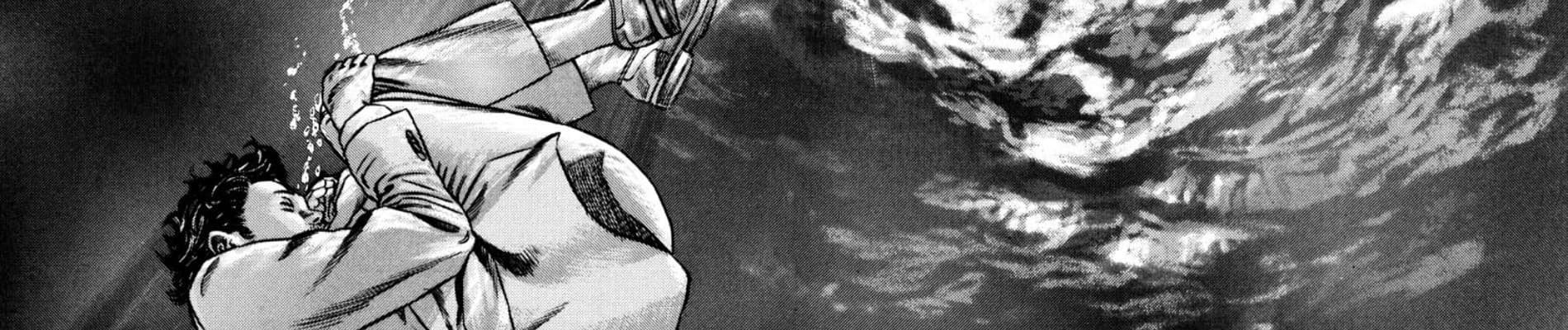
Homunculus
a review by melamuna
a review by melamuna
How do you define “being human” in the modern century?
From what we're told from the people around us, being “human” is being free from your thoughts, free from the judgment of others, and most importantly—being free from the chains that hold us back physically and having the capacity to do whatever we want. But that single line of thought brings us from two different perspectives of life. One that keeps climbing up the stars, capturing the highs of capitalistic life with a green sweat-smelling paper that shows people's hidden desires—but walking through that road requires you to be a robotic individual. Prejudice. Narrow-minded. Self-Centered. But then, once you defy that life, you'll be greeted with the miserable lane. Scraping every bit of organ in you to get by. A dreamer that never reaches the top.
With these in mind, I guess it's difficult to define what it means to be human based on labeled status. Maybe we have to look inward to see the reason to be "human," whether it be a passion or a hidden desire that we want to pursue. With this optimistic mindset, it blinds the dream that'll never be reached—thus being led in a question-filled limbo of human and nonhuman with the judgement-filled comments around humans. A person who once had everything will always fall down and crumble on the very floor they swear they'll never be on. If that's the case, then being “human” is someone who breaks off that cycle—getting out of that drowning feeling.
From what was said might be true, then the solution to being “human” for everyone is to free the desire from the tight-locked flesh. I guess so. But it's not that easy.
***

Imagine a character like Susumu Nakoshi: egocentric yet penniless, a misogynist who objectifies women, and a homeless man who stubbornly denies his own circumstances. He engages in self-destructive behaviors, including a grotesque fixation on his semen. Most disturbingly, he possesses a warped sense of self-righteousness, driven by an obsessive need to "save" others—but only through his own distorted methods. Now, imagine this man gaining the power to see the "true" forms of individuals—those who are trapped within their own flesh, silently wrestling to uncover their authentic selves.
How will this person save these people when he himself is twisted in the head? How will it even be determined if one is in need of saving? And most importantly, how will he interpret and decide the method of saving a person without any biases from his own perspective? Sure, it might have unlocked a new pathway for these individuals that he "saved," but was it really the right way to do it? If you read the manga's first few arcs, you will think that it's fine, but that awful bias comes back and ruins a person more than what you think—unless it's part of a delusional smile unreliably projected by the said “self-righteous” character.
So… that's it then? In order for people to be "human," they have to be saved by a non-bias righteous person. It sounds like a cop-out—because it is. If not everyone needs or wants saving—as most people are already content with their lives. Are they more human than the flawed? Is simply living is the answer? Is the person who is in between the labels the utmost human?
What defines a human?
After all, being free doesn't lead anywhere, as it can be the freedom that becomes a weapon. Every angle of asking the question becomes a double-edged sword. A limbo of a question that never shows itself out to the light—but never leaves you behind. It might be, or unless that idea is another perspective concurred by your own biases.
Or put it in another perspective, maybe it's a struggle to define what is human based on our protagonist’s worldview, because the main character might not be.
***

Homunculus is a manga series where it seems like a straightforward drama-horror series. But once you keep on reading, it doesn't hold back on giving you gut-tightening punches of the idea of being human, being part of a capitalistic society, and the lengths a person would go given by the imagined power in their hands. it constantly—yet subtly asks about your moral implications on each sequence in a horrifyingly realistic way.
This manga may take a while to resonate with people with its themes—especially with certain sequences that do not fly by in today's society—but it's still an important read that really questions your perspective on what being “human” really is. ***
9 out of 10 users liked this review
