After greatly appreciating the original television finale, I was profoundly disappointed by this film. Unfortunately, this experience has also negatively impacted my overall assessment of the series as a whole.
End of Evangelion, while featuring many shots of stunning artistic composition, represents a significant downgrade in numerous respects compared to the original television ending.
My primary criticism concerns character resolutions. The television ending left many character arcs unresolved, which was one of its main flaws. In EoE, these arcs are addressed, but in ways that I find deeply unsatisfactory.
Asuka’s trauma, which is originally rooted in her relationship with her mother, yet fundamentally driven by her inferiority complex toward Shinji; is effectively erased in a manner that barely makes any sense,
Rei remains, in my view, one of the most tragically wasted characters in anime; her initial setup was exceptionally strong, yet almost nothing compelling is ultimately done with her potential.
Shinji, whom I genuinely liked throughout the original series, becomes nearly unbearable here, not because of the hospital scene, which did not personally disturb me, but because the film discards his established character development in favor of complete psychological regression. This regression also feels considerably less psychologically credible than what preceded it.
Misato’s conclusion is unsatisfying, Ritsuko’s is passable at best, while Gendo is, in my opinion, the only character granted genuinely meaningful closure.
I also strongly disliked the heavy metaphysical dimension of the film, which unnecessarily complicates the narrative seemingly for its own sake. The sequence in which Shinji accomplishes virtually nothing of value after boarding the Eva, followed by his “awakening” after Asuka’s death, felt profoundly disappointing—especially given how visually powerful the awakening shot itself is. Profound or meaningful storytelling does not require biblical levels of cryptic obscurity.
The abstract sequences, reminiscent of episodes 25 and 26, constitute a substantial downgrade both in terms of meaning and execution. While a few philosophical lines stand out positively (notably “reality is at the end of the dream”), the overall psychological depth feels markedly inferior to that of the original finale.
The nudity, while contextually justifiable in the Lilith fusion scene, becomes excessive elsewhere. Rei’s persistent nudity throughout much of the film reads as gratuitous fanservice. I also find the sudden inclusion of visible nipples inconsistent, given their absence throughout the rest of the series.
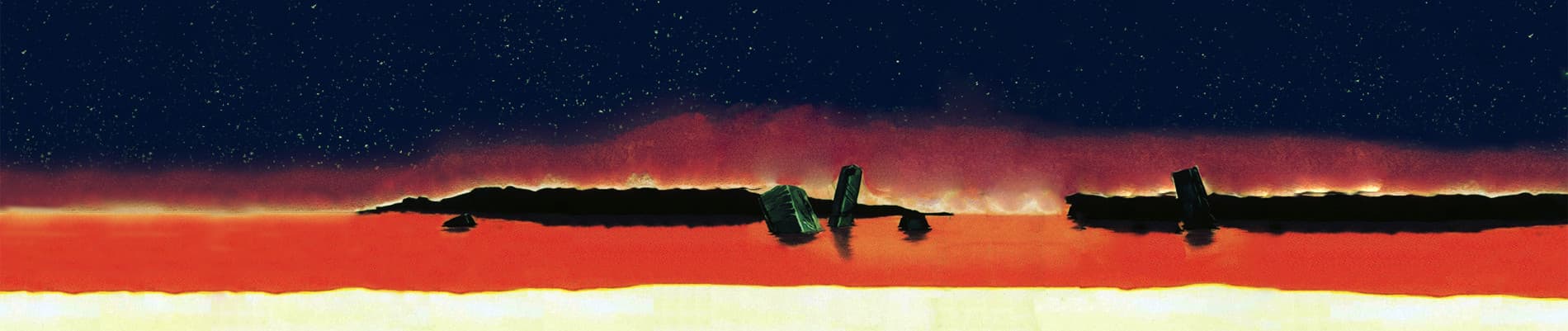
Finally, the ending—while compositionally striking—feels like an enormous slap in the face. People like coming up with a 1000 head-canons for this, but since they are indeed head-canons that also means that more pessimistic interpretations are just as correct.. When I first watched it, the scene registered as Shinji behaving reprehensibly and Asuka behaving only marginally less so. Subsequent readings and interpretations have led me to reevaluate it somewhat more favorably, but Asuka’s final line, “How disgusting,” remains impossible for me to view positively. It exemplifies what I consider the film’s most serious flaw—one of the greatest pitfalls of works that strive for sadness and depth:
It embraces an overwhelming nihilism that appears to exist purely for its own sake, completely undermining the central theme of a series fundamentally concerned with self-acceptance and self-love.
2 out of 3 users liked this review
