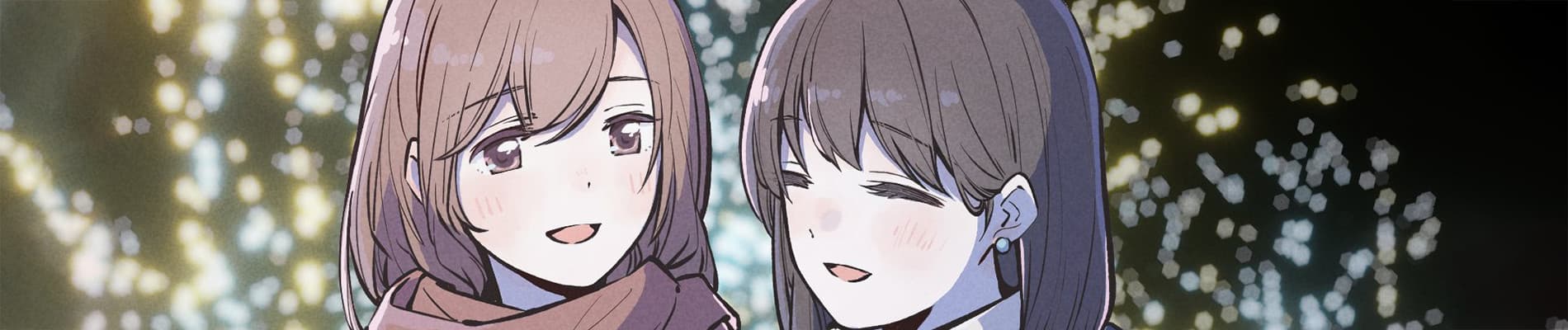
Ano Koro no Aoi Hoshi, or The Blue Star On That Day, by Kani is a coming-of-age yuri manga that follows Koumoto Umi, a rather ordinary high school girl in a seaside town, who finds herself drawn to the beautiful yet enigmatic Segawa Shou—an aloof schoolmate with a deep, almost spiritual fascination with the sea.
Story
The story starts rather simple and typical for a romance: the affable Koumoto Umi notices Segawa Shou, a quiet and solitary girl known for her academic brilliance and who stands out for her striking beauty.
What sets this manga apart is its distinctive storytelling—one that conveys raw, unfiltered emotion through both its expressive paneling and carefully crafted dialogue. The pacing is deliberately unhurried, the plot layered and moving. I found myself weeping on more than one occasion during my reading.
Their first encounter, albeit brief, occurs after school, when Umi goes to retrieve her confiscated phone and unexpectedly finds Shou waiting, assigned to return it. At the time, Umi had already been aware of her beauty and quietly admired her from a distance, in a manner that was purely platonic.
That is, until an unforeseen incident shifts the course of their (non-)relationship : after a conflict with one of her roommates, Shou is permanently relocated to share a room with Umi and her roommates.
Her moving indeed proves eventful : on her very first night in the shared room, Shou quietly slips out, unknowingly waking Umi, who, concerned, decides to follow her. Together, they walk along the shoreline, where Shou confesses a secret : she is searching for a mermaid she believes she once swam with during her childhood.
From that moment on, Umi’s feelings begin to unravel, messy and confusing. She can’t seem to keep the peculiar Shou off her mind, and before long, she finds herself asking if they might take another walk alongside the shore together, just like the night before.
The more Umi observes and comes to understand her, the more helplessly she finds herself falling in love.
Shou’s fascination with marine life is a constant but not overwhelming element in the story and plays a significant role in its development. She finds solace in caring for planktons, small fishes, and other sea creatures that she raises in the school's tanks, even as the only active member of the school’s aquarium club. In my opinion, the recurring image of the mermaid and the sea suggests Shou's longing for something distant, maybe unreachable. It kind of mirrors how Umi initially sees Shou, inaccessible and full of enigmas, and how Shou views her own memories.
The plot unravels gradually and realistically. There are no moments prone to hyperbole or unnecessary drama or misunderstandings, as is common in stories that take place in a high school setting.
Certain moments that may initially feel disappointing (like
The characters’ actions and dialogue always align with their established personalities, which allows the plot to unfold organically from their traits and choices. This coherence reinforces the story’s realism because nothing feels forced or out of character. It's not that "Hey I’m in love with you, let me just abandon everything I’ve ever known and loved and shout my love for you to the world!" kind of story. Yes, they grow, but their own qualities, insecurities and backstories are also acknowledged. Growth happens through compromise, learning, and respecting each other’s boundaries.
Some points were, I feel, purposefully left blank, such as the reason behind Ibu's resentment for Shou, or the cause of her being kicked out of her former room in the first place. As I previously stated, the plot is layered and unfolds progressively and we never really know what is to come. But I do think that is what keeps the story thrilling and live.
It is easy, almost expected for a romance to fall flat when it takes place in a small school in a remote town, where the number of exterior factors is inevitably more restrained than in the city. However, I find that the author's clever use of this stillness is what makes this setting so charming ; it allows the characters to evolve comfortably through acts of routine. Yes, it is frustrating for our protagonists who can hardly find a moment for themselves, but it shows how far they are willing to go to spend some alone time with each other despite the restrictions. Rather than relying on dramatic gestures, the author emphasizes the quiet intensity of simply being near someone, of learning their rhythms, noticing their silences, and choosing to stay close despite the discomforts of growing affection.
Characters
Through Umi and Shou, the story traces the fluctuating shape of adolescence : the confusion of finding one’s place, of reaching for meaning in others while still trying to understand oneself.
Koumoto Umi
As the story’s protagonist, Umi obviously plays a significant role in its progression. Yet, the narrative does not conform to her will. She makes choices : some misguided, others awesome.
Umi has never truly had anything wholly to herself before. With parents preoccupied by her siblings, she experienced a quiet sense of neglect, one she never revealed, perhaps out of a different kind of selfishness : the fear of burdening others with her needs.
I initially expected her character to be shallow and unremarkable, but it seems that there is far more to her than she lets on. She is kind and affable, caring and thoughtful, and I’ve grown incredibly fond of her.
There’s also her internalized homophobia, which initially prevents her from acknowledging the nature of her feelings and makes her hesitant to express her love for Shou openly.
I’m excited to see her evolution, how some other characters will react upon hearing the truth,
Segawa Shou
We’ve previously mentioned her quiet and aloof personality, but that is merely how other people perceive her. In reality, she is warm and passionate, sometimes awkward, sometimes even blushing. She is by far the most interesting and intricate character in the story.
I find that her body language often speaks louder than her words: her eyes drifting instinctively toward the ocean, the tenderness with which she interacts with Umi, the quiet vulnerability she reveals. She isn’t emotionally closed off; she’s simply someone who has never been cared for.
Her relationship with her father is contradictory because it is clear she resents him
Shou has always been bullied by her peers, for a multiple reasons : her strange fascination with the sea, her absent mother, her unusual personality. She pretends it doesn’t affect her. But it hurts. It’s left lasting scars on her self-esteem, no matter how unaffected she may appear on the surface.
As for her relationship with Umi, her love is unmistakably earnest. It’s true that, never having been cared for before, she might have confused friendship for something deeper. But as the story unfolds, it becomes crystal clear that what she feels for Umi is real love.
The narration deserves praise for this subtle evolution. You can feel how she slowly lets go of the mermaid, the mysterious saviour she has been chasing her entire life, and opens her heart to Umi, who stirs a far more chaotic but sincere, human longing.
Art
I am no expert when it comes to the technical terminology of art, so everything I say here is based purely on my personal enjoyment and subjective impressions.
What stood out to me the most is how deeply the author's love for sea creatures comes through in the artwork : their illustrations of marine life are by far the most detailed and captivating. The panels of the aquarium in particular were breathtaking. Also their knowledge of the marine life is just insane. I learned so much on that subject just reading the story.
The early chapters had a rougher, almost etched quality to them, which makes me think the author might not have initially anticipated such a positive reception or a full serialization. But the evolution of the art is clear because it improves remarkably with each chapter.
I’m truly amazed at how the author manages to convey such raw emotion through the characters' expressions. The abstract elements are especially striking. Every panel seems to carry meaning, though often subtle, and it's a genuine pleasure to read and interpret.
Another aspect I deeply appreciate is that the series is available entirely for free, which is rare considering the exceptional quality of the work.
Conclusion
I would recommend this manga to anyone.
To sum it up, this story really stands out. What starts off as a quiet, familiar school romance slowly grows into something much deeper and more meaningful. It takes its time, letting the characters develop naturally, and never rushes their emotions. The relationship between Umi and Shou feels honest and always genuine : that’s what makes it so powerful.
The writing is thoughtful, the pacing steady, and the emotions are never forced. Every small moment feels important, and the story makes you care deeply about these two girls figuring themselves out. The art, especially the way emotions and the ocean are drawn, adds a lot to that experience.
It’s not loud or dramatic, but it’s beautiful in its own way : full of longing, growth, and the kind of love that sneaks up on you. Even after finishing it, I keep thinking about certain scenes and what they meant. It’s the kind of story that stays with you, and I honestly can’t wait to see where it goes next.
Thank you for reading :D
10 out of 10 users liked this review