
Porco Rosso
a review by PollyannaQuixote
a review by PollyannaQuixote
Spoilers for Porco Rosso:
My knowledge of Porco Rosso prior to seeing the film was this image, often spread around online in political circles:
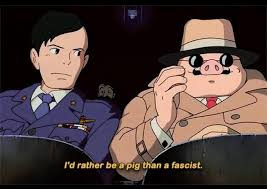 (This image became especially relevant when the White House twitter started posting ai-generated Studio Ghibli styled images)
This sort of gave me the impression that the film was some kind of explicitly anti-fascist narrative centered around implicit governmental policies and why they are abhorrent in a way that would be understandable for children. Given the current political climate, I was a bit curious and excited to see how this would play out, but while the film is certainly anti-fascist, it's more of a subtextual theme and backdrop to the rest of the narrative. That's certainly not a bad thing, and I still really liked the film, but sometimes one wants a good excuse to go on an unhinged rant, you know?
Regardless, that quote permeated my mind while watching Porco Rosso, so let's talk about that subtext. The film takes place in a quasi-fantastical Adriatic Sea, just before/during the rise of Mussolini. Our protagonist Porco is a ace pilot bounty-hunter who has inexplicably been cursed to have the face of a pig, and is being hunted down both by air pirates and the Italian state.
Porco's curse, which is never really explained in great detail, appears to be a metaphor for prejudice, the kind that allows fascist states to thrive. Proco is perhaps not literally a pig, but is perceived as swine by the public and the state, possibly for being a political dissident, operating outside of normal society, or being a part of some minority group we are unaware of. Porco is only seen as human by those who have been able to be close enough to see through to his humanity, such as when Gina, who remembers him before his transformation, or Fio who develops a bond to him that allows her to grasp a brief glimpse of his human face. Even the antagonist Curtiss seemingly sees Porco's face after recognizing him as a worthy rival at the end of the film. There's another line that sticks out to me, one where Porco is paying off a loan at the bank and he's asked by the teller if he wants to buy a bond for the people, only for him to respond that "I'm not a person." The literal interpretation here is that Porco is a pig and therefore has no allegiance to humankind, but the underlying implication is that Porco has no intent of supporting a government or country that refuses to see him as human or worthy of rights. In a similar way, that big quote is from a scene where Porco refuses to rejoin the air force, because in his eyes it's better to be seen as sub-human and retain morality than to accept security and societal acceptance in exchange for being complicit or an active participant in horrible actions. Notably, this conversation happens in a theatre displaying a meta-cartoon showing a pig-pilot as the villain.
Another aspect of this film I found very interesting was the 1930's aesthetic of it. You get these really bright colors native to all Ghibli films mixed with some fitting browns and greys representing the gloom of the depression and the industrialization of the 20th century. It's subtle but the way that characters dress in period accurate attire really helps set the mood and make it feel real, even when there's a pig in the room. I read that this film was based on a short manga/illustration book thing that was mainly made to convey Miyazaki's love for old planes, and that really carries over to the film. It's that kind of passion you see from a dedicated fan of a niche interest; shots admiring the movement and details of these flying machines, even if they're more cartoonish in the anime. I really liked that Porco's plane had to be repaired by a big group of women; it shows that during the depression, most women of lower income strata also had to find work, even more so during the war period when all the men went to fight. It's a part of history that I don't see very often in media, so it was cool to see here.
Despite the seriousness of dealing with fascism, the film itself is pretty lighthearted. I rather enjoyed the air-pirates, because despite being villains they really have this goofy and incompetent personality that makes them a lot of fun. Most of them look like Bluto from Popeye, and it's pretty funny to see them get completely stood up to by Fio or overrun by a group of schoolgirls. Porco is never framed as "bad", but as the film goes on you kind begin to understand him a bit more complexly which keeps him compelling throughout the run time. Fio was probably my favorite character; She has a very infectious positive attitude and has a lot of go-getting engineer spunk that makes for a great supporting cast member. I felt like Gina was just ok. Despite being Porco's love interest it didn't feel like she was really there enough or had enough tangible impact on the story to feel like she really needed to be there at all, though she was really offensive enough to have me think she should have been removed either.
Thematically I found the film quite interesting, but for the most part I actually enjoyed it as a simple and fun romp about our hero preparing for the big showdown. It wasn't what I expected, but I still rather enjoyed it. It's perhaps not the most earth-shattering of _Ghibli's _ films, but is still a _Ghibli _ film through and through, and definitely worth your time.
7.5 out of 8 users liked this review
