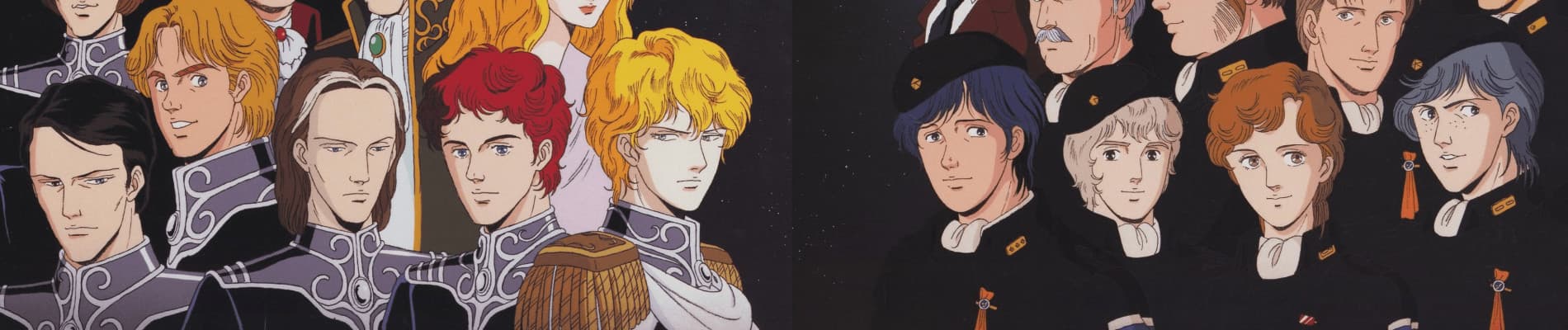
The greatest space opera anime ever made—and the genre’s best-kept secret.
“There are few wars between good and evil; most are between one good and another good.”
— Yang Wen-li
For a series so rich in history, Legend of the Galactic Heroes remains curiously overlooked by modern audiences. It lacks the visual flair of contemporary anime, the aggressive merchandising of mainstream franchises, and the sort of hook you can summarize in a single sentence. What it offers instead is something much rarer: a sweeping, character-driven epic that marries philosophical rigor with emotional weight—without ever insulting the viewer’s intelligence.
This is not a show that merely tells a story—it architects a world. Over the course of 110 episodes, it lays out a galaxy in turmoil: two major powers locked in a seemingly endless war, each slowly consumed by its own contradictions. The autocratic Galactic Empire and the crumbling democracy of the Free Planets Alliance serve not just as settings but as competing ideological systems. And rather than preaching, the series simply lets them collide.
The depth of LoGH’s worldbuilding cannot be overstated. Where most shows gesture vaguely at politics or history, this one delivers both with painstaking care. Episodes are routinely set aside for internal exposition—one dramatizing an attempted assassination of the Kaiser offers a surgical look at the decaying Imperial court, while another traces the very origins of the galaxy’s political systems through a fully realized in-universe documentary. These aren’t digressions; they’re structural necessities. The universe isn’t just textured—it’s alive, filled with historical momentum and institutional weight.
What makes this all work is the writing’s remarkable restraint. LoGH is deeply political, yet never preachy. Its characters act as people, not as ideological mouthpieces. Yang Wen-li, the series’ reluctant champion of democracy, is a military genius who openly doubts the system he defends. His belief in representative government is tinged with exhaustion and realism; he understands its flaws better than most and fights for it because the alternatives are worse. His opponent, Reinhard von Lohengramm, is not some villainous autocrat but a revolutionary within the Empire—ruthless, ambitious, and arguably idealistic. He wants to dismantle the aristocracy, centralize power, and reshape the galaxy, all while struggling to stay human under the crushing weight of success.
Their rivalry is the soul of the series. What elevates it isn’t just the ideological tension, but how naturally that tension grows from the characters themselves. When Reinhard contemplates the cost of victory, or Yang muses on the tragic pull of history, the writing never breaks form to insert a thesis. These are not lectures disguised as character monologues. They are moments of clarity earned through conflict, shaped by loss, and delivered with quiet precision.
Just as impressive is the supporting cast. For a series juggling well over a hundred named characters, it’s astonishing how many of them leave a mark. Figures like Kircheis, Oberstein, Julian, Frederica, and Bucock are not just narrative pieces—they’re ideological counterpoints, emotional mirrors, and, in some cases, harsh reminders of the cost of choosing principles over pragmatism. Even the most fleeting characters are rarely wasted. Consider Oberstein, whose loyalty to Reinhard is always transactional, yet unnervingly sincere. His decisions are cold, often horrifying, but always justified within the twisted logic of preserving stability.
Equally commendable is the series’ control over pacing. For all its length, LoGH rarely feels indulgent. Arcs such as Reinhard’s ascent to supreme ruler or Yang’s gradual transformation into a reluctant revolutionary unfold with a measured, deliberate rhythm. The conflict over Iserlohn Fortress, for example, is more than a strategic skirmish—it becomes a symbol of evolving power dynamics, used and reused across the narrative to different emotional and political effect. The show understands cause and consequence on a structural level. Victories matter. Defeats resonate. Every action casts a long shadow.
And yet, for all this calculated plotting, the series is never sterile. There’s deep emotion beneath the military formality and classical soundtrack. Losses are mourned. Triumphs are never clean. Characters age, falter, and in many cases, are swallowed by the very institutions they once sought to reform.
For a series that maintains such consistent narrative focus across more than a hundred episodes, Legend of the Galactic Heroes does remarkably well at dodging major missteps. But even the most legendary epics have their shadows—areas where ambition runs ahead of execution, or where narrative weight is undermined by weaker elements. In LoGH, these faults are few, but noticeable.
A recurring issue lies in how the series handles antagonists not named Yang or Reinhard. When the story is centered on those two ideological pillars, it rarely falters. But outside their gravitational pull, the antagonistic forces begin to lose definition. The show’s minor villains are often painted with broad, unimaginative strokes: decadent nobles with no vision, corrupt politicians with no depth, military figures who exist solely to be wrong and then defeated. While understandable from a structural perspective—the series needs opposing figures to highlight its central characters' strengths—the effect can feel flat, especially when it contrasts so sharply with the complexity afforded to the main cast.
Adrian Rubinsky, for example, begins with considerable narrative promise. As the cunning head of Phezzan, he presents a third political force—neither idealist nor reformer, but a self-serving manipulator playing both empires against each other. Early on, Rubinsky’s role as a wildcard is refreshing. He’s not driven by ideology, but by leverage. His moves shape major political events from behind the scenes, and for a time, he feels like a looming shadow over both Yang and Reinhard’s campaigns.
Yet by the series’ final arc, that promise quietly evaporates. Rubinsky’s downfall is handled abruptly and with little fanfare. For all the buildup, his narrative end feels perfunctory—less a climax than a box being ticked. His presence was once disruptive and calculating; in the end, it becomes a loose end needing to be tied. What could have been a lasting ideological foil instead becomes a background casualty of plot consolidation.
Then there’s Job Trunicht, a character who persists through sheer narrative stubbornness. He is, ostensibly, a critique of populist demagogues—charismatic, slippery, always surviving by shifting with the political winds. But where Rubinsky is underused, Trunicht is overexposed. His rise to power and cult of personality within the Alliance defy logic, particularly in a setting where most other figures are grounded in institutional nuance. His survival stretches the show’s believability—not because he’s a schemer, but because the show never convincingly articulates why people follow him. In a series that usually excels at making even the smallest decisions feel earned, Trunicht feels like satire dropped into the middle of a tragedy.
A similar fate befalls the Church of Terra, a faction introduced gradually and built up as a radical ideological undercurrent with dangerous reach. For a time, they seem poised to become a destabilizing force—not just politically, but philosophically. And then, almost as soon as they’re finally allowed to act, they’re swept aside with surprising ease. Their narrative purpose appears to be twofold: to offer a momentary distraction and to justify certain character decisions—but neither payoff feels worthy of the groundwork laid in earlier seasons. It's one of the few times the series gestures toward something profound, only to quietly walk it back.
All of this becomes more noticeable in the final arc, where the pressure to resolve dozens of ongoing threads begins to show. The pacing, which for much of the series is a strength, suddenly accelerates. Deaths, political shifts, and key farewells arrive with less ceremony than expected. Some moments land—the final fates of Julian, Reinhard, and the political structure of the galaxy are satisfying in concept—but the transitions are compressed. Scenes that would have benefitted from another beat or breath of silence are instead swept into the tide of conclusion. The result isn’t a collapse, but a soft unraveling. The series doesn’t fall apart—but it stops being as precise as it once was.
These weaknesses are not ruinous. If anything, they reveal just how consistently high LoGH sets its own bar. What disappoints isn’t what the show gets wrong—it’s what it almost does perfectly.
For a series that maintains such consistent narrative focus across more than a hundred episodes, Legend of the Galactic Heroes does remarkably well at dodging major missteps. But even the most legendary epics have their shadows—areas where ambition runs ahead of execution, or where narrative weight is undermined by weaker elements. In LoGH, these faults are few, but noticeable.
For a series so often described as "operatic," Legend of the Galactic Heroes rarely indulges in spectacle for its own sake. Its strength lies not in bombast but in balance—between action and stillness, between strategy and emotion, and between what is shown and what is simply understood. This restraint becomes especially clear in the show’s visual and auditory presentation, which, while uneven in places, serves the material far better than its budget might suggest.
Produced over nearly a decade and handled by multiple studios, LoGH’s animation is undeniably inconsistent. Character models shift slightly across arcs, and detail fluctuates depending on the episode’s focus. Conversations in command rooms may be punctuated by static shots or repeated pans. Some battles are conveyed almost entirely through maps, while others briefly bloom into vivid depictions of ships colliding in vacuum and formations falling apart under fire. These limitations are a product of time and circumstance—this was never a series designed to dazzle frame by frame—but their impact is felt nonetheless.
Yet, crucially, the series uses these limitations to its advantage. The scarcity of fully animated battles gives them more weight when they do appear. Much of the tension is front-loaded into preparation, positioning, and political consequence. Rarely does a confrontation occur simply for action’s sake. When fleets finally engage, it is the culmination of strategies, ideological shifts, and character choices made long before the first cannon fires.
This narrative discipline is further elevated by the series’ soundtrack, which makes perhaps the most brilliant use of classical music in anime history. Drawing from the likes of Mahler, Bruckner, Bach, and Wagner, the score does more than set tone—it establishes identity. Each faction is marked by distinct musical motifs. The Empire’s swelling, imperial overtures; the Alliance’s more melancholic, at times desperate orchestrations. Even the opening themes, which lean toward the grandiose and martial rather than catchy, act less as commercial hooks and more as ideological overtures. They are declarations of the show's tone, not invitations to sing along.
The music reinforces the show’s overarching truth: war is not thrilling—it is consequential. The violence, when it comes, is not stylishly choreographed or emotionally cathartic. It is tragic, strategic, often futile. Characters are introduced, developed, and then killed—sometimes in moments of heroism, more often in silence. It is a show in which legacy is measured not by survival but by the shape of the world left behind.
There is a moment late in the series, after countless battles and political shifts, where a commander looks across a fleet and simply observes how few of his contemporaries remain. No grand speech. No flashback montage. Just a passing comment, and the lingering silence it leaves behind. That’s where Legend of the Galactic Heroes lives—not in the shouting, but in the quiet after the storm.
Final Verdict
Legend of the Galactic Heroes is one of the most ambitious and intellectually satisfying anime ever produced. It does not beg for attention. It demands commitment. And for those willing to give it time, patience, and focus, it offers a reward few series can match: a sweeping, character-driven exploration of politics, war, and ideology that never forgets the cost of power or the fragility of peace.
Its flaws—an inconsistent visual style, a rushed final arc, and a few undercooked antagonists—are real, but they are dwarfed by its strengths. In a medium often dominated by formula and flash, LoGH stands apart: contemplative, exacting, and utterly sincere.
It is not merely a classic. It is a monument.
34.5 out of 36 users liked this review