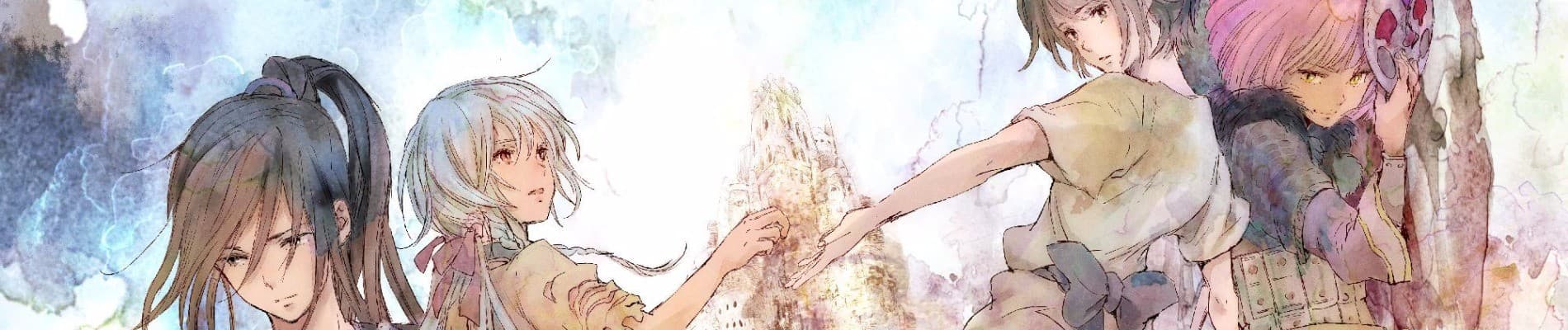

The Mud Whale, a floating island that sails the sea of sand that covers the world, is inhabited mainly by people known as the "Marked". These people are granted magical abilities (known as Thymia) by the markings that cover their bodies, but are also cursed with much shorter lifespans than their unmarked counterparts who run the island. Chakuro, the young village archivist whose powers are much weaker than many of his companions, joins the scouting group when they sail out to explore a new island and finds a young Marked girl within the crumbling remains. Their meeting changes his destiny and threatens his whole island's way of life.
Warning: Review contains some mild plot spoilers for Children of the Whales.

Children of the Whales is a visual delight. The soft yet varied colour palettes and fairy tale artwork does much to establish the beautiful, mystical world that the characters inhabit and is fitting for the peaceful and childlike civilisation of the Mud Whale. The animation is fluid, and few times the series does use 3DCG it is with specific intent to show the otherworldly abilities of the Nous that reside within each of its island ships. The unique visual style of Children of the Whales helps to make this series watchable despite its bland, disappointingly executed premise.
Soon after Chakuro brings Lykos, the girl who he finds on the ruined island, back to their village the Mud Whales' peaceful existence is threatened by the Empire's army. The majority of the series is based around fighting back against the evil empire and staying strong despite losing many of their treasured friends. Or, at least, it is until the last quarter of the series. From that point on the Mud Whale's inhabitants are picking up the pieces, except also there's internal strife, and we still see the villainous Empire talking about how they're going to go back and fight the Mud Whale again. Except they don't, because there isn't enough time for them to actually do that before the series ends. A lot of this could have been fixed by moving some of the events around, so that instead of what feels like the big ending climax happening in episode nine, it actually happens at the end of the series. Instead of ending with a bang, Children of the Whales ends with an unfocused whimper of "read the manga if you want to know what happens next, I guess."

The issues with the plot would be easier to forgive if it was backed up by strong characters. Unfortunately, Children of the Whales falls flat in this department as well. Chakuro isn't especially interesting; he is mainly around for most of the important events because the plot demands it due to his job as the village archivist because the story is vaguely framed as being told from his records. Ouni, who is part of a gang of troublemakers on the island and considered one of its most powerful Thymia users, also doesn't get much character development for the amount of screen time he gets. One of the worst offenders is Lykos, the girl from the ruined island, who is less of a character and more of a walking plot device who is there to get the story from point A to point B no matter how contradictory her actions may be. A lot of the problems with the plot could be fixed if she had any defining character traits, so it's a real disappointment that her character falls so flat. The most entertaining characters are mainly the villains, especially Liontari who livens up any scene he's in with his over the top, scenery-chewing personality. He also comes the closest of any of the characters to having an interesting back story.
For all of its faults, I still can't completely disregard Chlidren of the Whales. If you go into it not expecting much except for a lot of pretty visuals and an enjoyable soundtrack (the ending theme in particular is beautiful, and it's a shame Netflix kept trying to make me skip it) then you may still find something to enjoy in this flawed yet unique series. Just don't expect an enthralling story that will stay with you long after watching.