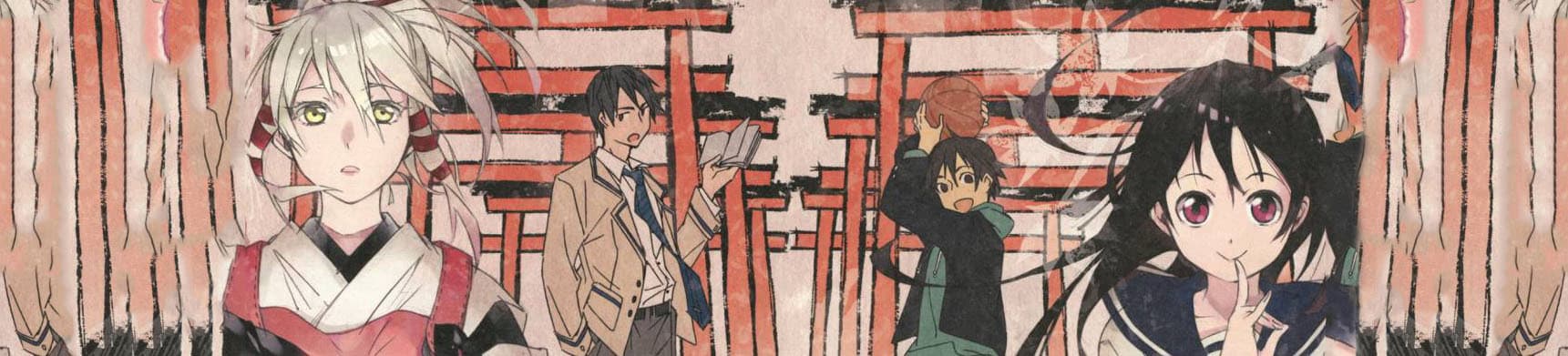
Inari Kon Kon
a review by Soemwriter
a review by Soemwriter
One answer is given by Inari, Konkon, Koi Iroha (or short InaKon), a 10 episode anime adapting the manga illustrated by Morohe Yoshida serialized in the magazine Young Ace from 2010 to 2015. The responsible studio Production IMS closed after not even five years of business and might be mostly known by animating the second season of Date A Live. Contrarily, the producers flying DOG (Tsuki ga Kirei, Honzuki no Gekokujou,...) and DAX Production (Sword Art Online, Fairy Tail,...) have been involved with several well-known projects and exhibit a remarkable amount of experience.
This is a series based on love, based on friendship, and based on realizing your own value.

Inari Fushimi is a school girl who is curshing on one of her classmates: Shirou Tanbabashi. There is just one problem, or better said two: First, Inari is quite clumsy and thus always messes up her encounters with him. Second, Tanbabashi seems to be always surrounded by the class' madonna Akemi Sumizome: beautiful, popular, and good at school.
As Tanbabashi puts on a serious attire and hands Sumizome a letter, Inari's heart breaks. Sumizome is everything Inari is not but wants to be. Our protagonist rushes to the local shrine after which she was named and cries her heart out. A goddess appears and grants her one wish, such that Inari bursts out: "I want to be Sumizome!"

The goddess seems to grant her wish, as Inari suddenly looks exactly like the beautiful classmate. Inari's vanishing yet causes a mess among her loved ones. But even more tragically, Inari is still her shy self inside, such that she cannot confess her feelings to Tanbabashi. She understands the need to return to her former appearance and begs the goddess to revert her doing. Due to complicated rules of the celestial society, the goddess cannot just turn her back to Inari's former self. Instead, she uses a loophole and gives Inari some of her god powers, such that Inari can transform herself.
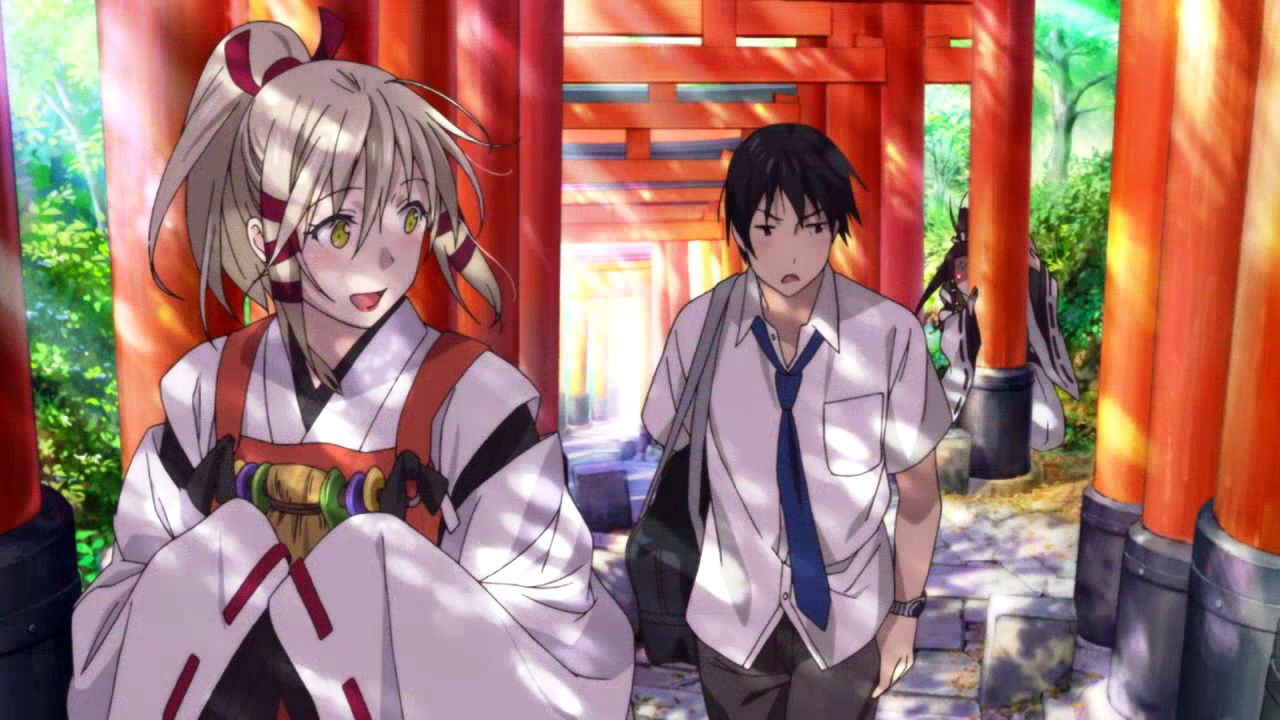
As one can imagine, this power comes with great implications. Inari gets connected to the goddess, involved in the complications of the celestial society, and suddenly has to incorporate Sumizome into her own group of friends. Circumstances require her to use her powers, always causing more trouble than actual solving. And what is going on between the goddess and Inari's older brother? When will Inari realize, that the goddess vanishes bit by bit as the girl uses her powers. And lastly, what is the ruler of the celestial society Amaterasu-sama scheming?
The first episode is already a mirror of what this story is about: if you try to be someone else it always turns out wrong and worse. Instead be yourself and solve your problems in your own way. This is quite obvious in the first episode, as Inari only causes problems turning into Sumizome.
It gets more subtle in the following, as also the goddess or Inari's friend Maru-chan carry their burdens with being themselves. A first climax is reached when Sumizome not only becomes Inari's friend, but also bursts into tears crying: "I want to be Inari." They are two sides of the same coin, longing for what they see in each other not valuing themselves for what they are.
Inari has a steep learning curve, as she understands quickly that no matter how tempting it is, no good comes from pretending to be someone you are not. Nevertheless, incident after incident require her to change into another person - be it for the health or safety of another person, or to make up for loosing a letter she is asked to deliver. But her using the powers - which by the way display a humourous but nice homage to magical girls - always comes at a cost. For example, transforming into her strong friend Keiko in order to scare some playboy hitting on Sumizume only complicates the relationship between the rescued and who seems to be the rescuer.
But there is one big benefit of the powers: they push Inari to the edge, developing her personality and pushing forward what is a great character arc. Inari has to confront her timid outer self, her selfish subconsciousness, and work on the relationships with her friends. She develops human powers that make her truly stand out.
Furthermore, this series does a great job at tying together the different side plots and leading to a big resolution in the end. It offers a nice mix of mysteries and revelations, always keeping the audience wondering how things might progress further.

The Opening Song "Kyou no Koiiro" by May'n has very warm and happy sound which perfectly matches the emotional tone of the series. It is not really romantic, but supports the tone of the friendships in this series. It illustrates the truly good nature of Inari, as well as her most often happy mood.
The Ending Song "SAVED." by Maaya Sakamoto is much calmer and has a mystic nature alluding to the goddess Uka, her mysterious powers, and the celestial society. Some bittersweet tones hint at Uka's inner conflict: sentenced to find a good marriage worthy of a goddess of her status, fascinated by humans and their way of loving, and threatened by vanishing into nothingness. The title "Saved." can both target Inari, who becomes Uka's friend and makes a point in fighting for her self-determination. But it can also be meant for Inari's brother.
It is difficult to claim InaKon to be special in any way. Everything beginning with the characters, including soundtrack and graphics, up to the plot is nice but not outstanding in the universe of anime. But the way every detail is authentic and lovely, all put together and displayed in a fantastic harmony, makes the whole series special in itself. It is perfect at being itself.
Thereby, this series perfectly mimics its protagonist Inari: she is a plain girl who does not stand out in any aspect (if we forget about her magical powers for a moment). She just tries to make it through her struggles, she values friendship, and eventually grows with her mistakes. And in being so plain, she is exceptional - for her family, for her friends, and for the viewers. Both she and the series have a heart of gold, which is why this anime feels as warm as a hot milk with honey on a cold winter's eve.
If you have not only landed on this anime entry, but also read this review up to here, I can recommend you this series with a clear conscience.
5.5 out of 7 users liked this review
