[This is an extensive treatise of musical theatre history and storytelling through music, in order to explain why this film is a poor musical. If that is of no interest to you, please do not read this. Seriously.]
“What the hell are musicals?”
“It appears to be a play where the dialogue stops and the plot is conveyed through song.” [1]
Musical theatre is an art form often defined by ‘people spontaneously bursting into song and dance.’ “Spontaneous” is an unfortunate misconception, as musical storytelling is much more deliberate than it can appear. There’s an old adage in musical theatre: “When you’re too emotional to speak, you sing. And when you're too emotional to sing, you dance.”
Songs are sung for a reason. They occur at the most heightened and passionate emotional moments of the story—vows of love, declarations of dreams [2], oaths of revenge, utter despair, making difficult decisions, self discovery and celebration of one’s self [3]. These feelings are relatable and powerful, functioning as the engines behind a medium that is inherently character driven. But a musical theatre song needs to do more than just express emotions.
In the 1940s, songwriter and lyricist duo Richard Rodgers and Oscar Hammerstein II [4] revolutionized musical storytelling. With very few exceptions [5], most musicals up until then had been frivolous and lighthearted. The narratives weren't a priority, and the song and dance numbers put the stories on pause, rather than advance them. Rodgers and Hammerstein decided to actually make the songs integral to their shows, and in 1943, Oklahoma! forever changed the way musicals were written. The late, great Howard Ashman (lyricist for Disney’s The Little Mermaid, Beauty & the Beast, and Little Shop of Horrors) explained this principle best:
“Music […] is information. It’s a way to get character and plot information across. […] you want it to develop story or character in some way so the song will carry its own weight so it can justify its existence.” [6a]
“If you can take a song and you can remove it from the script and the script still makes sense, you haven't done your job properly.” [6b]
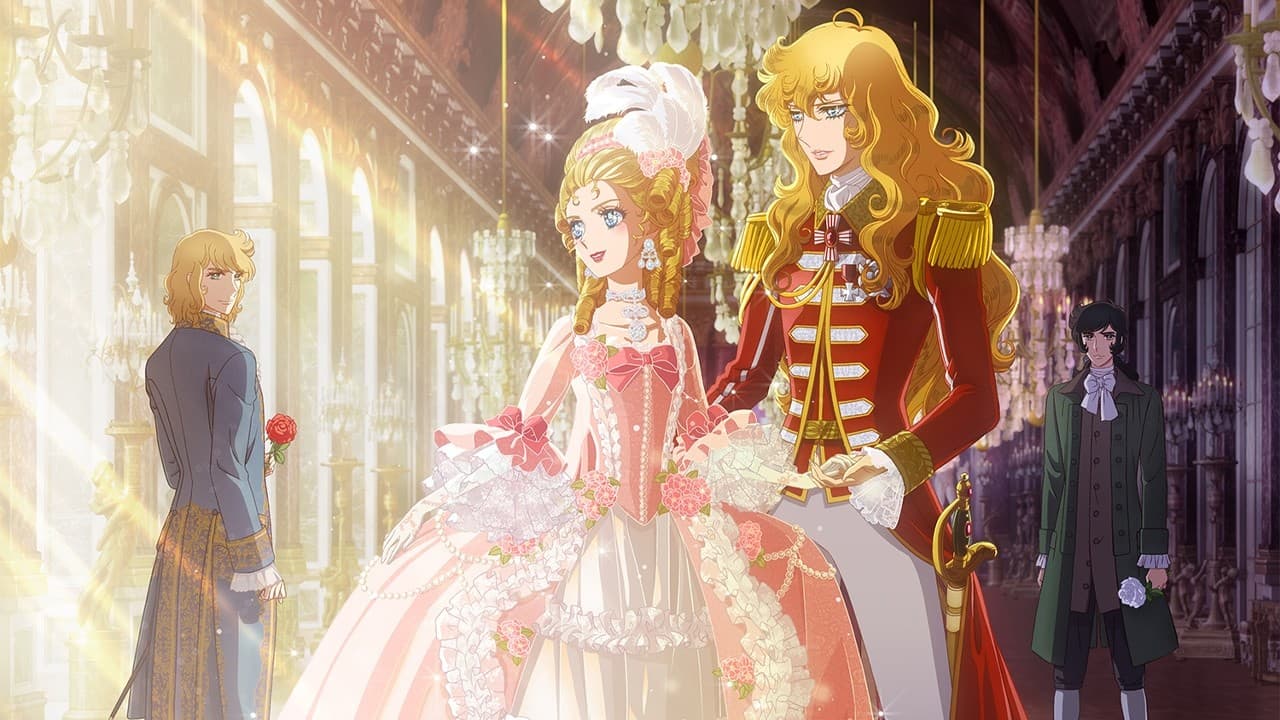
Rose of Versailles (2025) lacks this fundamental understanding. From the start, its opening song, 'May Our Souls Bloom in Love' functions more as a theme song, choosing to rely on an unseen and omniscient narrator to convey the setting and information throughout the whole film. Barring the song used in the ending credits, Rose of Versailles (2025) has fourteen songs. All but one fall under one of two categories:
The problem with the first category is that they completely put the story on pause. Those songs often start playing after the characters make their declarations, making them redundant. (‘Child of Mars’ is particularly guilty of this, as Oscar makes her decision before she starts singing. Songs are supposed to process emotions, not validate them.) Those in the second category do not interfere with the narrative or pacing, but are still reduced to nothing but anime insert songs. Unfortunately, there is another issue plaguing the songs: they’re not diegetic.
The definition of ‘diegetic’ is: happening within the created world of a story. Or in simpler terms: the music is actually being sung and heard by those in the film. (‘Poco Loco' is diegetic. ‘Dos Oruguitas’ is non-diegetic.) Instead of having the characters actually sing to each other, montage or no, Rose of Versailles (2025) opts for the Disney’s Tarzan approach [7] of having the singing offscreen—a fundamentally weaker musical decision. Songs in musicals are meant to be sung by the characters either to other characters or to the audience. Robbing them of that agency is a terrible thing to do.
The only exception, the only song in the whole film that is wholly diegetic is ‘Anger and pain,’ sung by Bernard and the Parisian commoners. It is the film’s ‘Do You Hear the People Sing?’ [8] moment, even using the motif from the opening song—perhaps the only true thoughtful and deliberate use of music. Other things the film didn’t seem to think about:
All of this to say that the cornerstones of musical storytelling just aren’t here. (‘Ma Vie En Rose’ and ‘Anger and pain’ are the songs closest to functioning properly.) Sawano Hiroyuki and Yamamoto Kohta have years of experience, both having composed for dozens of anime. But being a composer and understanding musical theatre are completely different skills [10]. Rather than a musical, it sounds more like a bland anisong concept album that was inspired by Rose of Versailles.
This film was not obligated to be the greatest iteration of Rose of Versailles. It was not obligated to be the greatest musical. But as a musical, it was obligated to tell its story through music. Rose of Versailles (2025) does not need the songs in order to tell its story. They're merely pretty distractions and actively detract from both the narrative and the characters, content to play it safe in shallow emotions. All but one of the songs can be skipped and nothing would be missed. For a musical, that is nothing short of complete and utter failure.
[1] The opening lyrics from ‘A Musical’ from Something Rotten! (2015)
[2] Commonly referred to as “I Want” songs. ('Part of Your World,' 'Almost There,' 'The Wizard & I')
[3] Commonly referred to as “I Am” songs. ('Gaston,' 'I Am Moana,' 'Meet the Plastics')
[4] Richard Rodgers & Oscar Hammerstein II were songwriting partners, initiating and championing the Golden Age of musical theatre, which lasted from the 1940s through the late 1950s. Aside from Oklahoma!, they are known for shows such as The Sound of Music, The King & I, South Pacific, Carousel, and Cinderella.
[5] Show Boat (1927) is the first musical to be credited with telling a story about serious topics with emotional weight.
[6a, 6b] Quotes taken from this interview. Howard Ashman and Alan Menken are the progenitors of the Disney Renaissance. Beginning with The Little Mermaid in 1989, the film single-handedly saved the Disney company from bankruptcy.
[7] Disney’s Tarzan has only two moments of diegetic music: Kala singing the beginning of ‘You’ll Be in My Heart,’ and ‘Trashin’ the Camp.’ The rest of the songs are sung by an omniscient Phil Collins who represents Tarzan. So at least Rose of Versailles (2025) actually has the voice actors singing for their characters.
[8] ‘Do You Hear the People Sing?’ is one of the most identifiable songs from Les Misérables.
[9] This seems to be a recurring trait among the takarazuka musical adaptations, as most of them focus on either Marie and Fersen, or Oscar and André.
[10] The other prime example of talented songwriters not understanding musical theatre storytelling is Disney’s Wish. (Wish at the very least still manages to function as a musical, as the songs are both diegetic, and are integral to the story.)
32 out of 35 users liked this review