Spoilers for Gyakkyou Burai Kaiji: Ultimate Survivor
A little over a week ago as of writing this I finished watching Gyakkyou Burai Kaiji: Ultimate Survivor with a friend of mine. Since then I've had time to ruminate on it and procrastinate on writing my thoughts about it, and throughout that time my mind always comes back to one inescapable conclusion:
This show has some truly magnificent schnozzes. Some truly stellar snouts. A plethora of undeniably notable nostrils.
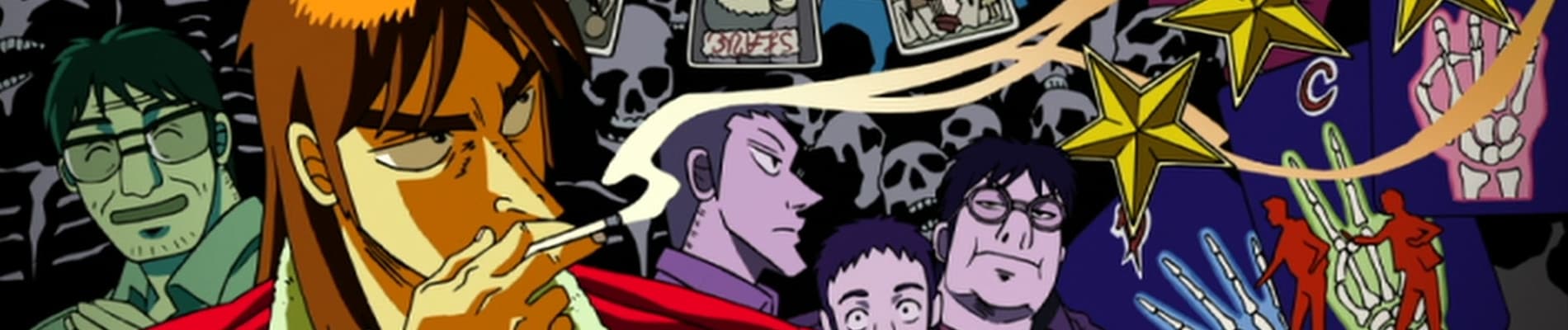
Not to be to on the nose about it, but Kaiji's art style is really unique and fascinating to look at. It's filled with these sharp and aggressive lines punctuated by thick outlines that contrast deeply with the round and bubbly anime I'm used to watching. It adds a certain level of ugliness to the show that is thematically appropriate and kind of refreshing given that, sometimes, it feels like all anime characters can be designed to be cute or good looking. It's honestly nice to see some ugly creeps from time to time. It's probably best exemplified by the aforementioned noses; noses are present in anime but are usually pretty subtle or kind of hidden, but in Kaiji they are very prominent and come in a large variety of shapes and sizes. I got pretty hype whenever I saw a new species of nasal cavity while watching.
For real though, when thinking about Kaiji, one is inevitably drawn to the show's examination of human behavior when placed under the weight of incredible circumstances, particularly those dictated by finances. Perhaps it is a display of my very apparent political biases to view the show this way, but admittedly the anime's central premise makes it difficult to not see it at least a mild critique of capitalism.
The show follows Kaiji Itou, a deadbeat waster who is coerced by his massive debts into participating in a series of dangerous-to-deadly gambling games hosted by a racket of shady loan sharks, seemingly for the entertainment of a wealthy audience. Despite being clever enough to weasel his way through each game (which are often horribly rigged against him) he ultimately still loses them all and is unable to pay back his debt.
The villains of the anime make multiple speeches about how succeeding in the games requires a cutthroat dedication to self-interest; a dog-eat-dog, survival above all else approach seen in the corporate world in order to achieve victory. Tonegawa even suggests that the reason he helps to host these games is to "reform" the ne'er-do-wells of society into someone who can function within the system; and if they die, they wouldn't have made it in the real world anyway. The tragedy of Kaiji's character is that despite being clever enough to beat the games and outsmart his opponents, he's too good of a person to succeed in them. He fails the first game because he trusts the goodwill of his fellow man; he fails the second because he has empathy and prioritizes the survival of his comrades over his own earnings, and he fails at the conclusion of the show because he is too proud to see injustice go unpunished, even if only in a petty way.
The show is split into two halves, and during the "intermission" of sorts where we go back to Kaiji's day to day life working a convenience store. It seems insane after his incredibly dangerous encounter on the Espoir to join another gambling game but 1) the rest of the show would be kind of dull if it was just Kaiji stocking shelves and 2) it's implied that it will take Kaiji over forty years to pay off his debt honestly. The reality is that the system Kaiji is operating under is exploiting him; not only does it not reward the hard-working and compassionate, it punishes them for their naivete. It is therefore not surprising that Kaiji tries again to get rich quick; the games are still a scam, but at least they are a scam with a seemingly better chance of success. Seemingly.
Still, even success within this system does no guarantee safety. When Tonegawa fails to defeat Kaiji (even though Tonegawa had rigged it against him), his boss Hyoudou forces him into a symbolic repentance punishment similar to the ones inflicted to the losers of the gambling games. Even the most loyal members of the regime can and will be sacked when they stop being useful.
The last thing I would note is that a Kaiji and the other gamblers, at least for the first two games, and being watched. This isn't given too much attention in the first game where the observers are hidden away in a private lounge of sorts, but in the second they are more prominent. The game itself is meant to resemble a a high-wire horse race, and in a similar fashion the onlookers cheer and jeer like people betting on their favorite horse, only the horses are people hopelessly in debt. These audience members are dressed well, and appear to be upper-class, taking great enjoyment from the suffering of those of the lower societal strata on the beams above. The contrast here is something I find interesting; Both of these groups, the participants in the game and the watchers, are gamblers. However, one group has been unlucky while the other seemingly has found success. These members of high-society bark at their "horses" like dogs all the same as the so called dregs would. What truly delineates these two groups of people other than their societal status? What really separates the high-stakes stockbroker from the lowly pachinko addict?
Kaiji as a show is very good at getting you in the mindset of a gambler, someone who is constantly trying to analyze things and play mind games, whether or not it makes sense to do so. When watching Kaiji (the character) you begin to appreciate how he's able to unweave the convoluted plots the show throws at him but also how recklessly addicted he is to the chase of taking big risks. This also kind of plays against the show however; part of the show's charm is taking a relatively simple idea like Rock Paper Scissors and turning it into a very complex game of strategy and phycological probability, but at a certain point it becomes SO complex it becomes kind of hard to follow. Not aiding with this is that sometimes the show waits to reveal a character's intentions until a big dramatic reveal which can make character actions within the story rather confusing. I can tell you how the story of Kaiji ends up, but I don't know if I could really tell you how we got there.
If I had a joke name for this anime it would probably be something like Ship in a Bottle. Kaiji heavily centers around the gambling games which take place in specific locations, and the show almost never cuts away from those locations, leading to every episode feeling something like a bottle episode. This is especially apparent during the first half of the show where the characters spend almost the entirety of it in a cruise ship lobby. Further, if you are the kind of person who does not like padding, you might find this show to be rather frustrating. The first half of the show I just mentioned is about twelve episodes, and about ten of them take place in an in-show four hour time frame. This anime has no qualms with taking its time. I swear there was one episode where all they did was convince a guy to play one hand of rock paper scissors. To the show's credit, it does do a good job of creating tension and creating cliffhangers so you're invested in knowing what happens next. This is often aided by the overly dramatic narrator, who sometimes feels out of place; I feel like his presence would be more welcome in a children's cartoon than a show like this, but I suppose I didn't mind him too much either.
I must admit, some of this analysis or review might be off. I watched Kaiji with a friend, and it was a lot of fun, but watching something with a pal compared to watching a lone is a very different experience. I was certainly spending a fair amount of time during the show trying to come up with riffs and gags to make my friend laugh, as well as trying to listen to her comments, and that probably led to me having a harder time following the plot. On the other hand though, I think I had more fun with it than I would have if I had watched it alone. She had already seen the show...but also seemed to know what was going to happen next about as much as I did. I wonder if she really forgot everything or if that was just for my benefit, hehe. It's always nice to share an experience like that with someone; to be able to talk to them about the show as its happening, what you think about it, and of course, test your bottom-tier improv. This was the first time I watched a whole anime (a show, not a film) with a friend, and regardless of my thoughts on a show, I'd rate the experience of watching anime with friends a 10/10, definitely recommend.
As for Kaiji itself, I think if you like thrillers or studying characters and thematic you might like the show, but if you aren't a fan of hanging out in a boat foyer for ten episodes you might not. As for me, Kaiji has some interesting ideas and characters, a cool art style, and enough there to keep me thinking and invested. I hope to check out the second season sometime so I can see what new noses they drew.
15 out of 15 users liked this review