UN-GO
a review by winnowgirl
a review by winnowgirl
UN-GO is one of the best shows I've ever had the pleasure of watching, where the only major criticism I can offer up is that there isn't more of it. If you like detective shows or mysteries in general, especially if you hate cops and the genre's frequent authoritarian bent, if you like speculative fiction or alternate histories, or if you like shows that respect their audience and push their premises to the absolute limit, this is an absolute must-watch show, and I'll still offer a hearty recommendation to everyone else: watch at least the first two episodes. If you get through the second and still aren't curious to see where it goes, I'll admit defeat here, but I am begging you to at least try this.
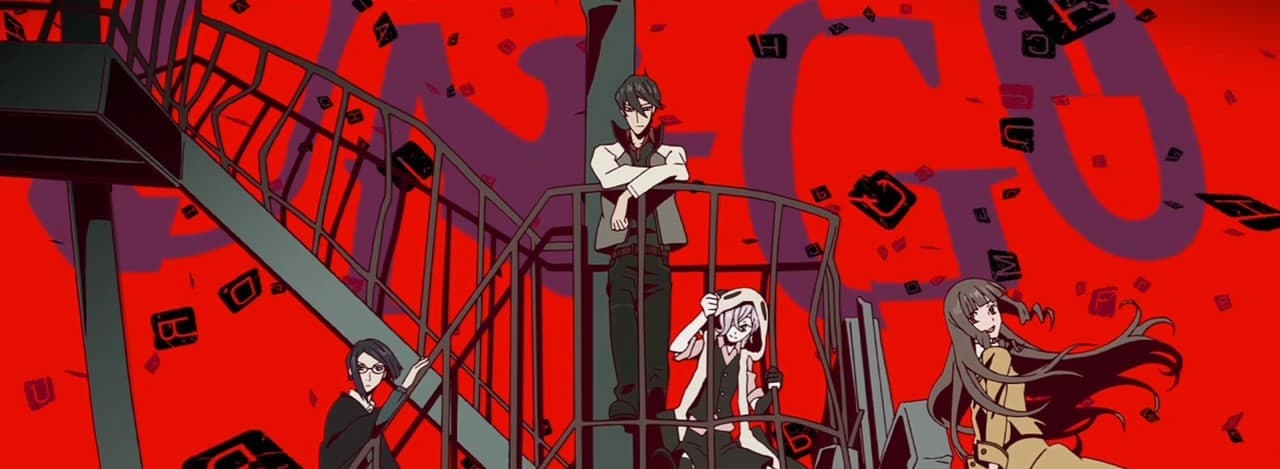
UN-GO is a sort of re-imagining of Sakaguchi Ango's Meiji-Era Detective Stories, which are pretty much exactly what the name implies -- look them up if you're curious about more detail. It's very liberal with it's re-imagining, though, and largely uses the original stories as a framework to operate in rather than any kind of direct adaptation. It's a mostly episodic detective show focusing on a relatively small cast of characters with rotating new faces introduced for each new case. That cast of characters is utterly flawless, though -- Shinjuurou, Inga, and Kazamori make up our primary faces, and I absolutely adore them. Inga is equal parts charming, silly, scary, and cool, Kazamori is adorable, funny, and always interesting, and Shinjuurou is an absolute classic detective in the best way. Kaishou Rinroku, Rie, Koyama and Hayami fill out the rest, and I similarly have nothing but praise -- they're all excellent characters used in excellent fashion.
I'm honestly baffled by how undiscussed and overlooked this show is, at least in the world of English-speaking anime fandom. It's got some pretty impressive credentials behind it -- it's animated by Bones, directed by the guy who directed the 2003 Fullmetal Alchemist anime (along with Shaman King 2001 and Gundam 00), it's loosely adapting stories by an incredibly well-known and critically respected 20th century Japanese author, and it's got Toyosaki Aki and Miki Shinichiro in leading roles. Somehow, no one talks about it, though. It's not even that it flopped and everyone hated it -- on the whole, most discussion and critique I've seen of it online has been largely positive! I don't care to examine exactly why that is, but I do want to make a case for why this is a show that by all rights should be receiving infinitely more acclaim.
SPOILERS FROM HERE ON.
The first episode of UN-GO is relatively basic, a soft introduction to this world, its characters, and the rules the show will operate on. It's also the case that, to my understanding, follows the original story it adapts most closely. It's classic stuff -- a ballroom murder mystery, and the wife did it. There's not a lot to say about this and most of episode two -- the murder isn't hard to guess, past a certain point, but it feels like the show is less concerned with getting any kind of genuine surprise out of you at the reveal, and more interested in getting you to engage not only with its characters, but with its worldview.
See, there's a few interesting things about this first episode. First, our protagonist isn't the POV character. Instead, we follow Kaishou Rie, the very first character we meet and daughter of (in)famous big-business chairman and amateur detective Kaishou Rinroku. Second, the murder motive is rather novel -- Kanou's wife didn't kill him because she was after money, because she secretly hated him, or because she wanted to evade suspicion or criminal prosecution herself. No, she killed him because he had to, in her words, "die as a hero". In line with that, we start to get our first peek at this world's alternate history -- Japan has just recently exited a devastating and unpopular war, wherein terrorist attacks and open conflict reached the Japanese mainland and the JSDF was re-converted back into a standing army instead of a self-defense force. Kanou's role and death is only scratching the surface on that. Third and finally, and also most interestingly, Shinjuurou successfully uncovers the truth, only for Rinroku's false explanation win over anyway and for the entire matter to be covered up. It's one thing for a detective show to have an episode where the hero fails like this, it's another entirely for it to be the first episode.
The second episode is similar. Not a hard mystery, but still an interesting one -- this is where we really start to see UN-GO's character writing shine. After all, the murderer herself is meant to be a sympathetic character! She kills her own mother to pursue her dream of being a singer, only to learn it was all for nothing anyway, and even for her uncle to die in the process. On top of it all, the truth of it is covered up, and not only does Shinjuurou again fail to make the truth of the matter known to anyone but himself and a few others, Eri doesn't even get the catharsis of being held accountable for her mother's murder. As far as the public is concerned, her uncle did it.
And then, UN-GO works its magic. Not only is the way that both Eri and the rest of Yonaga 3+1 were treated genuinely quite horrifying, but the way that Kaishou Rinroku and the current government continue to hide every aspect of the truth in the interest of further censorship and control makes my skin crawl. The show never presumes to make us sympathize with Eri, but it clearly shows that Shinjuurou does, and lets us draw our own conclusions. Regardless of whether you think Eri should be held accountable for the murder or if you sympathize with her enough to think that she shouldn't be held accountable, it's hard not to walk away with a sense of crawling disgust towards Kaishou, and it's even harder not to cheer when the song gets made public anyway and Shinjuurou walks away humming along to it.
This is a good point to mention that UN-GO is also scarily efficient at characterization. Not in a way that makes it feel underdeveloped or rushed, either, but that it's genuinely so good at packing so much meaning into such little time that we can get a well-rounded impression of characters incredibly quickly. Take Rie -- she's introduced to us as the victim's innocent daughter who doesn't believe her uncle did it, the truth of her circumstances is revealed and we learn that she's the murderer, but then we also learn that her mother was obviously controlling and abusive (she has essentially full control over her entire life, and that CD breaking flashback doesn't say anything good about how she was treated physically, either), we see Eri's genuine and earnest wish, and we watch her break down at the futility and waste of it all. Then, we watch her get back up anyway.
This efficiency of information is on full display in episodes three and four as well. The mystery itself here is more engaging -- there's more layers to it, and it's a bit harder to figure out exactly what's going on from the jump, though you'll probably have guessed most of it, if not the fine details, by the end of episode three. The show covers so damn much in these two episodes, though, both character-wise and thematically. We're introduced to a new recurring cast member, deal with some heavy characterization for her, and tackle subjects of censorship and its relationship to both government authority and the military-industrial complex, abuse both physical and sexual, explicit and exploitative media, sex work, child rights and autonomy, and human nature, all while setting up and delivering on a satisfying murder mystery, too! Komamori is a phenomenal way to end this case -- he's an perfect mix of both obviously awful and also frustratingly correct. If he were telling the truth about RAIs, the government's crackdown on them would be entirely unjustified, and regardless of that, his criticisms of the way the government seeks to monopolize RAI technology for military purposes are incredibly salient. This entire conversation mirrors real-world discussions of censorship and technology, and UN-GO masterfully threads the needle between justly critiquing that censorship and government overreach while still acknowledging the harm that's been inflicted and the horror of the situation.
Kazamori is such a fun character, too. She's deeply uncomfortable at first, but in a way that makes my heart ache. A friend of mine pointed out that a lot of her hypersexualization and attempted seduction of Shinjuurou is reminiscent of what some real victims of child sexual abuse do, a sort of testing of the waters to see if this adult is actually someone that they can trust or whether they'll repeat the exact same abuse with a little pushing and a little opportunity. Seeing her shift away from that behavior, bond with Inga, and grow more and more attached to Shinjuurou is such a rewarding process.
Episodes five and six are a little more straightforward, no two-parters this time. Five brings some welcome characterization to Shinjuurou, shows us exactly how he feels about the war, those who seek to profit from it or use it for their own benefit, and pushes him further and further while giving us yet more worldbuilding. Six brings us characterization of Kaishou Rinroku, further plants the seeds of doubt in Rie's mind, and elegantly ties into the themes of episodes seven and eight.
Then episode six ends, seven begins, and we go off the rails.
This is the point in the anime where I suspect many people were lost, and the shift that I think contributed to why UN-GO isn't very popular. Episodes seven and eight lean heavily into the surreal and the uncertain, to the point where what the hell is going on is the primary question, moreso than even who killed the victim. This shift will persist until the end of the show -- the introduction of Bettennou is really what does it.
The thing is, it feels incredibly natural to me. After all, where else could UN-GO go? In the span of six episodes we've already gotten more characterization, worldbuilding, and political commentary than most shows manage in an entire season, and in doing so we've covered almost all of the major detective story beats. We have several murder mysteries, including a ballroom murder, a mystery corpse murder, and two murders with sympathetic culprits and motives. We have a code-cracking missing persons case, rolled together with a nice fakeout on an infidelity case that could have turned into an actual murder. We've covered all the big topics for themes when it comes to detective shows -- money and war profiteering, family and career drama and abuse, technology and censorship and political prisoners, children and their vulnerability, nationalism and far-right reactionary politics, and arguably the iron triangle. The remaining topics that the show covers -- prison and the justice system, political influence and legislative bodies, faked deaths, international politics, and the purpose of a detective, really round out the list.
So of course, UN-GO has to turn to question the nature of truth itself. After all, from the very start Inga has been using supernatural abilities to literally force people into confessing, it's only natural that the foundation of that ability be called into question eventually. As an aside, Inga's ability is a wonderful twist to the show -- it could very easily have made the show boring by oversimplifying the process of uncovering the culprit, but not only is it necessary that Shinjuurou knows the right question to ask, the show constantly puts the two in situations where it's not as easy as just asking someone if they did it. There are two entire episodes where Inga doesn't use her ability at all, and the only cases that could have been shortened at all by a well-timed question are Pitiless Song and maybe The Phantom Statue, but in the latter, the fact that Shinjuurou lets his emotions get the best of him and screws up is the entire point! Instead, Inga's ability functions as a way to confirm the truth that Shinjuurou has already discovered.
So of course the show has to go and start undermining that very concept of truth. Episodes seven and eight are, even once you know the twist, still a fascinating exploration of both carceral punishment and the people that pass through it and what it means to be a detective, cursed to only appear once a murder has occurred and to uncover the truth, no matter how unsavory and miserable it is. On the whole, Shinjuurou struggles to help anyone at all, to make an impact, and to do anything but learn the truth behind grim murder after grim murder, unable to even make those truths known to the public. These episodes are a meditation on that, and both Bettenou and Kaishou Rinroku begin to make the show question whether there even is such a thing as a single absolute truth for anything, and whether the role of a detective is a pointless, outdated concept.
Those themes crash full-force into the final three episodes, where we finally dig into Kaishou Rinroku both as a character and a figure, tackle political maneuvering both national and international, and establish Bettenou's true nature once and for all. Things break down, people fall apart, and UN-GO pulls its favorite trick one last time with a twist, positioning the culprits as sympathetic and Kaishou as innocent, yet also still managing to condemn Kaishou even as Shinjuurou grudgingly produces the truth that he was never behind any of what happened, in this case at least.
It threads a terrifyingly tight line -- if you don't watch closely, you may come out the other side with the impression that the show is sympathetic towards Kaishou Rinroku. It isn't, though. For all that Kaishou seemingly gets the last word against his enemies, not only is his explanation itself wanting and questionable (he doesn't really address their criticisms of his plans to privatize renewable energy, and while his talk of sharing energy across borders sounds nice, it's both a borderline utopian vision with little grounding in the present and raises the question: is the world he envisions without borders one where all borders have been allowed to fall away, or is it one where all people have been forcibly subsumed under a single nation?), it's all but directly confirmed that he purposefully helped start the war on purpose for his own benefit, and Shinjuurou, our constant compass, turns down his offer of friendship and continues along his same solitary path in the very end.
It's impressive -- the final case involves our protagonist defending the central antagonist of the show, is also his only established victory outside of maybe episode six, and ends with him rebuffing Kaishou and Rie's friendship and continuing along as the Defeated Detective, and yet even on three re-watches, I can't bring myself to feel frustrated or upset with how it ends. After all, UN-GO is, perhaps more than anything else, a show about standing by your principles, even if the whole world opposes you. It's a show about those left behind by warmongering, nationalist governments and privatized industries, those hurt by regressive laws on censorship and expression, those abused by the very people who are supposed to protect them, and those pushed through no fault of their own to such desperate ends that they have no choice but to fall apart. It's about what happens when you dedicate your life to those people, about accepting failure and defeat as part of life, and finding meaning in something other than accumulating wealth and power.
UN-GO ends as it began: with Shinjuurou and Inga failing and falling. As someone who largely loves detectives but hates cops and a lot of the aforementioned authoritarian bent a lot of detective fiction can have, UN-GO is a breath of fresh air. It could have won me over by having the Shinjuurou's entire motivation for getting involved in the third case being to help out a sex worker (free of charge!) alone, but it's more than just that. The animation is by no means mind-blowing and the first two mysteries are relatively simple to solve, but don't let those first impressions fool you. UN-GO has more to say than almost any other show I've seen, accomplishes more in eleven episodes than some shows do in multiple two-cour seasons, and does it all with style, flair, great music, engaging characters, and some of the best writing in its field. And to end as I began, the worst part about the show is that there isn't more of it.
5 out of 5 users liked this review
