Berserk
a review by PollyannaQuixote
a review by PollyannaQuixote
Spoilers for Berserk (1997)
CW: Sexual assault, attempted suicide.
In my casual journey to catch up and see some all time classics that I've never taken the time out to see, I have been led to Berserk (1997), a show whose source manga has been critically acclaimed and isbecome tremendously influential (apparently being one of the best selling manga of all time) especially to the sub-genre of fantasy related manga/anime. Even as I'm currently playing Fire Emblem: Radiant Dawn, it's clear that Ike's design has some nods to Guts. On first blush however, it can seem as though those accolades were misplaced, as despite being interesting and good overall, the show is as unpolished as Gut's sword.
I can't pretend to know very much at all about the production of Berserk, but it seems to me that the show was on a tight budget. The animation makes frequent use of still-shots and watercolor freeze-frames, seemingly as a way to avoid having to draw intense and cost-prohibitive action scenes; a challenging thing to work with for an action show. It's not the worst thing ever, but it is very noticeable after a while and it becomes hard not to see any given scene featuring a lack of movement and think of it not as a decision made for artistic or thematic purposes but as a budgetary restriction. The OP an ED are also not especially good songs, nor are the sequences associated with them very impressive. The songs don't really match the tone of the show and come off almost kind of funny; as a Japanese band tries their best to emulate English and the sound of any given 2000's garage band. I appreciate the effort they put in, but I find them more charmingly lackluster than legitimately impressive. Were they not so corny I think I would consider them quite bad.
If you're willing to tolerate these problems and the incompleteness of the narrative (more on that later) _Berserk _starts to shine more brightly. The strength of Berserk is within its story, and fortunately that's the most important part. The anime revolves around the initial "Golden Age" arc of the manga, which sees an aimless and powerful swordsman, Guts, join a mercenary group known as the Band of the Hawk lead by Griffith, a low-born but very talented and ambitious leader as they attempt to realize Griffith's dream of becoming a king. While broadly the show is about medieval ultra-violence and political intrigue, thematically Berserk centers around the conflicts arising from personal ambitions and predetermination.
While Guts is our protagonist, Griffith is undoubtedly the central focus on the anime. He is the object of everyone's praise (as well as jealousy and scorn) and the quest to help Griffith become king is the driving motivator for most of the show. He is almost treated like a divine figure, with an elegant white hair and a noble demeanor to boot. However, to the audience, it becomes immediately apparent that something is up with Griffith form his first appearance, whether it be his mysterious motivations or the eyeball egg he keeps around his neck. Much of the show's tension is spent "waiting for the egg to crack" as it were; getting little inklings here and there that Griffith is going to turn about face, but not being sure what will cause it or when it will happen.
As the show progresses, it becomes clear that Griffith isn't motivated by a desire to do good, protect Midland, or maintain a sort of loyalty to his found family in the Band of the Hawk, but rather a cynical-but-masked-in-niceties desire for his self-interests. The pivotal scene in where Griffith exposes that he only considers a friend, and by extension an equal, someone who follows their own ambition rather than following the goals of others, is enlightening to his character. It reveals that Griffith cares about Guts, Casca, and the rest of his mercenaries; but not out of compassion, and only in as so much as they can be used as tools to help him achieve his own ends.
Having heard this almost objectivist/libertarian pronouncement from Griffith, Guts resolves to leave the Band of the Hawk after the war's completion, so that he may too find his own dream and become Griffith's equal. When Guts tries to leave, though, Griffith attempts to forcibly keep him in his service. Guts easily dispatches Griffith and leaves, which puts Griffith into an irrational state, leading him to sexually assault Midland's Princess, Charolette, and become imprisoned, effectively undoing all the work that he had spent the past three years trying to accomplish.
Griffith's breakdown and turn to deplorable action stems from his aforementioned philosophical motivations. Upon being defeated by Guts (something Guts had failed to do at the beginning of the show) it becomes apparent to Griffith that he can no longer exert control over him; as such, he is no longer simply a follower, a tool to be used for Griffiths ambitions. Through this act of defiance, through Guts pursuing his own goals at the expense of Griffith's, Griffith cannot see Guts as inferior to him anymore, and after so easily losing the fight, he is forced to contend with the idea that Guts may even be superior. After all, while Griffith took all of the glory, Guts was the one doing most of the heavy lifting during the battles.
The sudden sexual assault therefore is appalling, but not surprising. Griffith, who had been courting Charolette for some time, is implied to be trying to earn her affections primarily to secure a future position as the next king (in one episode, Guts is sent to assassinate the next in line for Midland's throne over an assassination attempt on Griffith, though it seemingly serves the dual purpose of leaving the spot open for Griffith when he tries to ascend). In a grotesque attempt to regain a sense of superiority and control after losing his most powerful warrior, Griffith sexually takes advantage of Charolette and upon being caught, invalidates all of the goodwill he had fostered with the court through his winning of the one-hundred year war as well as his cunning plans to eliminate any opposition to him from within it.
Trapped and tortured in a dungeon for a year, Griffith is rescued by the Band of the Hawk only to emerge a crippled, impotent shell of his former self. The once proud, unstoppable White Hawk, master of his own destiny and so many others, has ironically now been reduced to a shambling corpse with no agency at all.
At the end of the anime things start to get very End of Evangelion-y, but suffice to say it is revealed that the Kingdom that Griffith was prophesized to gain turns out not to be a physical fiefdom but actually a lordship among the God Hand, a royal court of archdemon sorts. The process of becoming a demon lord requires sacrificing one's flesh and blood, which in Griffith's case means being irreversibly mutilated and also feeding his army to a bunch of body horror creatures. Despite the problematic nature of this arrangement, Griffith complies and ascends to godhood in exchange for the slaughter of all of his comrades. A dour ending for sure, but one that is in line with his personal justification that those who follow must be sacrificed to meet the ambitions of those who lead.
Indeed, we are left wondering whether this had always been Griffith's intention, to sell out his friends as soon as they were no longer useful, or if somewhere along the way he was a more noble individual whose genuine care eventually became an act. A scene that stands out to me is one in which Griffith kills a pedophilic nobleman who he had sex with him some years earlier. A testament to the coldness and cruel pragmatism of Griffith's character is that he implies that he isn't mad about the sexual encounter (even though it is framed as a traumatic experience for him), seeing it more as an exchange of a service for money to advance his goals. Killing the nobleman to him is not an act of revenge, but simply done to advance his current goal of sieging a castle and eliminating a future threat.
Guts is in a sense a opposite to Griffith; while Griffith's goals are clear, Guts is aimless and without much direction. Griffith is refined, strategic, and almost androgynous looking, while Guts is muscular, bullheaded, and exceptionally masculine. However, both are exceptionally talented at what they do. If we're still going by the show's sort of pseudo-libertarian/objectivist take on things, we might see Guts and Griffith as an example of two "ubermensch", people who rise above the rest, work only for themselves, and are often leaders of the the masses. You know, the kind of stuff those alpha-male grifters like to talk about. This is what makes the two an unstoppable team, despite both of them having low societal status, their pure skill allows them to conquer any foe. For what it's worth, I don't really agree with this line of thought and think Ayn Rand is a hack, but I don't think the show is trying to display this idea as unequivocally positive, and that political disagreement doesn't take away form the show for me.
The real contrast between the two however, appears to be in motivation. Griffith desires, power, control, a kingdom, whereas what drives Guts self-interest isn't really clear. Even after Guts spends a year of self-discovery learning what to live for, the best he can come up with is the "sparks" he sees when swords clash. It's an almost arbitrary thing to care about, but that's seemingly the point. Both Griffith and Guts are attempting to achieve their own goals, but Griffith's goal is based around the material and political power of being a ruler, something that seems to have a lot of value but in truth is meaningless. Conversely, the apathetic and nihilistic Guts lives and fights seemingly for its own sake, to see another day, to try to learn something. Both are pursuing something, but seemingly what makes Guts noble and Griffith a monster is that the former seeks meaning and the latter seeks meaninglessness.
Curiously, running parallel to the themes of free will and personal ambition is that of predeterminism, questioning the idea that the efforts of our protagonists had anything to do at all with their success. The Band of the Hawk are a band of common mercenaries, and as such are looked down upon by much of the nobility they work for. Despite this, their incredible feats in battle continue to earn them higher status within feudal society. For Griffith a low born, Guts, a nobody born form a corpse, and Casca, the sole woman in both the army and patriarchal system, this seems like it would be evidence that ones merit ultimately beats out any pre-established caste system. However, a key plot point is Griffith's Behelit, which supposedly destines him to become king. We are therefore meant to question whether the accomplishments of this band of mercenaries is the result of their exceptional skill, or just some kind of predestined fate...or if belief in a predestined fate creates a self-fulfilling prophecy.
Griffith and Gut's fight with Immortal Zodd ends not because they are able to beat him, but because Zodd sees Grifftih's Behelit and understands that killing him would undermine destiny. When Guts breaks his sword fighting an enemy general, Zodd reappears (unseen by the Guts or the army) to throw his sword to him and give him a chance to defeat him; a random act of chance that prevents Gut's death. It's possible that this was an action taken by one of the God Hand's underlings to ensure the prophecy would be fulfilled. Indeed, when finally confronted by the God Hand, Griffith is told that all the events leading up to this moment were the result of "causality" and that he was chosen because the demons knew he could accomplish it. It therefore must be asked if all this talk of self-determination and aspirations are ultimately moot in the face of an all powerful God Hand of Fate that guides everyone to their eventual destination; that those who die painfully and those who achieve glory are not determined by will or talent but by pure chance.
I'm not sure any of that really made sense, but regardless, I'd like to talk about Casca. Casca is Griffith's second-in-command and is the only woman in the Band of the Hawk. She is widely respected by the group for her resolve and ability, but outside of it is constantly derided on account of her sex. She has a great respect for Griffith, and an initial rivalry with Guts which develops into a love interest. I found myself disappointed with Casca; not because I didn't like her but because I did like her and had to see her slowly sort of devolve over the course of the show. Casca's big hamartia is that she is strong in body but weak in spirit; she's a very skilled fighter but is ultimately still a follower who is dependent on others (which as we have established is within the context of the show a contemptable trait), first on Griffith, and then on Guts. This leads to a very confusing character who is at times really cool, badass, but doubting her motivations to a woman who needs constant rescue form sexual assault (this happens like at least three times) and tries to kill herself over not being able to see her favorite man. It feels like Berserk wants to have a cool girl fighter who defies expectations, but also wants to have a symbol of innocence and purity that Guts can protect, and because that role is usually filled by women and Casca is the only one she get shoehorned into it. To be clear, I'm no expert on feminist theory or anything, but it just never sat right with me, especially the way the she is left at the end of the show. I understand that Berserk is a brutal story, and that the scene is an display of the power and control has achieved through his ascent to godhood, but it just felt kind of skeevy.
While the show does feel a bit cheap in the animation department, the overall production isn't the worst. The show makes excellent use of watercolor drawings that help to replicate the detailed pictures of the original manga, even if they're there to avoid animating. Some of the backgrounds in the show use a great combination of loose linework and color to create something that could be out of a painting. The soundtrack is really good too; Guts theme is of course iconic, but the odd wavy synths mixed with more tangible medieval instruments really capture the mystery and horror coding the show has, especially during the later episodes.
One last thing to note before I wrap up is that the 1997 adaptation of Berserk has a certain lack of closure to it, which makes sense given that the manga wasn't finished at the time of its production (and remains unfinished after the tragic passing of
Kentaro Miura). Therefore, all but the first episode are dedicated to the "Golden Age Arc" of the manga. The first episode is, non-linearly told as an epilogue to the final one, which means on first viewing it's a bit of a non-sequitur episode that only makes sense once that series is completed. That being said, even after completing the series, the first episode still feels a bit hollow as it leads into the next part of manga which won't be animated until 2016. Then again, without this acknowledgement that the story continues, even if only retroactively, the ending of the show becomes a rather abrupt "everybody died, go home" sort of deal. I'm not really sure how to feel about it, other than to say maybe the first episode should have been just told linearly as the last episode and given more connective tissue.
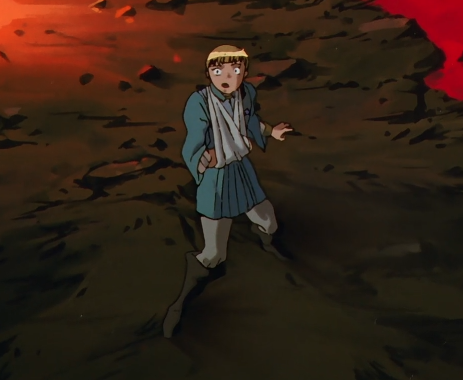
Still, I can see why there's much praise for Berserk. Despite its shortcomings, the core story has a lot to think about and chew on, compelling characters, and a lot of intrigue and blood to keep you invested. I think it's a good choice if you like 90's anime, dark fantasy stories, and narratives that will give you something to think about, but I wouldn't recommend it if you don't like blood, questionable depictions of sexual violence, or freezeframes. I wish I had a more powerful closing message to write here but I can't think of anything so here's a screenshot of Rickert looking goofy:
29 out of 29 users liked this review
